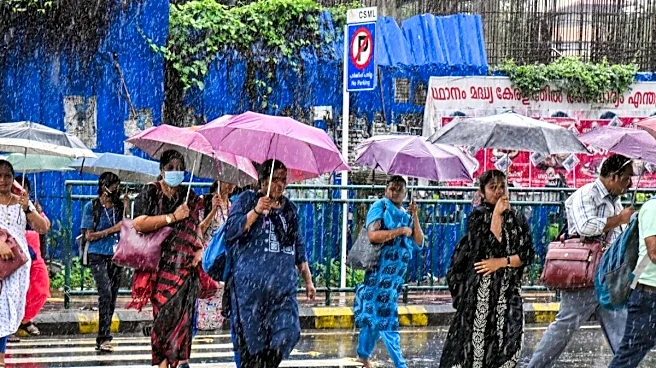



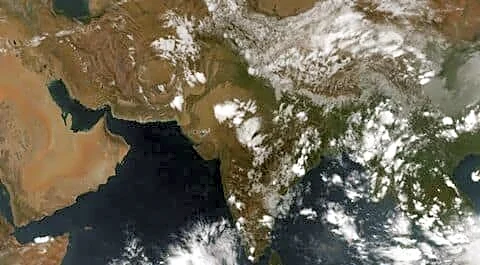
Kerala has already witnessed widespread rainfall, dark clouds have gathered over the Arabian Sea and weather models suggest the southwest monsoon is only days away. Yet, the India Meteorological Department (IMD) has not officially declared the onset of the monsoon.
The reason lies in a set of scientific benchmarks that must be fulfilled before the weather office can formally announce that the country’s most important weather system has arrived.
This year, the delay has attracted particular attention because the IMD had initially forecast an early onset around May 26. That prediction did not materialise, forcing forecasters to revise the arrival window. The weather department now expects the southwest monsoon to reach Kerala around June 4, after
favourable conditions weakened at the last moment.
मौसम संबंधी चेतावनी
मुख्य बिंदु
(i) केरल में दक्षिण-पश्चिम मानसून लगभग 4 जून, 2026 को शुरू होने की संभावना है।
(ii) अगले 6-7 दिनों के दौरान केरल में अलग-अलग स्थानों पर भारी से बहुत भारी वर्षा (7-20 सेमी) और तमिलनाडु और कर्नाटक में अलग-अलग स्थानों पर भारी वर्षा होने की प्रबल… pic.twitter.com/eb7EGjjEzb
— India Meteorological Department (@Indiametdept) June 2, 2026
The Three Conditions IMD Looks For
The IMD does not declare the onset of the monsoon based on rainfall alone. Instead, three key atmospheric conditions must occur simultaneously over Kerala and adjoining regions.
1. Widespread Rainfall Across Designated Stations
The first requirement is sustained and widespread rainfall. The IMD monitors rainfall at a network of designated weather stations across Kerala. For an official declaration, a majority of these stations must record specified rainfall levels for two consecutive days. This ensures that the rainfall is not merely a localised pre-monsoon thunderstorm but part of the organised southwest monsoon system.
Meteorologists say this condition has remained inconsistent in recent days despite intermittent heavy showers in parts of the state.
2. Strong Westerly Winds
The second condition relates to wind patterns.
The southwest monsoon is fundamentally a massive seasonal wind reversal. Before declaring its onset, the IMD looks for strong and persistent westerly winds over the Arabian Sea and the lower atmosphere around Kerala.
These winds transport enormous quantities of moisture from the ocean onto the Indian subcontinent. Without sufficiently strong westerlies, rainfall can remain patchy and unstable. Weather experts have pointed to weaker-than-expected wind patterns as one of the main reasons behind this year’s delay.
3. Deep Cloud Formation And Outgoing Longwave Radiation
The final benchmark is cloud structure.
Meteorologists assess satellite observations to determine whether deep convective cloud systems associated with the monsoon have become established. One of the indicators used is Outgoing Longwave Radiation (OLR), a measure that helps scientists gauge cloud density and atmospheric convection.
Lower OLR values indicate thicker cloud cover and stronger monsoon activity. Unless this clouding becomes sufficiently organised and widespread, the IMD does not declare the onset. Officials say this parameter too has not been consistently met over Kerala in recent days.
Why Is The Monsoon Running Late?
The delay is particularly notable because expectations earlier this month were for an early onset.
According to IMD’s seasonal forecast issued on May 15, the monsoon was expected to reach Kerala around May 26, with a margin of error of four days. Instead, atmospheric conditions weakened just as the system approached the coast.
Meteorologists have attributed the slowdown to weak low-level winds and disruptions in the development of large-scale monsoon circulation over the Arabian Sea. Some forecasts also pointed to cyclonic circulations near Lakshadweep affecting the strengthening of the westerlies needed for monsoon onset.
The IMD now says conditions are becoming favourable again and the monsoon is likely to advance into Kerala within the next few days.
Why Does Monsoon Always Enter Through Kerala?
Every year, the country waits for the same announcement: “The southwest monsoon has set in over Kerala.” There is a scientific reason for that.
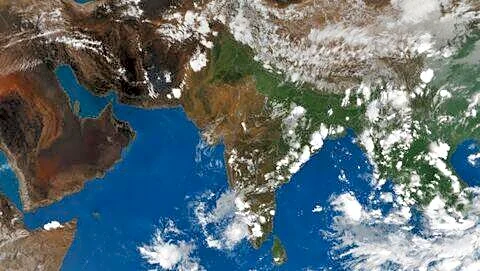
Kerala sits directly in the path of moisture-laden winds that originate over the southern Indian Ocean and travel across the Arabian Sea. The state’s location at the southern tip of the Indian peninsula makes it the first major landmass encountered by these winds.
The Western Ghats further amplify rainfall by forcing moisture-rich air to rise, cool and condense into rain-bearing clouds. As a result, Kerala acts as India’s traditional gateway for the southwest monsoon. From there, the weather system advances northward and usually covers the entire couantry by mid-July.


/images/ppid_a911dc6a-image-178057369264180302.webp)




/images/ppid_59c68470-image-1780465028719912.webp)