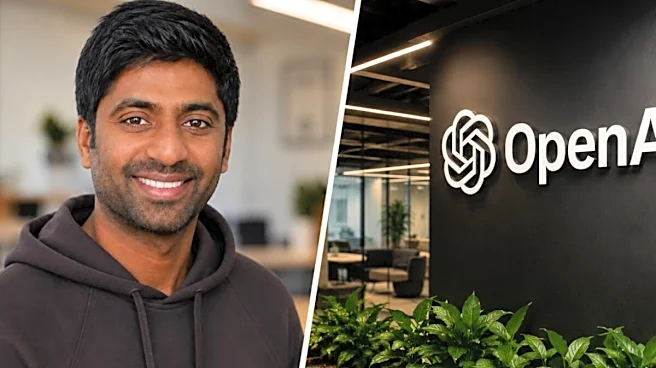



A viral post on X has reignited a familiar debate in Indian tech circles, arguing that Uday Ruddarraju’s rise to Chief Technology Officer of Compute at OpenAI is “another proof that you need to leave India to make it big in life.” The post, which shared a screenshot of Ruddarraju’s LinkedIn profile, highlighted one detail in particular: he didn’t graduate from an IIT, the usual pedigree associated with Indian-origin tech leaders in Silicon Valley, but from a comparatively lesser-known engineering college in Hyderabad.
From CBIT Hyderabad, Not An IIT
Ruddarraju was born and raised in Hyderabad and earned his Bachelor of Engineering in Computer Science from the Chaitanya Bharathi Institute of Technology (CBIT), a respected regional college rather than an IIT. He later completed
a Master of Science in Computer Science at the University of Minnesota, Twin Cities, in the United States. While still a student at CBIT, he secured an internship at Amazon Web Services, an early entry point into the cloud infrastructure work that would go on to define his career.
Uday Ruddarraju’s Rise
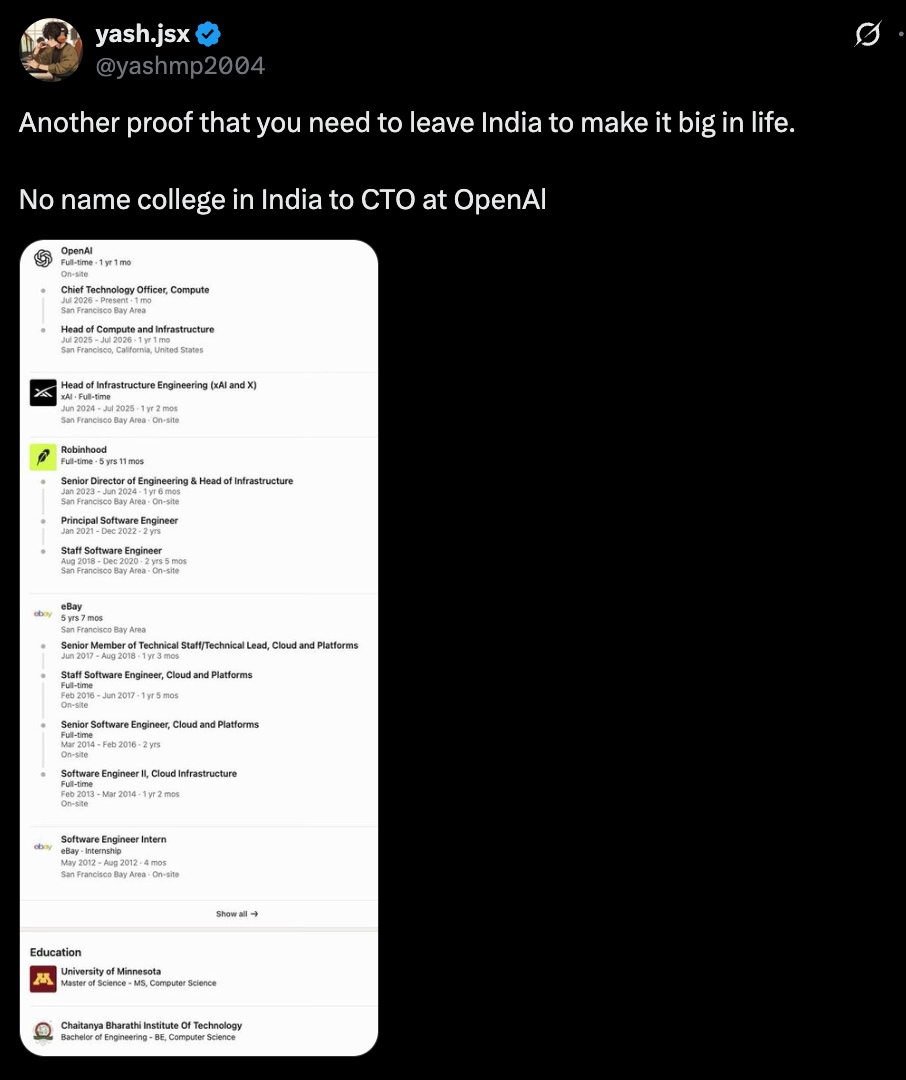
What the viral post frames as a single leap is really a decade-long, methodical climb through infrastructure engineering roles at some of tech’s biggest names:
- eBay (2012-2018): Started as a Software Engineer Intern, then moved through Software Engineer II, Senior Software Engineer, Staff Software Engineer and eventually Senior Member of Technical Staff, all within Cloud and Platforms infrastructure, over close to six years.
- Robinhood (2018-2024): Joined as Staff Software Engineer, was promoted to Principal Software Engineer, and eventually became Senior Director of Engineering and Head of Infrastructure, spending nearly six years at the trading platform as it scaled rapidly.
- xAI (2024-2025): Took on the role of Head of Infrastructure Engineering at Elon Musk’s AI company, where he led development of Colossus, one of the world’s largest AI supercomputing clusters, built to train xAI’s Grok models.
- OpenAI (2025-Present): Joined as Head of Compute and Infrastructure in July 2025, and was promoted to Chief Technology Officer, Compute, in July 2026, roughly a year later.
Another proof that you need to leave India to make it big in life.
No name college in India to CTO at OpenAl pic.twitter.com/2FqZL9avMd
— yash.jsx (@yashmp2004) August 30, 2026
As CTO of Compute, Ruddarraju now oversees the infrastructure that lets OpenAI train and deploy its large AI models, arguably one of the most resource-critical functions at the company as computing power becomes AI’s central competitive battleground. Announcing his promotion on LinkedIn, he wrote: “My first 12 months at OpenAI have been incredibly rewarding. Our Compute team has worked relentlessly to bring capacity online quickly and reliably, while doing the deep systems across compute, network, and storage, and ML work needed to train frontier models like GPT-5.6.” He added that the team was “on a mission to build the world’s largest compute footprint so frontier AI can reach everyone and every workflow.”
Ruddarraju’s move from xAI to OpenAI wasn’t entirely without controversy, though not because of anything he did personally. Last September, xAI accused OpenAI of hiring away a number of its employees, Ruddarraju among them, as part of an alleged scheme to obtain data centre trade secrets. OpenAI rejected the claims, calling the lawsuit one of several attempts by Elon Musk to slow the company’s momentum. The case has been dismissed twice at the district court level, with xAI now appealing to the Ninth Circuit. Ruddarraju himself has not been accused of any wrongdoing in the matter.
The “Leave India” Narrative
The viral post’s core claim, that success at this level requires leaving India, is a reading of Ruddarraju’s story rather than something his own profile states. What his LinkedIn history actually shows is a career built on more than a decade of specialised, compounding infrastructure engineering experience across three major US tech companies, not a single dramatic move abroad. Whether that reflects limited opportunities for this kind of work within India, or simply where the AI infrastructure industry happens to be concentrated right now, is a separate question the post doesn’t really answer, but one that’s driving much of the reaction to it.
/images/ppid_59c68470-image-178819255392511540.webp)

/images/ppid_59c68470-image-17881930219781669.webp)