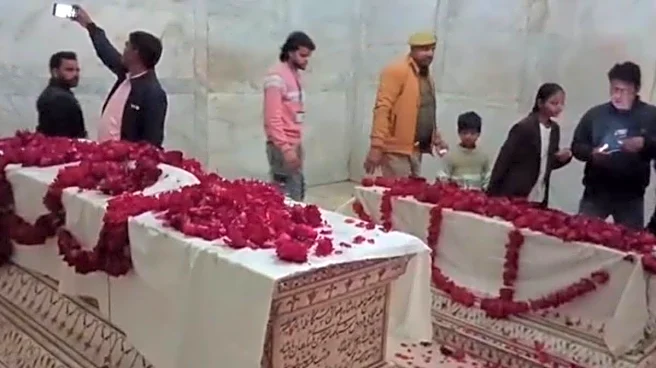

Marking the 371st Urs (death anniversary) of Mughal emperor Shah Jahan, the Archaeological Survey of India (ASI) opened the underground chamber of the iconic Taj Mahal, briefly unveiling one of its most
closely guarded secrets–the original grave of Shah Jahan and Mumtaz Mahal.
The occasion gave heritage enthusiasts, tourists and devotees taking part in the Urs rituals a rare chance to witness the real graves of Shah Jahan and Mumtaz Mahal, hidden more than 22 feet below the marble cenotaphs that the world associates with their legendary love story.
For most visitors, the Taj Mahal’s story ends at the exquisitely decorated symbolic graves beneath the main dome. Few know that these are only cenotaphs. The actual graves lie in a sealed rectangular basement directly below, inaccessible for most of the year. The chamber was opened as part of the traditional Urs rituals, transforming the monument from a static symbol of love into a living space of faith, history and ceremony.
ASI officials descended nearly 22.2 feet underground, opening the locked chamber ahead of the Urs rituals. Members of the Urs Committee followed, and the centuries-old ghusl ceremony—ritual cleansing of the graves—was performed. Sandalwood paste was applied, and prayers were offered to mark the occasion.
Walking down 21 narrow steps into the dimly lit basement, the atmosphere changes instantly. The ornate beauty of the Taj Mahal gives way to striking austerity. The underground chamber is enclosed by plain marble walls, with no carvings, no inlay work and no inscriptions. Only two graves lie there—silent, symmetrical and deeply moving in their simplicity.
Mumtaz Mahal’s grave stands completely undecorated, reflecting restraint and balance. Shah Jahan’s grave, placed about 0.12 metres higher, is adorned with colourful inlaid beads. The slight elevation and embellishment subtly signify imperial hierarchy, even in death. Both graves are positioned exactly beneath their symbolic counterparts upstairs, maintaining the architectural symmetry envisioned by Mughal builders.
The staircase leading to the chamber begins near the cenotaphs on the main floor and is usually sealed behind a metal grille. Except for periodic conservation work, the basement remains closed throughout the year. Due to the absence of ventilation, the chamber remains humid and suffocating, making prolonged access difficult. For tourists, this space is strictly off-limits—except during the Urs, when tradition allows it to be opened for three days.
Speaking about the significance of this year’s celebrations, Adnan Sheikh, vice-president of the Khuddam-e-Roza Taj Mahal Urs Committee, said Urs is being observed with the same devotion and grandeur as every year. “As always, Shah Jahan’s Urs is being celebrated with full fervour. This time, a 1,720-metre-long Hindustani satrangi chadar, which was also the country’s largest chadar, was offered at Shah Jahan’s grave,” he said.
He added that what makes it special is that this chadar was prepared collectively by people from all religions. The Urs of Shah Jahan is observed every year during the 26th, 27th and 28th days of the Islamic month of Rajab. This year, the dates fall between January 15 and 17. The three-day programme follows a fixed ritual calendar. The first day is marked by ghusl, in which the graves are bathed with rose water and kewra. The second day observes the sandal ritual, involving the application of sandalwood paste and recitation of fatiha. The final day culminates in the grand ‘chadar poshi’ ceremony.
During the Urs, devotional qawwalis were organised on the premise of the Taj Mahal complex, while prayers were offered for peace, harmony and prosperity in the country. The highlight of the final day was the ceremonial presentation of the massive multicoloured chadar, described by the committee as the longest ever offered at the monument.
The chadar procession began from near the Hanuman temple at the Taj Mahal’s southern gate, accompanied by religious scholars and committee members. From there, it passed through the southern gate and reached the main mausoleum, where it was carried down into the basement and offered at the real graves.
In view of the Urs, ASI has announced free entry for visitors. On January 15 and 16, the entry for the tourists and devotees was allowed from 2 pm until sunset, while on January 17, entry was allowed from sunrise to sunset.
The event, however, has also drawn opposition. Members of the Akhil Bharat Hindu Mahasabha staged protests outside the ASI office in Agra, raising slogans and burning an effigy in protest against the Urs celebrations.
Despite the controversy, the opening of the underground chamber once again highlighted the Taj Mahal’s layered identity—not just as a monument of love admired from afar, but as a living heritage site where history, faith and ritual continue to coexist beneath its timeless marble dome.



/images/ppid_a911dc6a-image-177105322971173172.webp)




/images/ppid_a911dc6a-image-177105253714182198.webp)
/images/ppid_a911dc6a-image-177105248655682778.webp)
/images/ppid_a911dc6a-image-177105245071149153.webp)