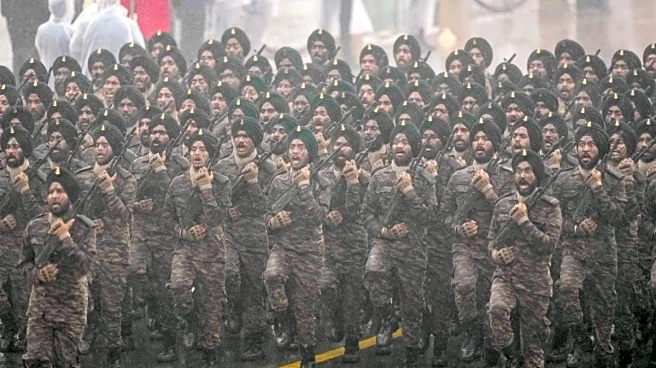

The Republic Day Parade 2026 on Kartavya Path will bring together new additions to India’s military display along with the parade’s long-standing ceremonial features.
Marking 150 years of the national song
Vande Mataram, the parade will bring together India’s military capability, cultural diversity and a series of historic firsts, including the presence of European Council President Antonio Costa and European Commission President Ursula von der Leyen as Chief Guests. With a total of 18 marching contingents and 13 bands, the celebrations will reflect India’s evolving defence posture, indigenous technological progress and the increasing global interest in its ceremonial showcase.
The Indian Air Force is the lead service for this year’s Republic Day and will oversee all ceremonial events, while the Indian Army will introduce its first-ever phased battle array, the debut of the Bhairav Light Commando Battalion and several regimental contingents. The Indian Navy and IAF will each field 144-member marching contingents, and a separate European Union contingent will join the parade as part of the Chief Guest presence.
India’s mechanised strength will also be on full display: high-mobility reconnaissance vehicles, T-90 and Arjun tanks, BMP-II and NAMIS-II systems, Nag and BrahMos missile platforms and indigenous artillery will form part of a phased battle array appearing for the first time in the parade’s history.
Army’s Battle Array will be a key focus.
Apaches, Prachand helicopters, T 90 tanks, Arjun MBT, BMP II with Nag missiles, Spike systems, UAV mounted vehicles and unmanned ground vehicles.#RepublicDayRehearsals pic.twitter.com/ZIVoX6mgDc
— Akash Sharma (@kaidensharmaa) January 23, 2026
Below is the complete breakdown of all marching contingents.
Marching contingents from Army, Navy, Air Force, CAPFs, NCC and Delhi Police.
Mixed scouts, Para, Rajput, Assam, Gorkhas, JAK LI and artillery units in step. pic.twitter.com/2Ow3Inc2QF
— Akash Sharma (@kaidensharmaa) January 23, 2026
The Army’s Marching Contingents
The Army will field seven marching contingents, a mounted column of the 61 Cavalry, and the parade’s first phased battle array.
The Mounted Column Of 61 Cavalry
The 61 Cavalry remains one of the world’s last operational horse-mounted, active-duty cavalry regiment. It traces its origins to the early years after Independence, when the cavalry units of several erstwhile princely states were reorganised to form a single horse-mounted regiment. In 1954, the Gwalior Lancers, the Jodhpur/Kachhawa Horse and the Mysore Lancers were merged to create the present-day 61st Cavalry. The regiment has since maintained ceremonial and equestrian responsibilities alongside limited operational roles.
The Animal Contingent Of The Remount & Veterinary Corps
For the first time, the Remount & Veterinary Corps (RVC) will field a dedicated animal contingent, reflecting India’s high-altitude operational reality. The formation includes Bactrian camels, Zanskar ponies, raptors, indigenous military dogs and existing Army dog units.
For the first time, a specially curated animal contingent of the Indian Army’s Remount & Veterinary Corps will march along Kartavya Path during Republic Day 2026. #RepublicDay2026 #IndianArmy https://t.co/JBPcseh3zC
— News18 (@CNNnews18) January 2, 2026
The Bactrian camels represent New Generation Pack Animal Capability for Ladakh and can operate above 15,000 feet, carrying up to 250 kilograms in extreme cold and low-oxygen terrain. The Zanskar ponies offer exceptional endurance at similar altitudes, carrying loads between 40 and 60 kilograms and often accompanying patrols for distances reaching 70 kilometres per day. Raptors will appear as part of the Army’s bird-strike management practices.
The RVC dog units — both indigenous and conventional breeds — represent operational roles ranging from explosive detection and tracking to avalanche rescue and counter-terror deployments. Indigenous breeds now widely used include the Mudhol Hound, Rampur Hound, Chippiparai, Kombai and Rajapalayam.
The Scouts Contingent
The mixed Scouts contingent will comprise troops from the Arunachal Scouts, Ladakh Scouts, Sikkim Scouts, Garhwal Scouts, Kumaon Scouts and Dogra Scouts. The contingent commander is Lt Amit Chaudhary, and the formation includes 144 other ranks, three JCOs and one officer. The Scouts represent India’s specialised high-altitude and frontier troops, raised for mountain warfare, border vigilance and rapid response in some of the toughest terrains across the Himalayas.
The Rajput Regiment Contingent
The Rajput Regiment, raised in 1778 under the British Indian Army, is one of India’s oldest infantry regiments. Post-Independence, it became a major part of the Indian Army’s infantry structure, with its regimental centre at Fatehgarh in Uttar Pradesh. The regiment’s history spans colonial-era campaigns, the world wars and all modern conflicts.
The regiment’s motto, Sarvatra Vijay (Victory Everywhere), and its war cry, Bol Bajrang Bali Ki Jai, are central to its identity. Its emblem of crossed Rajput daggers with Ashoka leaves reflects the regimental heritage. While historically dominated by Rajput communities, its current composition includes Ahirs, Gurjars, Brahmins and Bengalis.
The Assam Regiment Contingent
Raised in 1941 to defend the Eastern frontier, the Assam Regiment has earned battle honours in the Burma theatre of World War II, J&K in 1947–48, Chhamb in 1971 and a long record of operational excellence in counter-insurgency. The regiment’s war cry, Rhino Charge, invokes its emblem, the one-horned rhino of Northeast India. The contingent commander is Capt Aryan, and the formation will bring 144 personnel to Kartavya Path.
The regiment’s distinction as one of the best-performing marching contingents in past Army Day and Republic Day parades adds historical resonance to its return in 2026.
The Jammu And Kashmir Light Infantry Contingent
The Jammu and Kashmir Light Infantry (JAK LI) is the only regiment raised entirely in Independent India, emerging from voluntary militias that halted the 1947–48 invasion of Kashmir. Its role specialises in small-team tactics, mountain warfare, high-risk reconnaissance and operations in harsh terrain. Its motto, Balidanam Vir Lakshanam (Sacrifice is the Characteristic of the Brave), and its war cry, Bharat Mata Ki Jai, reflect its identity.
The regiment has played key roles in counter-insurgency, high-altitude warfare and major operations across the northern theatre.
The Regiment Of Artillery Contingent
The Regiment of Artillery, historically known as the God of War, traces its origins to 1827 with the formation of 5 (Bombay) Mountain Battery. Modern artillery’s evolution — steel gun barrels, stable recoil systems and high-energy propellants — transformed the regiment into the firepower backbone of the Indian Army.
After Independence, the regiment played key roles in the 1947–48 conflict, the 1962 India–China war, the 1965 and 1971 India–Pakistan wars, and the 1999 Kargil war, where artillery bombardments were crucial in recapturing high-altitude positions.
Its trajectory also includes a milestone in gender integration: the induction of women officers beginning 2023, with women commanding mechanised columns at the 2024 parade. Its equipment today spans mortars, field guns, medium and self-propelled artillery, multi-barrel rocket launchers and surveillance radars.
The Bhairav Light Commando Battalion
The Bhairav battalion will make its Republic Day debut this year. Army Chief Gen Upendra Dwivedi said the Bhairav Battalion has been introduced to “bridge the gap” between the infantry and special forces.
The battalion was raised by the Army around October last year, and currently, there are two units of it, defence sources told PTI. It participated in the Army Day parade in Jaipur earlier this year.
The Ladakh Scouts Contingent
The Ladakh Scouts, affectionately called the Nunnus, earned national recognition during the 1999 Kargil conflict, leading to their elevation from a militia-origin unit to a full regiment in 2000. With only five battalions, it is the smallest infantry regiment but among the most decorated, with over 600 honours. The regiment earned the Battle Honour Turtuk (1971), Battle Honour Batalik and Theatre Honour Kargil (1999), and has served in Siachen, Eastern Ladakh and UN peacekeeping. President Ram Nath Kovind praised it in 2017 as a model of exceptional valour and dedication.
The Indian Navy Contingent
The Navy’s contingent of 144 sailors represents a cross-section of India, reflecting the service’s vision of being a combat-ready, cohesive and self-reliant maritime force. Led by Lt Karan Nagyal, with platoon commanders Lt Pawan Kumar Gandi, Lt Priti Kumari and Lt Varun Dreveriya, the contingent will showcase the Navy’s expanding human capital and its jointmanship with national initiatives.
With an average age of 25 years, the personnel have been carefully selected from across the Indian Navy and have undergone specialised training of over two months for the parade.
The Navy’s tableau will depict maritime history from stitched ships of the 5th century CE to the Maratha Navy’s Gurab vessels, culminating in modern indigenous platforms such as INS Vikrant, Project 17A frigates, Kalvari-class submarines and the GSAT-7R satellite. Cadets from the Sea Cadets Corps will accompany the tableau.
The Indian Air Force Contingent
The IAF will field a 144-member marching contingent led by Squadron Leader Jagdesh Kumar. The contingent reflects a blend of tradition and modernity and has undergone rigorous training to uphold the IAF’s motto, ‘Touch the Sky with Glory’. Supernumerary officers include Squadron Leader Nikita Choudhary, Flight Lieutenant Prakhar Chandrakar and Flight Lieutenant Dinesh.
The IAF band, with 72 musicians including nine women Agniveervayu for the first time, will perform the tune Sound Barrier. The IAF will also present a veterans’ tableau themed Sangram se Rashtra Nirman Tak, depicting historical war machines and the evolving role of veterans in nation-building.
The flypast will include 29 aircraft in eight formations, ranging from Rafale, Su-30 MKI, MiG-29 and Jaguar fighters to C-130 and C-295 transports, ALH Mk IV, Apache and LCH helicopters and a dedicated Operation Sindoor formation.
Central Armed Police Forces, Delhi Police, NCC And Youth Contingents
The Central Armed Police Forces will be represented by marching contingents from the Central Reserve Police Force, Central Industrial Security Force, Border Security Force, Sashastra Seema Bal, Indo-Tibetan Border Police and Assam Rifles.
The CRPF contingent will be led by Assistant Commandant Simran Bala, a 26-year-old officer from Nowshera in Jammu and Kashmir’s Rajouri district, who will command more than 140 male personnel after being selected through a rigorous multi-stage evaluation process. It will be the first time a woman officer will lead an all-male CRPF marching contingent at the Republic Day parade.
The BSF’s camel-mounted contingent and the joint CRPF–SSB women’s motorcycle team will also take part in the parade. Alongside these, Delhi Police, NCC boys and girls contingents and youth organisations will participate, maintaining the parade’s traditional mix of military and civil formations.
The European Union Contingent
A European Union contingent will march in this year’s Republic Day Parade, marking a significant international presence at the national celebrations.
As part of the march past, four European Union flag bearers riding on two Gypsy vehicles will participate along the parade route. The contingent’s participation coincides with the visit of European Union leaders, who will grace the Republic Day Parade as the Chief Guests.
Their presence underscores India’s expanding engagement with Europe across trade, technology, climate action, and geopolitical stability.
/images/ppid_a911dc6a-image-177080410105599843.webp)






/images/ppid_a911dc6a-image-177080404434550310.webp)
/images/ppid_a911dc6a-image-177080403791670538.webp)
/images/ppid_a911dc6a-image-177080382939031904.webp)
/images/ppid_a911dc6a-image-177080283060312298.webp)