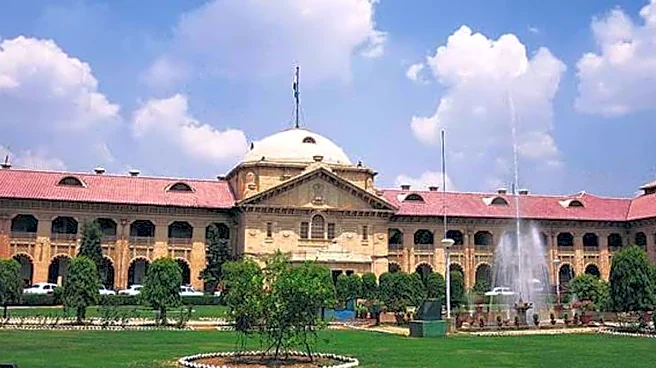




The Allahabad High Court on Wednesday ordered the Uttar Pradesh State Election Commission to complete elections to Panchayati Raj institutions across the state within three months.
A bench of Justices Ajit Kumar and Garima Prashad issued the direction while allowing a petition filed by Dashrath Yadav and others.
The petitioners approached the court, seeking directions for the poll body to submit a detailed, time-bound schedule to complete the panchayat election process before the tenure of district panchayats expires.
The three-tier Panchayati Raj elections cover zila panchayats at the district level, Kshetra panchayats at the intermediate level and Gram Panchayats at the village level. The elections are conducted simultaneously.
The bench directed
the state government and the State Election Commission to begin preparations immediately and complete the polls within the stipulated period.
“The State Government and the State Election Commission shall proceed forthwith with the preparatory steps, issue the election programme, and complete the elections to the village panchayats in Uttar Pradesh within three months from the date of this judgement. The schedule shall provide for the steps necessary to constitute the elected bodies within the above-prescribed period.”
The court also ordered that the elections be conducted under the existing reservation framework, including the 27 per cent quota for Other Backwards Classes (OBCs).
“The State Government and the State Election Commission shall conduct the entire elections under the existing reservation arrangement, including 27 per cent reservation for Other Backwards Classes.
“The elections shall not be conducted by treating the OBC-reserved seats as open seats merely because the Dedicated Commission’s inquiry remains pending. Reservations for Scheduled Castes, Scheduled Tribes and women shall be maintained in accordance with the applicable laws, subject to the aggregate ceiling governing vertical reservation,” the court said.
The bench further directed the state government to provide the necessary personnel, funds, security and logistical support to ensure the elections are held within the prescribed timeframe. It clarified that the deadline would not permit administrators to remain in office beyond the period allowed under the law.
“The State Government shall provide the staff, funds, security and other logistical assistance as may be required by the State Election Commission to hold elections within the time-bound period above. The time allowed to complete the elections does not extend an administrator’s tenure beyond the period permitted by law. Any intervening administrative arrangement must remain within the applicable statutory limits,” the court added.
On the Dedicated Commission’s inquiry into OBC representation, the court directed it to continue collecting empirical data and prepare its report in light of the observations made in the judgment.
“The dedicated Commission shall continue with its investigation and inquiry considering the observations contained in the body of the judgment for collective empirical data qua OBC and preparation of report on that basis.
“It shall complete its process within the period already prescribed within such extended period as be provided by the State Government. The State shall thereafter examine the recommendations and undertake the statutory steps and amendments, where required, for their lawful implementation.”
The court rejected the petitioners’ challenge to the appointment of administrators in Gram Panchayats, including outgoing Pradhans, under the government order dated May 25, 2026.
“The relief for quashing the Government order dated May 25, 2026 invoking power under Section 12(3-A) for appointment of administrator and so also relief for quashing of the appointments of outgoing Pradhans as administrators of respective Gram Panchayats are hereby rejected. The relief for declaration that Sections 12(3-A) and 12-BB(3) as ultra vires Article 243-E is also hereby rejected and hence the Writ petitions in that regard stand rejected,” the court said.
(With inputs from PTI)