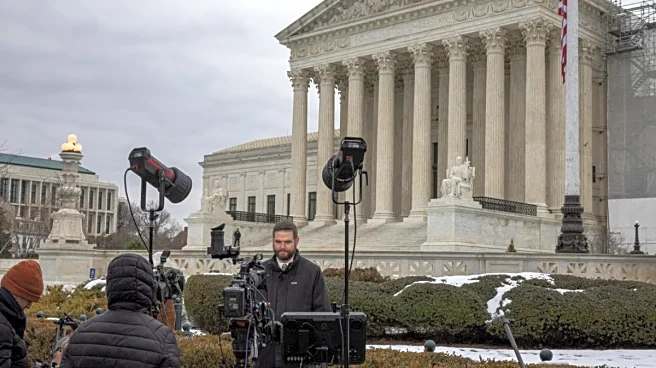




The US Supreme Court addressed the contentious issue of transgender athletes in girls’ and women’s sports on Tuesday.
The conservative-leaning court is evaluating challenges to state laws in Idaho and West Virginia that prohibit transgender athletes from competing in female sports.
In recent years, over two dozen US states have enacted laws preventing athletes designated male at birth from participating in girls’ or women’s sports.
The Idaho case before the nine justices originates from the state’s 2020 Fairness in Women’s Sports Act, led by Republicans.
A transgender athlete from an Idaho university contested the law, and lower courts determined it breached the equal protection clause of the US Constitution.
“Idaho’s law classifies on the basis
of sex, because sex is what matters in sports,” Idaho Solicitor General Alan Hurst stated during Tuesday’s oral arguments.
“It correlates strongly with countless athletic advantages like size, muscle mass, bone mass, and heart and lung capacity,” Hurst noted. “If women don’t have their own competitions, they won’t be able to compete.”
West Virginia’s 2021 Save Women’s Sports Act was contested by a middle school student barred from competing on the girls’ track team.
An appeals court ruled the ban as sex-based discrimination, violating Title IX, the federal civil rights law that bans sex-based discrimination in educational programs.
In February, President Donald Trump issued an executive order to bar transgender athletes from girls’ and women’s sports after campaigning on the issue.
“From now on women’s sports will be only for women,” Trump asserted. “With this executive order the war on women’s sports is over.”
The executive order allows federal agencies to withhold funding from schools that permit transgender athletes to compete on girls’ or women’s teams.
University of Pennsylvania swimmer Lia Thomas became central to the debate over transgender athletes in women’s sports after competing in female collegiate meets in 2022.
Critics and some fellow swimmers argued Thomas, who had previously swum on UPenn’s men’s team, should not compete against women due to a perceived physiological advantage.
UPenn eventually prohibited transgender athletes from its women’s sports teams, resolving a federal civil rights complaint related to the controversy around Thomas.
The decision came after the Education Department’s Office for Civil Rights concluded the university had violated Title IX by allowing Thomas to compete in women’s events.
With a six-to-three conservative majority, the Supreme Court addressed two high-profile transgender cases last year.
They upheld a Tennessee law banning gender-affirming medical treatment for transgender minors and supported Trump’s move to exclude transgender troops from the military.
The Supreme Court is anticipated to rule on the new case by June or early July.
(With agency inputs)