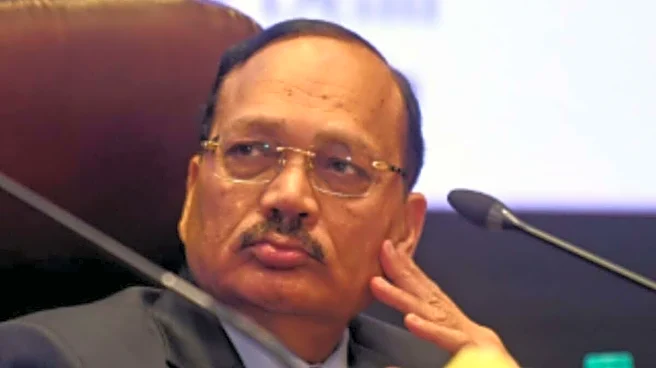




Chief Justice of India (CJI) Surya Kant on Saturday said the Indian judiciary has taken an active approach to tackling emerging forms of economic crime, including the digital arrest scam, rather than waiting for Parliament to introduce new laws.
Addressing the closing session of the 43rd International Symposium on Economic Crime in London, Kant said India’s approach to economic offences has evolved through a combination of legislation, institutional mechanisms and judicial principles.
He cited the Supreme Court’s recent intervention in cases involving digital arrest scams, where fraudsters impersonate police personnel, judicial officers or bureaucrats during video calls and deceive victims into handing over money.
According to Kant, the Supreme
Court has directed both the Centre and state governments to examine the extent of the problem and explore the creation of a separate offence carrying punishments proportionate to the damage caused.
“In response, the court has directed the Union and the states to evaluate the extent of this problem and has called for the establishment of a distinct offence, with penalties proportionate to the harm inflicted,” he said.
“This exemplifies a broader pattern: an Indian judiciary that proactively responds to emerging fraudulent schemes, rather than waiting for Parliament to address them,” he added.
Kant said India’s framework for dealing with economic crime should not be viewed as being based on a single piece of legislation. Instead, he described it as “a layered architecture, built deliberately over successive decades”, with laws, institutions and judicial doctrine performing distinct roles.
He specifically referred to the Prevention of Money Laundering Act, 2002, and the Fugitive Economic Offenders Act, 2018, as key components of this framework.
The CJI, however, acknowledged that these mechanisms have faced criticism and allegations of misuse. “I must note that these are not infallible mechanisms. Numerous individuals have alleged misuse of the PMLA process by investigating authorities, including claims of arrests made without articulated reasons, and of custody extended beyond what the existing facts appear to justify. In each such instance, the judiciary has intervened to rectify the situation,” he said.
Kant also highlighted the Supreme Court’s ruling that an accused must be provided the grounds for arrest in writing, rather than having them merely read out.
While referring to the Supreme Court’s decision in AAP chief Arvind Kejriwal versus CBI, Kant said, “The court upheld the legality of the arrest but nonetheless granted bail, based on the principle that prolonged pre-trial detention should not be transformed into punishment under a different guise.”
He said that judicial principles such as due process, proportionality and the presumption of innocence have remained central to the court’s approach despite changes in technology and the legal landscape.
Turning to insolvency proceedings, Kant said the Insolvency and Bankruptcy Code, 2016, functions alongside criminal proceedings. He noted that India’s justice system has increasingly accepted the continuation of parallel civil recovery proceedings even when a criminal case takes considerable time to conclude.
International cooperation, he said, remains crucial in recovering assets linked to economic offences. Kant observed, “India has learned through hard experience that Mutual Legal Assistance Treaties with other countries, however imperfect their machinery and modalities, bring a recovered asset home far more reliably than extradition ever does. Illicit wealth, after all, rarely stays where it was stolen.”
Kant also spoke about the enormous scale of global money laundering. He said that if worldwide estimates were even approximately accurate, the amount laundered annually would be sufficient to purchase a modest laptop for each of the world’s eight billion people, with money still left over.
“And of that immense tide of illicit wealth, by the most generous reckoning, less than one unit in a hundred is ever recovered,” he said.
Drawing from Kautilya’s Arthashastra, Kant pointed to passages describing different methods through which state officials could divert public wealth. He then cited a line that he said remains relevant even today: “it is as impossible for an official to handle the king’s revenue and take nothing from it as it is akin to holding honey or poison upon the tip of the tongue and taste neither.”
Kant stressed that economic crime and illicit wealth operate across borders, making international vigilance and cooperation essential. He also underlined the importance of ensuring that efforts to combat such offences remain grounded in the rule of law.
In his concluding remarks, the CJI said the true measure of the symposium would not be how effectively the problem was discussed, but how seriously individual jurisdictions acted to tackle it.






/images/ppid_59c68470-image-178823762811965060.webp)

/images/ppid_59c68470-image-178816003597887566.webp)