
/images/ppid_59c68470-image-17865375635026998.webp)

Sabyasachi Mukherjee has never been particularly interested in keeping fashion inside the boundaries of fashion. His world has always stretched across art, architecture, history, jewellery and the slow, almost obsessive language of craftsmanship. Now, that instinct has found perhaps its most significant home yet: The Metropolitan Museum of Art in New York.
On August 10, Sabyasachi and The Met announced a multi-year collaboration that will see the Indian designer draw from the museum’s extraordinary collection of art and material culture to create contemporary jewellery, accessories, clothing and objects. The partnership will unfold over several years, transforming works from the museum’s vast archives into what Sabyasachi describes as modern
heirlooms.
The first chapter arrives this September.
A First Chapter In Byzantine Gold
Sabyasachi will return to New York Fashion Week on September 15, 2026, nearly two decades after his first New York runway presentation, to unveil the opening collection of the collaboration: a high jewellery line inspired by the art and cultural exchange of the Byzantine world.
The collection draws upon the Byzantine Empire’s visual language and its position at the crossroads of civilisations. Centred around Constantinople, modern-day Istanbul, the Byzantine world existed at the intersection of Europe, Asia and the Mediterranean, absorbing influences from Ancient Greece and Rome, Persia, Egypt and trading cultures connected by the Silk Route.
That interconnectedness is precisely what makes it so compelling for Sabyasachi.
The Met itself describes its Byzantine holdings as one of its most comprehensive collections, encompassing sculpture, mosaics, icons, metalwork, jewellery and luxury objects from across the eastern Mediterranean, North Africa and West Asia.
For a designer whose own visual vocabulary is rooted in the meeting of cultures, craft and history, it is fertile territory.
Why Start With Jewellery?
If the collaboration promises to eventually encompass everything from textiles and leather goods to accessories and objects for the home, why begin with high jewellery?
Sabyasachi’s answer is characteristically uncompromising: start with the hardest thing to do.
The designer has spoken about approaching the project as a challenge, to enter the deepest end of the craft spectrum and create pieces that can become personal treasures rather than seasonal fashion.
That philosophy also explains why the collection is being positioned less as merchandise inspired by a museum and more as a conversation between two archives of craftsmanship.
The first collection comprises more than 100 pieces, according to Town & Country, with prices ranging from approximately $2,500 to $100,000. The jewellery will use 18- and 22-karat gold alongside gemstones including tourmaline, spinel, amethyst and lapis lazuli.
From Roman Sarcophagi To Modern Heirlooms
The first glimpses already reveal how literal and yet unmistakably Sabyasachi, the conversation with The Met can become.
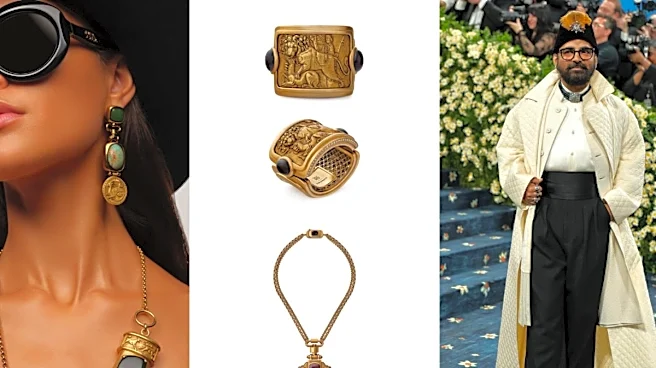
One wrist cuff draws from a third-century Roman marble sarcophagus depicting lions felling an antelope, translating its sculptural imagery into 18- and 22-karat gold, garnet cabochons and brilliant-cut brown diamonds.
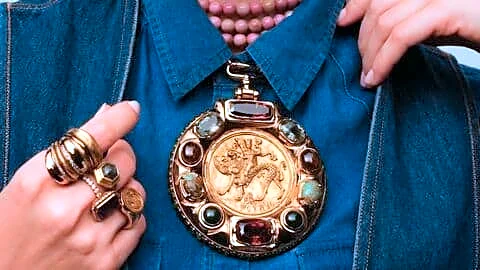
Another pendant necklace looks to a Roman funerary relief dating to the second or third century CE, combining gold with tourmaline, garnet, jasper, lapis lazuli and jade.
Then there is the striking animal-inspired necklace, built around a tiger-claw-like form and informed by a 12th-century Italian or Byzantine carved bone-and-ivory panel depicting animals.
A second cuff takes its cues from a late Imperial Roman marble sarcophagus portraying the Triumph of Dionysos and the Seasons, dated to around 260–270 CE.
What emerges is not an exercise in historical reproduction. Instead, ancient motifs are enlarged, abstracted and layered with Sabyasachi’s instinct for maximalist jewellery.
The Beauty Is In The Exchange
Perhaps the most interesting aspect of the collaboration is that Sabyasachi is not treating Byzantine culture as a closed historical chapter.
The designer has pointed to the movement of people, ideas and craftsmanship across continents, arguing that Byzantium was shaped by cultural exchange rather than a single geography. That idea also creates a direct connection to his own hometown.
Calcutta, like Constantinople, developed through trade, migration and exchange. For Sabyasachi, that makes the collaboration less about borrowing from a distant civilisation and more about tracing the routes through which beauty has travelled.
It is an important distinction.
Luxury fashion has increasingly turned museums into sources of visual inspiration. But Sabyasachi’s proposition is more ambitious: what happens when museum history is translated through another culture’s living craft tradition?
The Human Hand At The Centre
For all the grandeur surrounding the project, the most important word in Sabyasachi’s vocabulary remains remarkably simple: handmade.
Every piece in the inaugural collection is being conceived, developed and handcrafted in India through his network of master artisans. The emphasis places Indian craftsmanship at the centre of a collaboration with one of the world’s most important cultural institutions.
It also reinforces the designer’s long-standing argument that true luxury isn’t simply about rarity or price. It is about the knowledge embedded in an object.
That philosophy feels especially relevant when the source material is centuries old. A Byzantine jewel may have survived because of the material it was made from, but its real value lies in the hands and intelligence that created it.
Sabyasachi’s ambition is to recreate that sense of permanence for a contemporary audience.
From The Met’s Archives To The Next Generation
The larger collaboration is deliberately open-ended. Jewellery is only the beginning; future chapters are expected to explore other categories, with the museum’s collection providing the starting point.
And that is where the partnership becomes more interesting than a conventional designer collaboration.
This isn’t simply Sabyasachi meets The Met. It is two ideas of cultural preservation meeting each other: one housed in galleries and archives, the other carried through living Indian craftsmanship.
The designer has described himself as a kind of ferryman between the past and the present. In this collaboration, that metaphor feels unusually precise.
The Met holds thousands of years of objects that have already survived history. Sabyasachi’s task is to take fragments of that history and give them another life—one that can be worn, collected and eventually passed down.
New York Gets The First Look
The first chapter of Sabyasachi x The Met will be unveiled on September 15 during New York Fashion Week 2026, marking the designer’s return to the New York runway after nearly 20 years. For Sabyasachi, it is a fitting return.
He first arrived in New York as an Indian designer looking outward. This time, he returns carrying something much larger: an Indian interpretation of a global archive, shaped by thousands of years of cultural exchange and executed through the hands of Indian artisans.
And perhaps that is the real luxury proposition here, not nostalgia, not historical costume, but the possibility of making something from the past feel indispensable to the future.

/images/ppid_59c68470-image-178659253030340441.webp)


/images/ppid_59c68470-image-178671003361931929.webp)



/images/ppid_59c68470-image-178654753067968978.webp)