
/images/ppid_59c68470-image-178470009227024252.webp)
/images/ppid_59c68470-image-178470005883059347.webp)
/images/ppid_59c68470-image-178470015846491281.webp)


What if launching a satellite were as simple as booking a cab — allowing customers to choose when it leaves and where it goes instead of waiting for space on a much larger rocket?
That is the idea behind Skyroot Aerospace’s Vikram-1, which is scheduled to lift off from the Satish Dhawan Space Centre in Sriharikota at 11.30 am on Saturday.
The launch, part of Mission Aagaman, will mark Skyroot’s first attempt to place payloads into orbit. If the 16-minute flight succeeds, the Hyderabad-based company will become the first Indian private firm to launch a rocket into orbit.
It would also place India alongside the United States and China as countries with private companies capable of conducting orbital launches.
Beyond that milestone, Vikram-1 will test
a model Skyroot describes as a “cab service to space” — offering small-satellite operators dedicated launches tailored to their schedules and required orbits.
What Does Skyroot’s ‘Cab Service To Space’ Mean?
Small satellites are frequently launched as secondary payloads aboard larger rockets.
This means their operators must work around the schedule and destination of the main mission. A customer may have to wait months or even years for a suitable launch opportunity and may not be able to choose the precise orbit in which its satellite is deployed.
Skyroot wants Vikram-1 to offer an alternative: a smaller rocket that customers can book for a dedicated launch to an orbit suited to their satellite.
“If you want to just go to a friend’s house, you don’t need a train, you book a cab, an Uber. What we are offering is a cab service to space, which can be used to ride to a unique location in the orbit to place a satellite or visit a station,” Skyroot co-founder and CEO Pawan Kumar Chandana told the BBC.
If the model works, it would be broadly similar to that of US-based Rocket Lab, which provides small-lift launch vehicles.
Why Small Satellites Need Dedicated Launches
Small satellites support services ranging from Earth observation, communications and navigation to agriculture, fisheries, disaster management and national security.
However, Chandana told the BBC that access to space remains “a major bottleneck, with satellite operators often waiting for months or even years for a launch opportunity”.
Vikram-1 has been designed to carry payloads of up to 350 kg to Low Earth Orbit. The seven-storey rocket is expected to head towards an orbit about 450 km above Earth during Saturday’s mission.
Its capacity makes it suitable for customers who do not require the payload space of a much larger rocket but want a launch planned around their own mission.
What Vikram-1 Will Carry On Mission Aagaman
Mission Aagaman, named after the Sanskrit word for “arrival”, is expected to carry six payloads into orbit.
These include an Earth observation camera, satellites including one from a German company, and a robotic arm designed to help remove space debris.
The mission will also carry two symbolic objects linked to Indian science and creativity.
One is Cosmic Bloom, a lotus made from lab-grown diamonds and developed by Cosmos Diamonds. Chandana described it as an artist’s tribute to space and a celebration of India’s creativity.
The other is a tiny gold rocket containing micro-sculptures of three figures closely associated with Indian science and the country’s space programme — Nobel Prize-winning physicist CV Raman, former president and aerospace scientist APJ Abdul Kalam, and Vikram Sarabhai, regarded as the father of India’s space programme.
Each sculpture is smaller than a grain of rice.
“We exist because of the Indian space programme, we stand on the shoulders of our early visionaries and this is our way of paying tribute to three great scientists who shaped India’s space programme,” Chandana told the BBC.
Why Vikram-1 Is A Bigger Test Than Vikram-S
Skyroot has flown a rocket before, but Vikram-1 represents a considerably more difficult mission.
In November 2022, the company launched Vikram-S, India’s first privately developed suborbital rocket. That flight reached space but did not place a payload into orbit.
An orbital mission requires a rocket to achieve far greater speed and follow a precise trajectory so that its payloads continue travelling around Earth instead of falling back.
Vikram-1 will therefore test whether Skyroot can progress from a suborbital demonstration to a commercially viable orbital launch system.
Chandana acknowledged the risks involved in such a mission, pointing out that SpaceX succeeded only on its fourth attempt.
“This will be a historic flight for the private space sector in India. It’ll be a major milestone,” he said.
Skyroot’s Rise From Start-Up To Space-Tech Unicorn
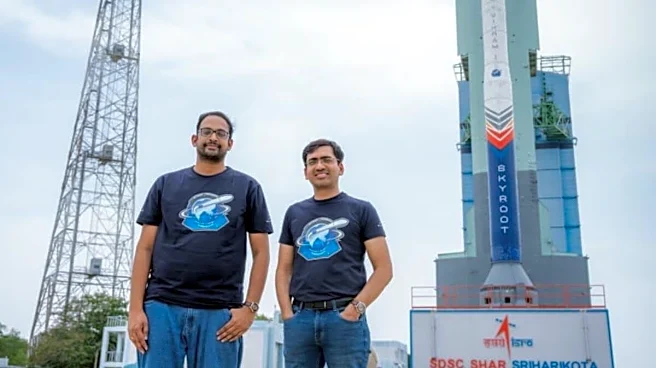
Skyroot was founded in 2018 by Chandana and Naga Bharath Daka, both former Indian Space Research Organisation engineers. It recently became India’s first space-tech unicorn after reaching a valuation of $1.1 billion.
The company’s growth followed India’s decision in 2020 to open its space sector to private firms.
The reforms allowed private companies to build rockets and satellites and use ISRO’s launch facilities, as part of an effort to increase India’s share of the global space market from about 2% to 10% by 2030.
More than 400 space start-ups have since been established in the country, according to the government.
Can Skyroot Turn Its ‘Space Cab’ Into A Regular Service?
Saturday’s flight is expected to be the first of two test missions planned by Skyroot this year. The company intends to begin commercial launches next year.
Chandana said Skyroot’s Hyderabad facility has the capacity to manufacture one rocket every month. “We have the capacity to build one rocket every month at our factory in the southern city of Hyderabad,” he told the BBC.
That manufacturing capacity will be crucial if Skyroot is to offer frequent missions and reduce the long waiting periods its dedicated-launch model is designed to address.
The company expects most of that demand to come from outside India, with Chandana saying that “70-80% of our market would be the global economy”.
“These would include satellites supporting services that millions rely on every day, from agriculture and fisheries to disaster management, communications, connectivity, navigation and national security. So, the economic opportunity is huge,” he told the BBC.