

/images/ppid_59c68470-image-177583756157150733.webp)

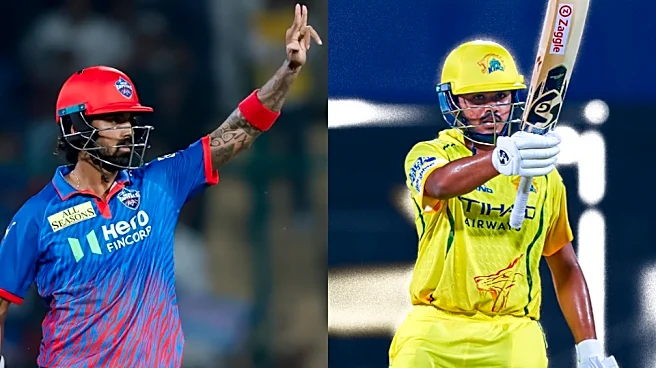
Former India pacer and Delhi Capitals’ bowling coach Munaf Patel represented the team at the press conference at the Arun Jaitley Stadium on Tuesday (April 7). The questions and answers revolved around pacers. DC has multiple exciting ones, including Mitchell Starc, who is a huge talking point because he has yet to arrive and who Munaf defined as one of the best, only comparable to ace India pacer Jasprit Bumrah.
But, even more than the Starc gossip, the conversations continued to circle back to another pacer: South Africa’s Lungi Ngidi, even in questions that weren’t about him per se.
For a man whose identity was born in the shadows of Proteas’ assorted pace quartet, Dale Steyn, Kagiso Rabada, Morne Morkel and Vernon Philander, in 2018, Ngidi
has carved a niche of his own only in the last few months.
The anticipation around him, especially among the cricket geeks, is just short of hero-like. It’s comparable to the early days of watching Rajasthan Royals for Vaibhav Sooryavanshi or Punjab Kings for Priyansh Arya.
After Steyn’s pacy outswingers, Morkel’s bounce, Phillander’s irritating precision and Rabada’s mix of all, Ngidi has an innocuous-looking but lethal weapon of his own: the off-cutter.
“In today’s game, good variations are essential to become a good bowler,” Munaf said. “Ngidi has strong, slower balls and a good understanding of conditions, especially in India, because he has been playing regularly for South Africa. He has spent time with other teams and has a very good idea of when to use which variation, especially given the conditions. He isn’t like other bowlers who will try to bowl 150 Kph and get hit. He bowls to his strengths and uses variations smartly when required.”
Ngidi has four wickets in IPL 2026 so far, and all have been off-cutters. In the first match, against Lucknow Super Giants, he bamboozled Nicholas Pooran with a full, dipping cutter, before taking out two tailenders with different versions of the same trick.
In the next game against the Mumbai Indians, Ngidi’s cutter sneaked under a well-set Suryakumar Yadav’s pull shot to somehow hit him in the line of the stumps.
The basics of it are well-publicised. Firstly, Ngidi has learned from the greatest, DJ Bravo, during his time at Chennai Super Kings, and has spent the last few years working hard to perfect it.
Secondly, as Eric Simons shows with Bravo’s example in the video below, and previously explained by The Wisden, and The Indian Express, he squeezes the ball hard with his fingers, keeping it away from his palm and putting a ton of sideways motion on it, making it to float, dip, and sometimes even drift.
That, combined with his consistent arm speed, makes it arduous for the batter.
View this post on Instagram
But there’s also some other fun stuff that the data from the recent 2026 T20 World Cup, where Ngidi was among the best bowlers, shows. Firstly, off-cutters made up 49.03% of Ngidi’s recorded deliveries, by far his most used variation, resulting in five of his 12 wickets in the competition.
His stock ball made for just over 26% of the deliveries.
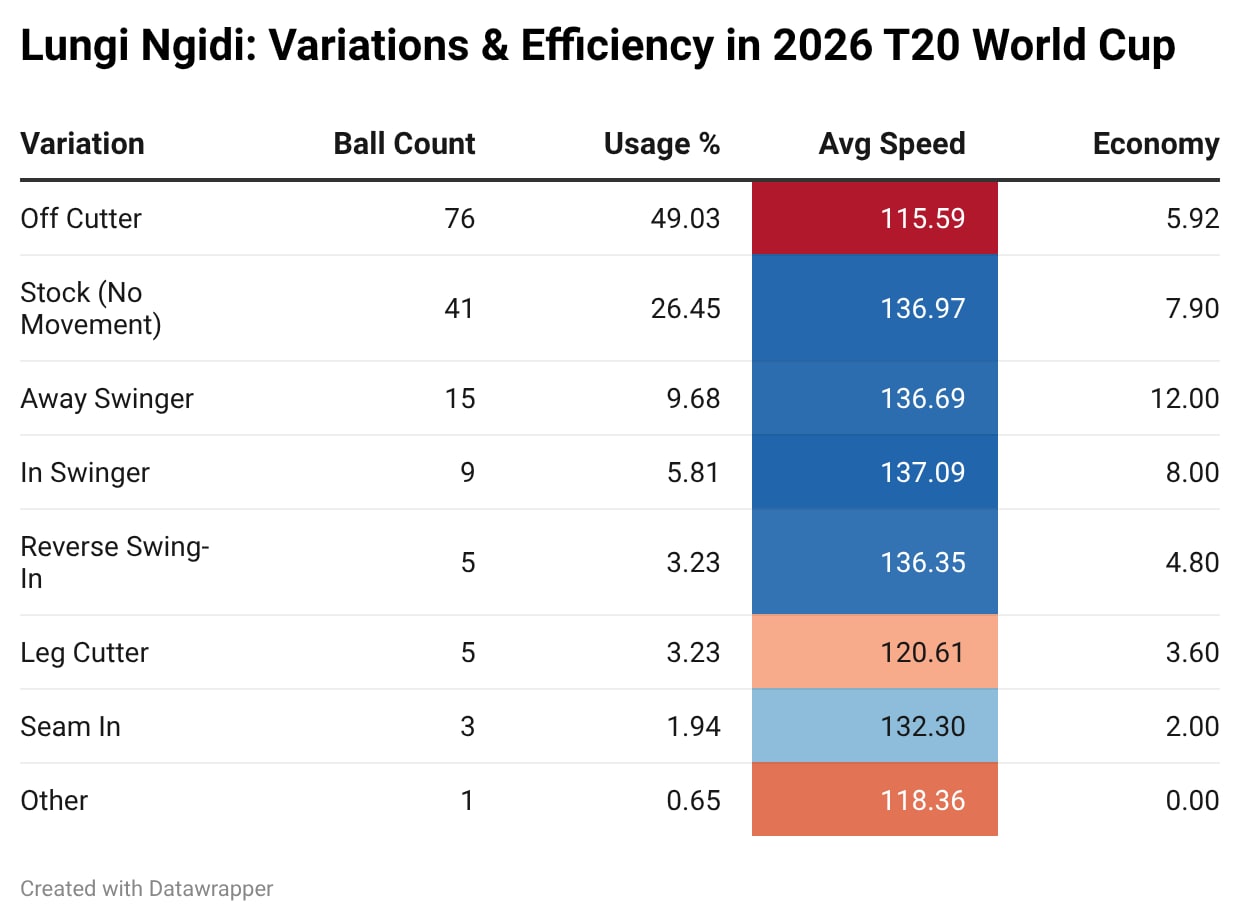
And Ngidi used it all the time — 36.92% of his deliveries in the powerplay were off-cutters, only behind Matheesha Pathirana (43.75%). In death overs, that number rose to 70%, the highest (12 balls in the phase as a cut-off). In overs 6-15, it was around 50%, also the highest.
And why wouldn’t he? The incessant off-cutters earned him an economy rate of 5.92. Only Bumrah and Azmatullah Omarzai had more success with the variation. Thanks to it, overall, Ngidi had the third-best economy rate in the entire competition, 7.19, in IPL 2026 till now; he is at an excellent 7.95.
There’s more. Analyst Himanish Ganjoo has devised a metric to quantify ‘impact’ in T20 cricket. This uses the Duckworth-Lewis method to find the runs a batter is expected to score, depending on two variables: balls left in the innings and wickets remaining for the team.
Among pacers who bowled at least 80 balls in the tournament, Ngidi’s impact/ball of 0.37 was only behind USA’s Shadley van Schalkwyk (0.78) and Bumrah (0.62).
What separates Bumrah from Ngidi?
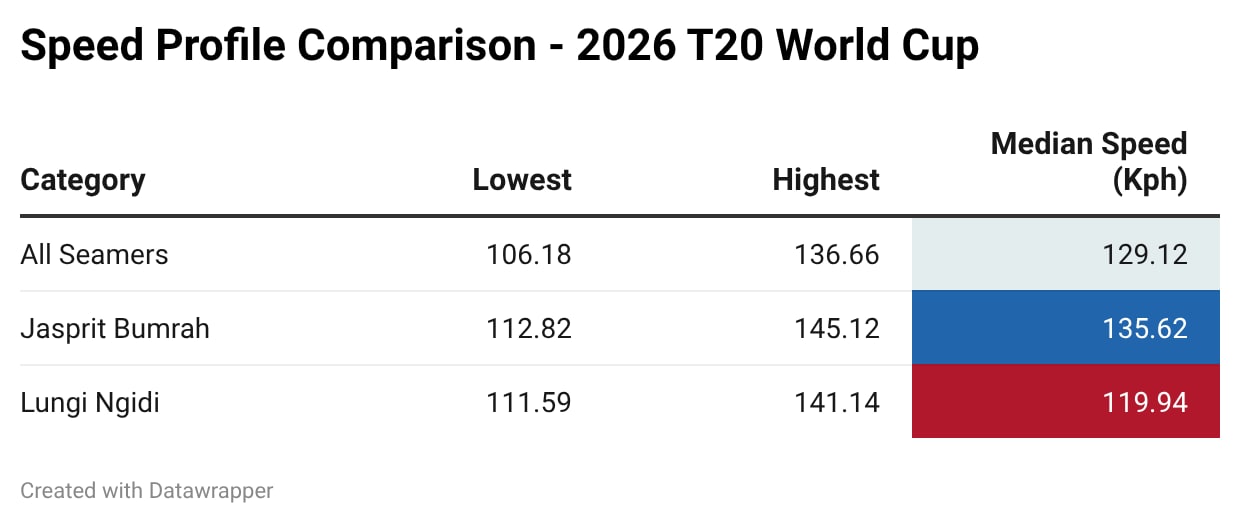
There was not much difference between Bumrah and Ngidi’s quickest deliveries in the 2026 T20 World Cup. Nor was there any difference between their slowest ones.
However, while the average seamer’s median pace in the tournament was 129.12 Kph and Bumrah’s was 135.62 Kph, Ngidi was much lower at only 119.94 Kph.
This means most of Bumrah’s deliveries were on the higher end of the pace spectrum. The Indian used his ability to drop the pace by 20 clicks as a surprise element. Ngidi, on the contrary, used his slower ones as the stock ball, trying to stop the run flow and building pressure, while using the express pace to catch a batter off guard.
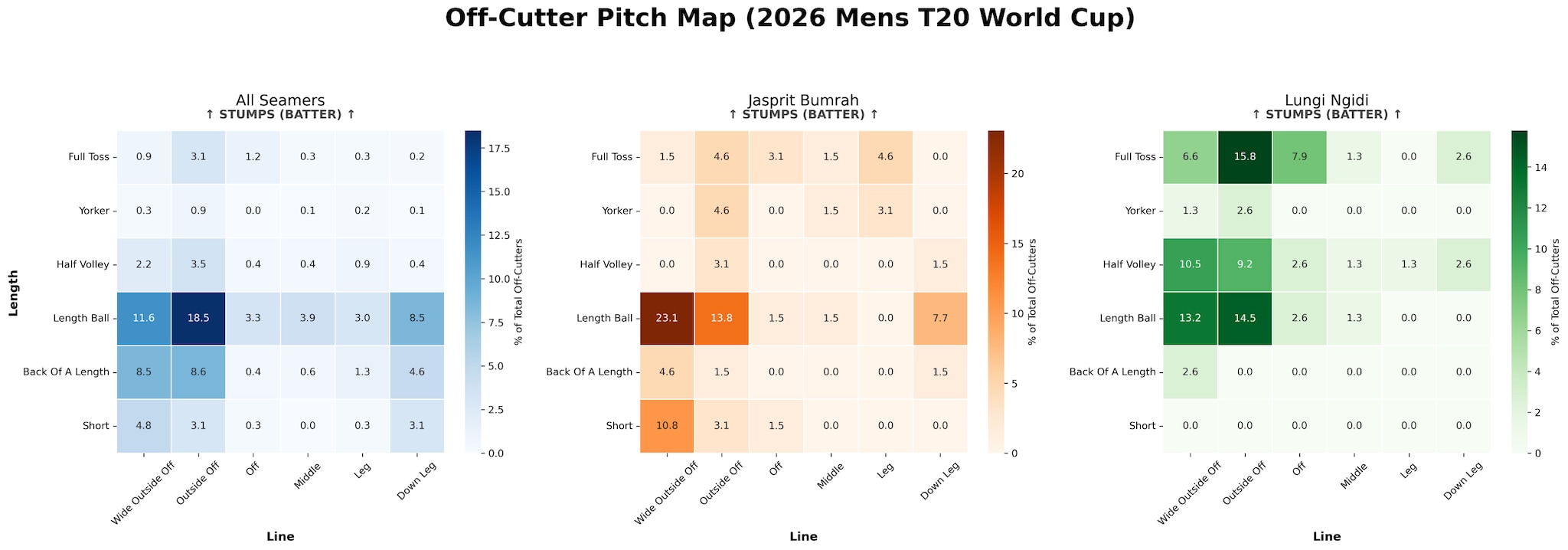
The other difference lay in the length distribution of the off-cutters. While Bumrah bowled more off-cutter bouncers and yorkers than average, Ngidi leaned heavily on the in-between, what we consider the slot areas.
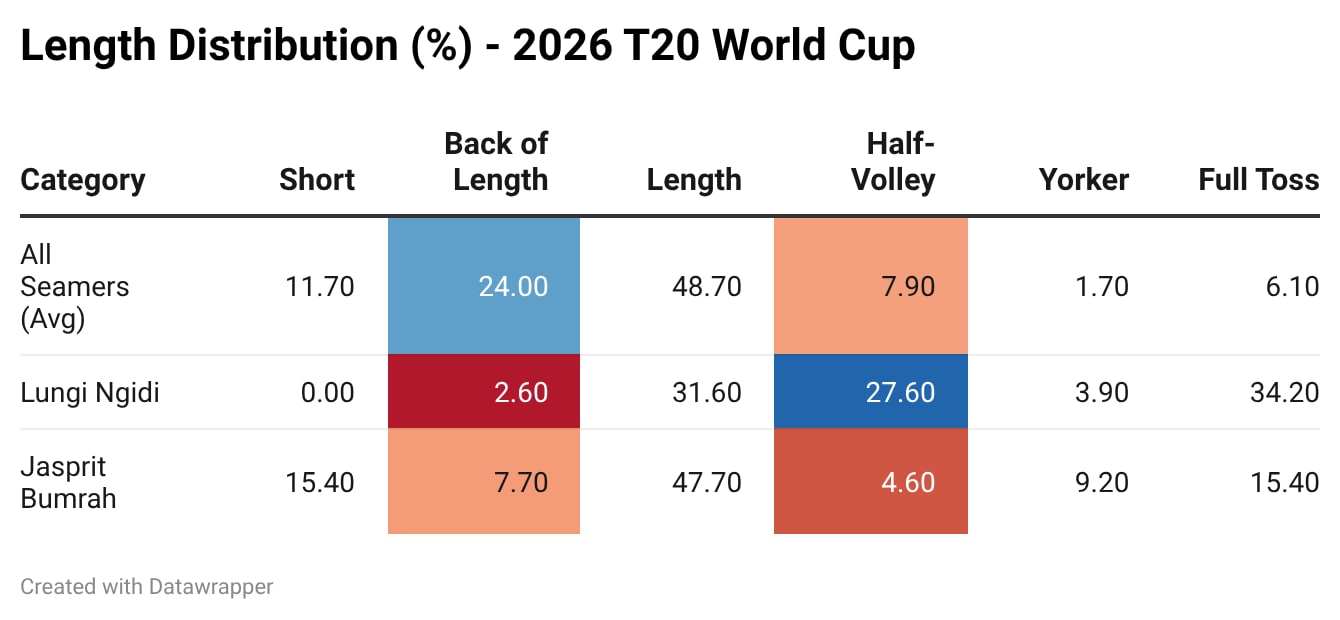
Some of these would certainly be him trying and missing the yorkers, but it also showed his will to pitch it up, where the dip is the most effective, just like for the Pooran dismissal.
That he still went neck-to-neck with Bumrah in terms of frugality despite taking the less ‘defensive’ option, tells you how difficult batters found it against him.
Bumrah’s accuracy, extra pace, awkward action, and overall smarts make him the more complete, all-format bowler. But Ngidi, two years his junior, is showing real signs of getting there himself.
At the presser, Munaf was keen to mention that Ngidi wasn’t like ‘other foreign players’ in how much he likes to learn from the DC coaches. At the base price of Rs. 2 crore, there’s not much more you can ask for.


/images/ppid_59c68470-image-177584003147239586.webp)




/images/ppid_a911dc6a-image-177583902703828601.webp)


/images/ppid_a911dc6a-image-177583843201259316.webp)
/images/ppid_a911dc6a-image-177583822527287353.webp)