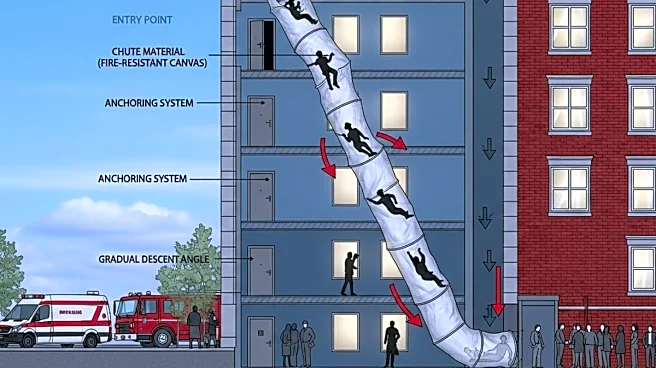




Imagine you are on the 24th floor when a fire breaks out on the levels below. Your instinct is to rush to the staircase, but what if it’s already filled with thick smoke? By the time you make your way down, prolonged exposure to toxic fumes could leave you seriously ill, or worse. In such situations, the biggest challenge isn’t just escaping the flames, but surviving the smoke.
WithIndian cities growing increasingly vertical, safe evacuation from high-rises has become a critical concern. In this context, fire escape chutes are emerging as a potential life-saving alternative to conventional methods. Already a standard safety feature in “mega high-rises” in cities like Dubai and Singapore, these systems are now being introduced in select premium
residential projects in Mumbai, Pune and Gurugram.
Far from being simple fabric tubes, fire escape chutes are sophisticated systems designed for controlled and secure descent. Built with multiple protective layers, they allow occupants to exit a building quickly without exposure to smoke or flames. Experts say they offer a key advantage in emergencies — they are significantly faster than stairwells and far safer than attempting to jump or wait for rescue.
Also Read: Delhi Fire Kills 9: Why Your AC Could Be A Ticking Bomb In Summer And How To Prevent Blast
As high-rise living becomes the norm, such innovations are increasingly being seen not as luxury add-ons, but as essential components of modern fire safety infrastructure.
How Fire Escape Chutes Work
Fire escape chutes work by using gravity and friction to provide a controlled descent from high-rise buildings. Unlike a playground slide, where you are at the mercy of your weight, a fire escape chute is a sophisticated “textile tube” that lets you regulate your speed with your own body.
The Triple-Layer Protection
A fire escape chute is not just a piece of fabric; it is a sophisticated piece of engineering, usually consisting of three distinct layers:
- Outer Layer (Flame Shield): This is a heavy-duty, fire-resistant fabric (often fibreglass or specialised treated nylon) that can withstand temperatures up to 600°C–800°C. It protects the passenger from radiant heat and flames licking out of windows as they pass by.
- Middle Layer (Braking/Friction Layer): This is the “magic” part. It is built with an elasticised or spiral design. As you go down, the fabric exerts a gentle, constant pressure on your body.
- Inner Layer (Structural): This layer supports the weight of the person and ensures a smooth, snag-free ride.
How Do You Control Your Speed?
The biggest fear people have is “free-falling.” However, you are in total control of your descent:
- “Pencil” Position: If you keep your arms at your sides and legs straight, you move faster.
- “Star” Position: By simply pushing your elbows or knees outward against the fabric, you increase friction and can come to a complete stop mid-chute.
- Automatic Braking: Most modern chutes (like the Ingstrom or Global Chute models) are designed so that no matter your weight, you never exceed a speed of about 2 meters per second (roughly a fast walking pace).
Why Are They Better Than Stairs In Crisis?
Speed: A single chute can evacuate about 25 to 30 people per minute. In the time it takes one person to walk down 20 flights of stairs, a chute can clear an entire floor.
Accessibility: You don’t need to be fit to use a chute. You can place an infant in a specialised bag, a person with a physical disability, or even an unconscious person into the chute, and they will safely glide to the bottom.
Psychology: In a fire, people often panic and trip on stairs. The chute is “blind”—you don’t see the height or the smoke outside once you are inside the tube, which significantly reduces “height-induced” paralysis.
How To Install Fire Escape Chute
Permanent (Exterior): These look like vertical metal boxes or “capsules” attached to the side of a building or a balcony. When a lever is pulled, the chute drops out like a long stocking to the ground.
Portable/Mobile: Fire departments in major cities now carry “Chute Trucks.” They can raise a platform to a window, and the chute is deployed from the truck’s arm to the ground in seconds.
Internal: Some modern buildings have “chute rooms” built into the core of the building near the elevators.
The “Landing” Part
The bottom of the chute typically ends about 2 to 3 feet above the ground. It has a padded “exit capsule” or a weighted base. As you reach the bottom, your feet touch the ground, and you simply step out. Because the friction layer has slowed you down, there is no “impact.”







/images/ppid_a911dc6a-image-177782853832660490.webp)