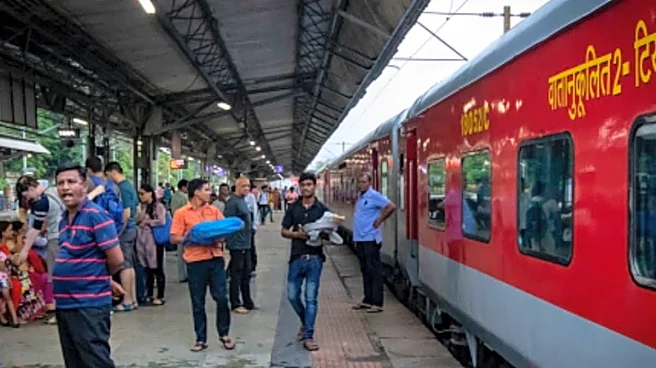

Railway Shares Rise: Shares of railway-linked companies rallied sharply on Friday, December 26, with several stocks gaining up to 10% after the government’s revised passenger train fares came into force.
The move marks the second fare hike in 2025 and is aimed at improving the financial sustainability of Indian Railways while keeping travel affordable.
Rail Vikas Nigam Ltd (RVNL) led the rally, with its shares jumping as much as 9.7% to Rs 379.20 on the BSE. Indian Railway Finance Corporation (IRFC) rose 6.7% to Rs 129.60, while Jupiter Wagons advanced 3.6% to Rs 352.65. Shares of Indian Railway Catering and Tourism Corporation (IRCTC) were up 1.9% at Rs 692.80. Other rail-related stocks such as Ircon International also traded higher. Investor interest has been supported by expectations around higher sectoral allocations in the Union Budget 2026–27, alongside the fare revision.
Fare hike details
According to the Railway Ministry, the revised fares apply to ordinary and mail/express trains, while suburban services and season tickets—both suburban and non-suburban—remain unchanged. For ordinary non-AC (non-suburban) services, fares have been rationalised in a graded manner across second class, sleeper class and first class ordinary travel.
For second class ordinary journeys, there is no fare increase for distances up to 215 km. Fares rise by Rs 5 for journeys between 216 km and 750 km, Rs 10 for 751–1,250 km, Rs 15 for 1,251–1,750 km, and Rs 20 for 1,751–2,250 km. Sleeper and first class ordinary fares have been revised at 1 paisa per kilometre for non-suburban routes. Mail and express trains will see a uniform increase of 2 paise per kilometre across both non-AC and AC classes. As an example, the ministry said a 500 km non-AC mail/express journey will cost passengers roughly Rs 10 extra.
Wider impact
The fare revision covers a wide range of services, including Tejas Rajdhani, Rajdhani, Shatabdi, Duronto, Vande Bharat, Humsafar, Amrit Bharat, Tejas, Mahamana, Gatimaan, Antyodaya, Garib Rath, Jan Shatabdi, Yuva Express and Namo Bharat Rapid Rail. Tickets booked on or after December 26 reflect the new fares, while bookings made earlier remain unaffected. Updated fare charts have been displayed at stations.
The ministry also highlighted that the previous fare hike implemented in July 2025 has generated around Rs 700 crore in revenue so far, underlining the financial impact of such revisions.
Budget expectations
Railway stocks have further benefited from optimism around the Union Budget 2026–27. Reports suggest that the FY27 budget could allocate a record Rs 1.3 trillion towards rail safety, accounting for nearly half of Indian Railways’ capital expenditure, amid concerns over accidents and the pace of safety system implementation.
With the revised fares now in effect and budget announcements approaching, railway stocks are expected to remain firmly in focus as 2026 approaches.

/images/ppid_59c68470-image-177090252752740734.webp)

/images/ppid_59c68470-image-177085753226281386.webp)
/images/ppid_59c68470-image-177090253948689009.webp)
/images/ppid_59c68470-image-177077508321758455.webp)
/images/ppid_59c68470-image-177078270540393001.webp)
/images/ppid_59c68470-image-177077268877789072.webp)
/images/ppid_59c68470-image-177079002661354065.webp)
/images/ppid_59c68470-image-177069274594727234.webp)
/images/ppid_59c68470-image-1770652537956142.webp)