

/images/ppid_59c68470-image-177582503358310704.webp)
Everybody Loves Sohrab Handa Review: There is something uncanny, something deeply disquieting about the way Rajat Kapoor’s Everybody Loves Sohrab Handa unfolds. It does not merely hinge on the suspense of a murder or the mechanics of a whodunit. What truly holds your attention is the shifting chemistry among the suspects, the bruised egos, unresolved tensions, old resentments and private wounds that keep surfacing in plain sight. The intrigue here is not just about who killed Sohrab Handa, but about the kind of life he led, the people he kept around him, and the emotional wreckage he seemed to leave in every room he entered. Whether you guess the culprit before the final reveal or not, Kapoor’s way of guiding you through that terrain feels startlingly
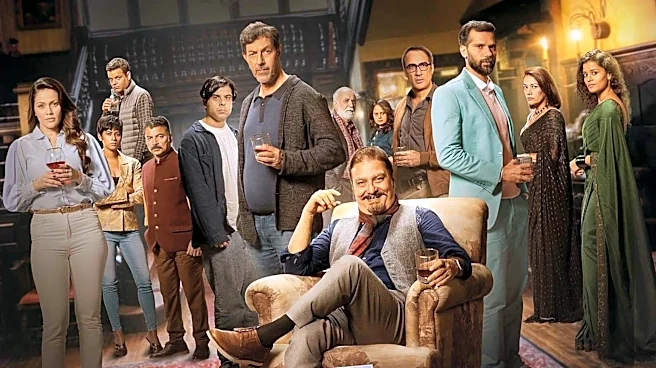
organic and lived-in, and that is precisely what makes this film feel a shade more unsettling than many Indian titles mounted in this genre. Backed by a formidable cast featuring Vinay Pathak, M K Raina, Neil Bhoopalam, Ranvir Shorey, Danish Hussain, Chandrachoor Rai and several others in the ensemble, this is a film that deserves to be seen.
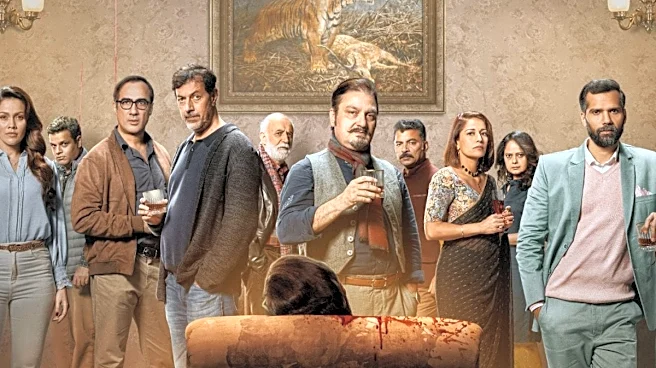
The story unfolds during what is meant to be a picture-perfect tenth wedding anniversary celebration hosted by Raman and Jayanti, with Raman played by Neil Bhoopalam and Jayanti by Palomi Ghosh. Raman also happens to be Sohrab’s business partner. They gather a close circle of family, friends and associates for an outstation getaway at a secluded old mansion in Himachal Pradesh, the kind of hill-station property whose very remoteness adds a lingering mood of isolation and unease. At the centre of this gathering is Sohrab Handa, played by Vinay Pathak, Raman’s business partner and the most overbearing presence in the room. He is loud, abrasive, foul-mouthed, sharp-tongued and impossible to ignore. Armed with a vicious wit and a habit of bulldozing his way through every social interaction, Sohrab spares nobody. He insults, belittles and needles everyone around him. He is tolerated, occasionally even entertained, because his brutal honesty is mistaken for authenticity, but beneath that tolerance lies fear, irritation and quiet loathing. What gives the character heft, however, is that the film does not reduce him to a cardboard bully. There are deeper insecurities and bruised corners within him, which make him complicated, unpleasant and yet undeniably compelling. He presides over the evening with drinks, banter, laughter and parlour games like dumb charades, turning the room into his own personal arena.
Then the film twists the knife. What begins as conviviality, eating, drinking and raucous amusement, turns dark late into the night or perhaps in the early hours of morning, when Sohrab is found dead in the hall with his throat slit. With the mansion cut off from the outside world, the celebration curdles into a crime scene. The central irony of the title rises to the surface. Everybody who seemed to love Sohrab, or at least endure him, had some reason to want him silenced.
By dawn, local police inspector Afzal Qureshi, played by Saurabh Shukla, arrives with an associate to investigate. From there, the film steadily peels away at friendships, kinships and appearances. Tensions that had only been simmering begin to bubble over. Accusations begin to fly, past wounds return to the table, and long-buried secrets begin to stain the surface. The group is left to navigate suspicion from within, with limited outside intervention, and what follows is a tense web of revelations, betrayals and moral unease. Kapoor blends suspense and dark humour with a distinctly contemporary spin on the classic whodunit, while also probing hidden traumas, performative relationships, and the ease with which civility falls apart under pressure.
One of the more interesting choices Kapoor makes is that he does not bother spoon-feeding the viewer. No flamboyant title cards announce who each character is and what role they are supposed to play. The characters enter the film in a chaotic, overlapping, entirely natural fashion. As a result, it may take a while to place everyone and understand the precise relationship web at play. But once that fog clears, and it does, you are drawn into the lives of these people with surprising ease. The investment grows rather quickly. Though the plot revolves around Sohrab Handa and his murder, it is the constellation of characters around him, even before the killing takes place, that makes the film such an absorbing character study and nudges you into becoming your own detective.
There is Raman, for one, Sohrab’s business partner and the man hosting this intimate and warm celebration, but who is also already entertaining thoughts of edging Sohrab out of the business, something hinted at in his interaction with his wife Jayanti. Then there is Dr Chandra, played by Rajat Kapoor himself, Raman’s friend who has come all the way from Canada to be part of the gathering. He is a psychologist, someone gifted with the ability to read people through their behaviour, their speech and their smallest tells. There is Arun, played by Chandrachoor Rai, Sohrab’s younger brother, a seemingly subdued figure who often finds himself at the receiving end of his father Baba’s reprimands, with Baba played by M K Raina. Then there are Suman, played by Sadiya Siddiqui, and her husband Sandeep, played by Sharat Katariya, who too find themselves pulled into this swirling family drama.
As the afternoon wears on, the gathering keeps expanding. Kumar, played by Danish Husain, arrives. He is an independent journalist, and he is accompanied by his wife Nena, played by Waluscha De Souza. Then comes Madhavan, played by Ranvir Shorey, who later walks in with his age-gap girlfriend Nazia, played by Kankana Chakraborty. Once everyone is under the same roof, the afternoon segues into sporadic moments of tension, with Sohrab repeatedly locking horns with those around him. Whether he is sparring with Madhavan over philosophy or taking an open swipe at his own father, Sohrab immediately comes across as someone carrying a deep bitterness, someone who is not quite what he initially projects himself to be. His confidence springs from insecurity. His anger is a covering, a garment thrown over trauma. He is never rendered as one-note, and the more you watch him, the more frustrating he becomes. At first glance, he appears jealous, mean-spirited and incapable of saying anything generous about either family or friends. In one scene, he chastises his father for wanting another helping of mutton. In another, he flares up during a discussion on how the media sensationalises news to reach a wider public, and how it operates through the logic of consumerism. When Madhavan remarks that we have become a morally bankrupt society, Sohrab erupts, branding him a fraud and dismissing philosophers from Socrates to Plato to Sartre. He then launches into an aggressive tirade about how people like Madhavan contribute nothing to society, whereas it is people like Sohrab who toil day and night, make money, generate employment and keep the world moving.
It is this steady dissection of Sohrab Handa’s life, running parallel to the hunt for his killer, that elevates the film beyond most crime dramas. There are several such moments where Sohrab makes sure that no situation remains easy or pleasant for too long. Even his devoted wife Isha Handa, played by Koel Purie, is not spared from his bitterness. Beneath the gathering’s warmth lies a constant tug-of-war for power among family members and friends, and that friction only really surfaces when they are all brought together in one space. That is what sharpens the central mystery. It makes you genuinely curious about who killed Sohrab Handa, even if the answer may strike some as surprising and others as plainly evident.
What Rajat Kapoor continues to do so well is root his stories in realism. Whether it was Kadakh before this or now Everybody Loves Sohrab Handa, he has a strong grip on how to make people feel alive on screen. The characters do not feel arranged for effect. They feel like people you may have met, sat with, argued with, or even tolerated during your own family and friend gatherings. Their conversations, even the ones unfolding in the background, have a casual naturalism to them, and that is what lends the film its texture and depth. Kapoor also deserves credit for shaping each character with a discernible personality, regardless of whether their screen time is expansive or brief. That attention to detail makes the film an invigorating experience.
Having said that, the film is not without its drawbacks. At certain points, it becomes somewhat obvious who the killer might be. But even if the identity begins to feel apparent, it is the motive that can still catch you off guard. At the same time, there are characters who, despite being given a personality and a space within the ensemble, do not quite add enough to the larger story. There are also aspects that remain unresolved or mysterious in ways that feel less intriguing and more incomplete, and those are things that ought to have been addressed toward the end. The climax feels rushed, and the film could have benefitted from a slightly longer runtime, if only to tie up a few loose ends instead of leaving too much open for the audience to decode on its own.
While the cinematography has a lived-in quality to it and the score adds weight to the dramatic beats, it is the ensemble’s performances that truly pull you in. Vinay Pathak is undoubtedly the soul of the film. His portrayal of Sohrab Handa, whether in the character’s eccentric turns or his acid-tipped jibes, is thoroughly compelling. Chandrachoor Rai plays Arun with finesse. Neil Bhoopalam brings an effortless charm to Raman. Sadiya Siddiqui lends Suman a striking simplicity. Ranvir Shorey is thoroughly convincing as Madhavan. M K Raina, as always, is masterful. Saurabh Shukla brings a grounded and believable authority to the role of Afzal Qureshi. The rest of the cast too, Waluscha De Sousa as Nena, Danish Husain as Kumar, Rajat Kapoor as Chandra, Sharat Katariya as Sandeep, Palomi Ghosh as Jayanti, Koel Purie as Isha Handa and the others, all seem perfectly placed within this world.
In the end, Everybody Loves Sohrab Handa is a decent watch. Through the framework of a murder mystery, it throws light on interpersonal relationships within families, unresolved trauma and its cost, the ironies that life quietly breeds, and the fragile line that separates being real from merely appearing so. It keeps you hooked till the end, even if its treatment is not always consistent.
/images/ppid_a911dc6a-image-177597705773443730.webp)


/images/ppid_a911dc6a-image-17758300342421186.webp)
/images/ppid_a911dc6a-image-177587902481351046.webp)
/images/ppid_a911dc6a-image-177579852447818164.webp)

/images/ppid_a911dc6a-image-17757915592362332.webp)