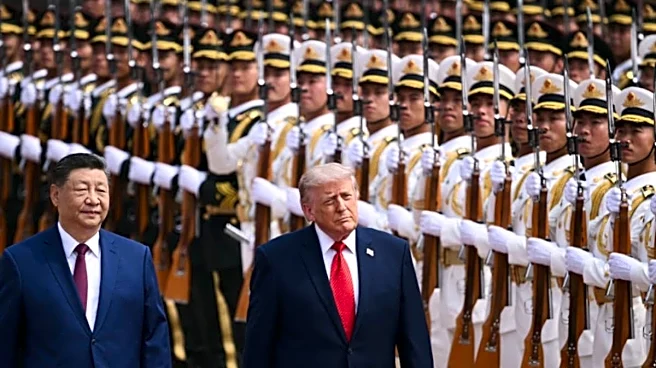




US President Donald Trump on Thursday said that China had agreed to purchase 200 Boeing jets. However, China is yet to confirm the big-ticket purchase.
“It was sort of like a statement, but I think it was a commitment,” Trump said in an interview with Fox News while describing his conversation with Chinese President Xi Jinping.
The remarks have once again drawn attention to the strategic importance of Boeing for the United States — not just as an aircraft manufacturer, but as a major pillar of the American economy, defence ecosystem and diplomatic influence.
Founded in Seattle in 1916, Boeing has grown into one of America’s most strategically important companies. Successive US administrations, irrespective of party lines, have aggressively promoted
Boeing aircraft abroad as part of broader economic and geopolitical policy.
Economic Engine And ‘Too Big To Ignore’
Boeing remains one of the largest exporters in the United States, with international aircraft sales contributing billions of dollars to the American economy every year.
The aerospace giant supports more than 1.3 million jobs directly and indirectly through its vast supply chain spread across all 50 states. Economists often describe Boeing as “too large to fail” because disruptions in its production cycle can have measurable effects on US manufacturing output and GDP growth.
Recent quarterly results also reflected Boeing’s continued recovery after years of manufacturing and safety-related setbacks, with the company reporting improved aircraft deliveries in early 2026.
A Key Pillar Of US National Security
Beyond commercial aviation, Boeing is also one of America’s most important defence contractors.
The company manufactures fighter aircraft, surveillance systems, military helicopters, satellites and missile defence technology for the US government. In 2026, Boeing expanded production agreements linked to PAC-3 missile defence systems, which are considered critical to American and allied security infrastructure.
Washington also views Boeing as strategically important for maintaining domestic aerospace expertise and reducing dependence on foreign manufacturers in sensitive defence sectors.
The company additionally plays a central role in US space ambitions through NASA-linked programmes, including the Space Launch System and Artemis missions.
More Than Aircraft: A Tool Of Diplomacy
For decades, Boeing aircraft deals have also served as instruments of American diplomacy and soft power.
Major aircraft purchases are frequently announced during high-level state visits and bilateral meetings, especially with Gulf nations and Asian economies. Such agreements are often projected as symbols of strategic partnership and long-term economic cooperation with the United States.
Even the aircraft used by the American president — Air Force One — is manufactured by Boeing, reinforcing the company’s symbolic association with US global power.
The Global Battle With Airbus
The global commercial aviation industry is largely dominated by two giants: Boeing and Europe-based Airbus.
Successive US governments have openly backed Boeing in its competition with Airbus, arguing that European governments provide strong policy and financial support to their own aerospace champion.
Although Airbus has led Boeing in several order categories in recent years, Boeing has shown signs of recovery through increased deliveries and stabilising production levels.
The Financial Push Behind Boeing Deals
Another major factor behind Boeing’s global expansion is support from the Export-Import Bank of the United States (EXIM Bank), which helps foreign airlines finance purchases of American aircraft.
The programme has often been defended by US lawmakers as necessary to help Boeing compete against rivals backed by state-supported financing in Europe and China.
With China simultaneously investing heavily in its homegrown aviation giant COMAC, the battle for dominance in the global aircraft market is increasingly becoming part of a larger geopolitical and economic contest between major powers.







/images/ppid_a911dc6a-image-177879102412232379.webp)




/images/ppid_a911dc6a-image-177878756506087867.webp)