
/images/ppid_a911dc6a-image-177077322976413782.webp)
/images/ppid_59c68470-image-177077258165510745.webp)
/images/ppid_59c68470-image-177077272281824806.webp)
Lionel Messi’s left foot is reportedly insured for about $900 million, which is more than Rs 8,000 crore. No kidding!
This makes it one of the most valuable insured body parts in sports. And because of this high-value insurance policy, Lionel Messi did not play a football match or exhibition game during his four-city India visit – a limitation that, in hindsight, might feel more like a blessing than a restriction given how the tour unfolded.
If there’s one thing Messi will be glad about, it’s that he didn’t have to jeopardise his precious left foot in the chaotic scenes that greeted his return to Indian soil – particularly in Kolkata, where what was billed as a historic football moment, somehow turned into an impromptu episode of ‘Event Management
101: What Not to Do’.
Kolkata, known for its football frenzy, has deep-rooted passion for the game and one of India’s most iconic venues – the Salt Lake stadium, which is a cauldron of sport where league derbies have drawn crowds comparable to international fixtures.
So, when Messi’s ‘G.O.A.T India Tour 2025’, which marked his first visit to India since 2011, kicked off with an event in the city, the expectations were astronomical. Fans paid hefty sums for what was marketed as an extended Messi appearance and a celebration of football. Instead, the spectacle was unexpectedly brief.
Messi’s on-field time was cut dramatically – from a planned hour or more to roughly 20 minutes – amid what officials later described as security and organisational concerns. The result?
Frustrated fans who couldn’t see him clearly found themselves behind VVIP barricades and celebrity perimeters, forced to watch the action – or lack thereof – mostly on big screens. And then the volcano erupted.
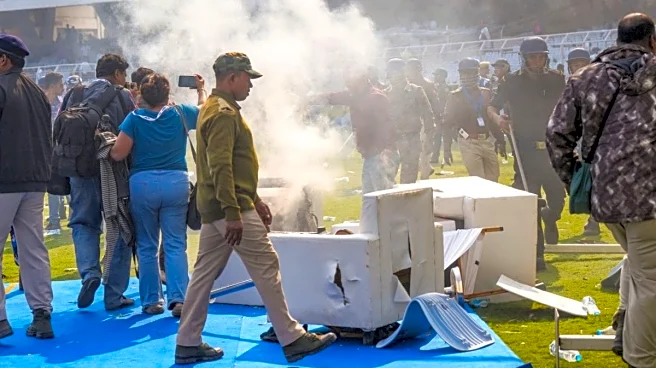
What followed was ugly, dramatic, and, frankly, embarrassing for an event of this scale: chairs were ripped from their fittings and hurled; water bottles flew through the air like protest confetti; spectators stormed parts of the pitch, venting their anger at organisers and an experience many described as “feeling cheated”; local police had to step in, arresting the event’s chief organiser and launching an investigation into what went wrong, including alleged unauthorised ticket sales and crowd mismanagement; in an almost cinematic twist, West Bengal Chief Minister Mamata Banerjee issued a public apology to Messi and the fans, acknowledging the fiasco and promising accountability.
For a tour meant to elevate India’s football culture in Messi’s embrace, the episode exposed how enthusiasm can easily outpace execution.
It wasn’t all doom and disorder.
In Hyderabad, Messi’s presence was calmer and better marshalled. He greeted fans, shared football moments with local attendees, and engaged in light activity that actually felt like what fans had paid to see – heartfelt interaction rather than a fleeting vignette.
Mumbai followed suit with a far more controlled, media-friendly spectacle. The ambience was celebratory: Messi met Indian sporting legends, crowd energy was high, and the event delivered on many of the fan aspirations that the Kolkata leg failed to realise.
But even here, the earlier chaos lingered in the public consciousness – like a bruise that refuses to disappear.
With the tour rolling into New Delhi for its final leg, authorities and organisers seemed determined to course-correct, with the capital’s stop being a more structured affair at Arun Jaitley Stadium.
Delhi’s preparations – from formal traffic diversions to heightened security and explicit entry advisories – reflect lessons learned from the Kolkata misstep.
Messi’s India tour, after its chaotic opener, has evolved into a sort of cultural mirror – it reflects the unbridled passion Indian fans have for global sporting icons.
It exposes the gaps in event management infrastructure when mass enthusiasm meets poor organisation. And it highlights how high expectations can collide disastrously with on-ground logistics.
There’s an uncomfortable lesson here: celebrity alone doesn’t guarantee a smooth experience – you need planning, crowd science, and realistic expectation setting. Messi might not be playing a full match – thanks to that $900 million insurance policy but the most valuable lesson from this tour will be for Indian organisers: don’t overpromise what you can’t control, and never underestimate the intelligence of a crowd that came to see a legend.
/images/ppid_59c68470-image-177077760046699504.webp)

/images/ppid_59c68470-image-177077752738996998.webp)
/images/ppid_59c68470-image-177077764100798849.webp)
/images/ppid_59c68470-image-177077755993327863.webp)
/images/ppid_59c68470-image-177077759049498278.webp)
/images/ppid_59c68470-image-177077754454222790.webp)
/images/ppid_59c68470-image-177077753316323586.webp)
/images/ppid_a911dc6a-image-177077683848562681.webp)

/images/ppid_a911dc6a-image-177077603394625504.webp)
/images/ppid_59c68470-image-177077512106794299.webp)