

/images/ppid_a911dc6a-image-17772274286776852.webp)

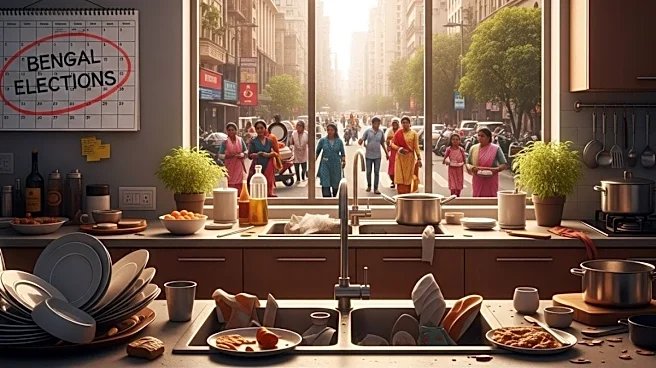
A throwaway joke about Gurugram residents waiting for their maids to return after Bengal elections has snowballed into a larger debate that goes far beyond social media outrage. At its heart lies an uncomfortable question: How did a state once seen as India’s intellectual and cultural powerhouse become the subject of such stereotypes?
The issue erupted after writer and economist Sanjeev Sanyal took umbrage at a tweet posted by former Chief Election Commissioner of India, Dr SY Quraishi, who had shared a poster with a “harmless joke”: “Gurugram wishes smooth elections in West Bengal. We want our maids back safe and soon.”
It is a tragedy that a state that produced Vivekananda, Netaji, AJC Bose, Tagore, Bankim and Vidyasagar is today thought of
merely a source of household help in the rest of India. While there is nothing wrong in working as a maid or driver (all honest labour should be respected),… pic.twitter.com/j7kTjHMLzK
— Sanjeev Sanyal (@sanjeevsanyal) April 26, 2026
A Joke Rooted In Reality?
The viral remark didn’t come out of nowhere.
ALSO READ | Hold The Broom, Please: House Helps Working In Metro Cities Have Vanished. Reason? Bengal Elections
Across Gurgaon and parts of Delhi-NCR, residents reported a shortage of domestic workers in the run-up to elections in West Bengal as many migrant workers returned home to vote, temporarily disrupting urban households.
News18 had also reported how households are struggling to find replacements, upending daily routines and focusing the spotlight on dependence on migrant labour. What is usually invisible labour now becomes impossible to ignore.
A Migrant Hub
This is not a one-off disruption; it reflects a larger trend.
West Bengal has, over time, emerged as a major source of migrant labour for Indian cities. Workers move for jobs, income stability, and networks, with many entering the informal sector such as domestic work, construction, and services. Migration also often follows community chains, with entire localities linked to specific cities. For instance, cities like Gurugram, Mumbai, and Bengaluru rely heavily on this workforce.
This joke is in bad taste, tragic too. It came from S.Y. Quraishi, former Chief Election Commissioner of India.
West Bengal acquiring the image of “maid supplying state” is sad. It was once the most industrialised state. Dukkhito. @DrSYQuraishi pic.twitter.com/TJbjCAg10I
— Dilip Mandal (@Profdilipmandal) April 25, 2026
But over time, this visibility has hardened into something else: a stereotype that reduces an entire state to a single kind of work.
ALSO READ | Gurugram’s Bengali-Speaking Locals Give ‘Major Hint’ Over ‘Missing’ Maids: ‘Their Accent…’
The problem isn’t migration but how it is perceived. As Sanyal also noted: “While there is nothing wrong in working as a maid or driver (all honest labour should be respected), the cultural and economic decline of my home state is not a joke…”
Bengali-speaking workers are often clubbed into a narrow identity, with language sometimes triggering suspicion about citizenship or origin. Social media often amplifies these simplifications into casual humour, case in point being the Gurugram joke. The dig reflects the shift from economic reality to social shorthand and further to a mere stereotype.
From Renaissance To Remittance
The discomfort runs deeper because of Bengal’s past. The state that produced Swami Vivekananda, Subhas Chandra Bose, Jagadish Chandra Bose, and Rabindranath Tagore, and once stood at the centre of India’s intellectual awakening, early industrial and educational development and reform movements that shaped modern India today stands at a crossroads. Its national image is increasingly tied to outmigration and informal labour and it is this contrast between historic prestige and present perception that gives the debate its emotional charge.
How did we Bengalis end up being stereotyped as ‘maids’ in an entire city?
I mean, there are blue-collar workers from almost every community in all metropolitan cities, engaged in different occupations.
How is it possible that all ‘maids’ of Gurgaon are Bengali by… pic.twitter.com/NsBxNLAJfC
— Dibakar Dutta (দিবাকর দত্ত) (@dibakardutta_) April 26, 2026
What Explains The Shift
The biggest reason is limited job creation. While the economy has grown, it has not generated enough high-quality jobs, pushing many to seek work outside the state. Opportunities remain concentrated in and around Kolkata, leaving many districts dependent on migration.
Also, over decades, this migration has become self-reinforcing: Workers connect others from their villages, and entire communities build ties with specific cities.
Add to this the politics of identity and “infiltration”. Debates around illegal migration have blurred lines between Bengali-speaking Indians and undocumented migrants, especially from Bangladesh. This has contributed to suspicion and stereotyping, especially in northern cities.
Election season amplifies the issue as migrants return home in large numbers, leaving sudden labour gaps in cities. This makes everyday dependence on help from the state more obvious.
As reported by News18, this cyclical movement often leaves urban households scrambling, bringing migration into public conversation, sometimes crudely.
The backlash to the joke, and reactions like that of Sanjeev Sanyal, underline a key distinction: There is nothing wrong with domestic work or manual labour, but reducing a state’s identity to that work signals a shift in perception. The issue is not what Bengalis do; it is what Bengal is seen to represent.




/images/ppid_a911dc6a-image-17772825259875927.webp)