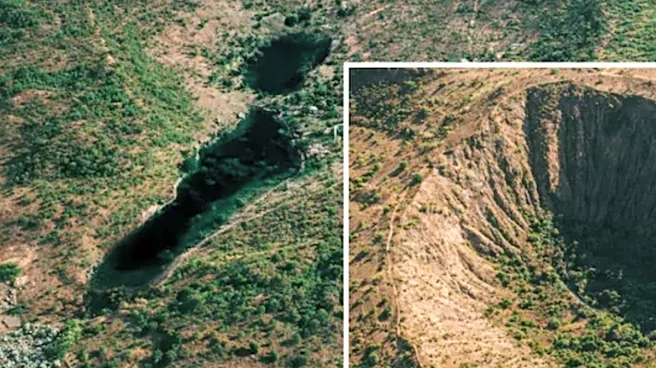




Researchers have discovered significant new evidence regarding the Ramgarh Crater in Baran district, southeastern Rajasthan, a region more commonly known for its deserts. Tiny magnetic particles hidden in the soil have offered insights into the type of meteorite that struck this area thousands of years ago.
Location And Structure Of Ramgarh Crater
Ramgarh Crater is situated near Ramgarh village in Baran district, Rajasthan. It is a circular geological formation roughly 3.5 kilometers in diameter. When filled with water, the crater forms a lake.
The site has long been considered the result of a meteorite impact, and geologists have been studying its origin and the celestial body responsible for years.
Investigating The Meteorite Impact
In the latest research, scientists examined sediments inside the crater, identifying
very small magnetic particles that reveal the nature of the meteorite. The findings were presented at the Lunar and Planetary Science Conference (LPSC) 2026.
Researchers collected approximately 30 soil samples from two shallow trenches dug within the crater. Using magnets, they separated the magnetic particles from the soil, analysing them under microscopes and with chemical analysis tools.
Discovery Of Microtektites
Many of the particles were smaller than a millimeter, smooth, and round. Scientists believe these particles were once drops of molten rock thrown into the air during the meteorite impact and cooled rapidly. Such particles resemble microtektites, tiny glass-like fragments formed when meteorite impacts produce extreme heat, melting rocks that then spread into the atmosphere.
Chemical tests revealed the presence of iron, nickel, and silicon in several particles. Nickel is particularly significant because it is commonly found in meteorites but rare in the sandstone around Ramgarh. Some particles also had high concentrations of iron and iron-rich mineral structures, suggesting they likely contain fragments of the meteorite itself.
Implications Of The Findings
Scientists say these findings strongly indicate that the Ramgarh Crater was formed by an iron-rich meteorite impact. Meteorites often vaporize or fragment upon striking Earth, making direct evidence rare.
Studies like this help us understand how meteorites and asteroids shape the Earth’s surface and what happens to materials during high-energy impacts.
Importance Of Impact Craters
Impact craters serve as crucial records of the solar system’s history, showing what types of celestial bodies have collided with Earth in the past.
Despite its clear and circular structure, Ramgarh Crater remains one of India’s lesser-known impact sites. This new discovery highlights its growing scientific importance.
Future Research Prospects
Researchers note that deeper analysis of the crater’s soil and rocks could provide direct evidence of the meteorite and possibly determine when the impact occurred.
The study demonstrates that even tiny, almost invisible particles in the soil can reveal the story of an ancient cosmic collision that shaped the geography of this region in Rajasthan.






/images/ppid_a911dc6a-image-177095803945834897.webp)

/images/ppid_a911dc6a-image-17709580293397222.webp)
/images/ppid_59c68470-image-177095764644795315.webp)

/images/ppid_59c68470-image-177095772128260787.webp)
/images/ppid_59c68470-image-17709576039333966.webp)