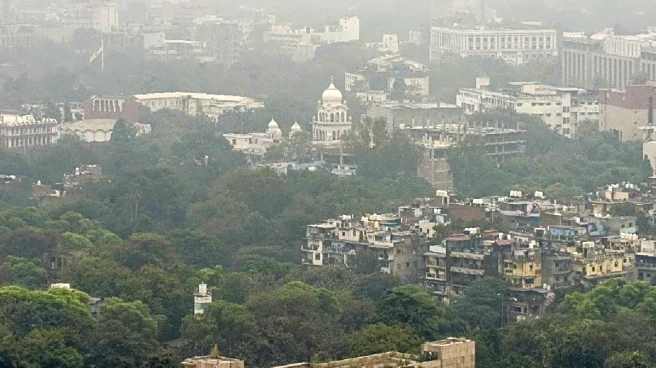

Delhi continued to reel under poor air quality, with the overall Air Quality Index (AQI) recorded at 387 at 6 am on Friday morning, remaining in the ‘very poor’ category and signalling no respite from
the ongoing pollution spell.
This marks a deterioration from Thursday morning’s AQI of 356, underscoring the steady decline in air quality across the city.
Compounding commuters’ woes, dense fog also impacted flight operations at Indira Gandhi International (IGI) Airport, prompting authorities to implement CAT III operations, which may lead to delays and disruptions.
In a passenger advisory, Delhi International Airport Limited said on-ground teams are working in close coordination with all stakeholders to assist travellers across terminals, while passengers have been advised to check real-time flight updates with their respective airlines.
Update issued at 0700 hours.
Kind attention to all flyers!#Fog #FogAlert #DelhiAirport pic.twitter.com/85lt0GvEFQ— Delhi Airport (@DelhiAirport) December 19, 2025
Several pollution hotspots reported alarmingly high readings. R K Puram emerged as the most polluted area with an AQI of 447, followed closely by Anand Vihar, Vivek Vihar, and Sirifort, all recording 442.
Other areas also remained deep in the severe zone, including Dwarka Sector-8 (429), Nehru Nagar (425), NSIT Dwarka (423), Dr. Karni Singh Shooting Range (423) and Okhla Phase-2 (422).
Visuals around ITO area shared by ANI showed a layer of toxic smog engulfing the national capital. CAQM (Commission for Air Quality Management) has invoked all actions under GRAP Stage-IV in Delhi-NCR.
#WATCH | Delhi | Visuals around ITO area as a layer of toxic smog engulfs the national capital. CAQM (Commission for Air Quality Management) has invoked all actions under GRAP Stage-IV in Delhi-NCR.
AQI (Air Quality Index) around the area is 409, categorised as ‘severe’, as… pic.twitter.com/qggwpifjyZ
— ANI (@ANI) December 19, 2025
Even locations that fared comparatively better continued to record poor air quality. Shadipur and Alipur both logged an AQI of 306, while Burari Crossing stood at 313. Najafgarh (346), North Campus, Delhi University (350), and Lodhi Road, which ranged between 351 and 354, also remained in the ‘very poor’ category.
An AQI between 0 and 50 is considered ‘good’, 51 to 100 ‘satisfactory’, 101 to 200 ‘moderate’, 201 to 300 ‘poor’, 301 to 400 ‘very poor’, and 401 to 500 ‘severe’.
Against this backdrop, Delhi has tightened anti-pollution measures. From Thursday, non-Delhi private vehicles below BS-VI standards are barred, and fuel is denied to vehicles without valid PUC certificates under the ‘No PUC, No Fuel’ rule.
Enforcement involves cameras, alerts, police checks, and transport teams, alongside steps such as carpooling, traffic management, waste processing, and rapid pothole repairs.