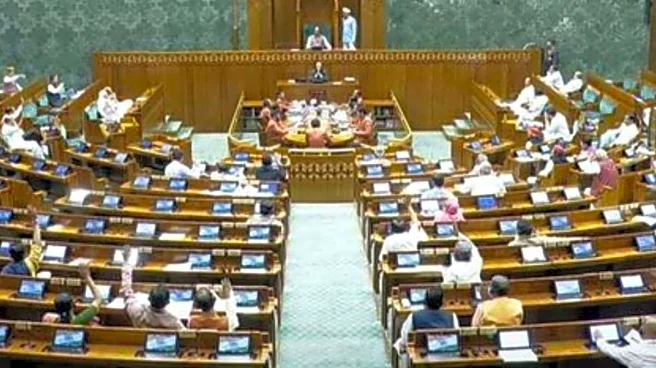

Prime Minister Narendra Modi on Tuesday welcomed the growing use of regional languages in Parliament, calling it a heartening reflection of India’s cultural and linguistic diversity.
Reacting to recent
data showing a sharp rise in speeches delivered in mother tongues in the Lok Sabha, PM Modi praised Lok Sabha Speaker Om Birla and Members of Parliament across party lines for encouraging linguistic inclusivity on the floor of Parliament.
“This is gladdening to see. India’s cultural and linguistic diversity is our pride,” the Prime Minister said in a post on X.
The Prime Minister’s remarks come as official data from the Lok Sabha secretariat highlights a significant shift in parliamentary discourse, aided by the availability of live translation in all 22 official languages.
During the winter session of Parliament, 160 speeches, either fully or partially, were delivered in languages other than Hindi and English.
Tamil accounted for the highest number with 50 speeches, followed by Marathi with 43 and Bengali with 25.
This marked a sharp increase compared to the previous monsoon session, where there were 13 speeches in Tamil, 12 in Marathi and 10 in Bengali, despite the session being longer.
Officials said the expanded translation infrastructure has played a key role in this change.
Earlier, many MPs opted to speak in Hindi or English due to the lack of interpreters and technical support, and those wishing to use regional languages were required to give advance notice. That requirement has now been removed.
Under Speaker Om Birla’s initiative, live translation services, first introduced with 10 languages, were expanded to cover all 22 official languages and English. The system was fully rolled out on December 11, 2023, during Question Hour.
Currently, around 84 translators are deployed during parliamentary sessions, significantly reducing technical constraints.
In the recently concluded winter session, 37 MPs spoke in languages other than Hindi and English, including Bodo, Manipuri, Santhali, Assamese, Urdu and Kannada.
Officials noted that several lawmakers prefer speaking in their native languages so their constituents can better understand parliamentary proceedings. DMK leader TR Baalu, for instance, spoke in Tamil for the first time in 11 years during the winter session.
The emphasis on multilingualism has also extended beyond Parliament. Officials said the Lok Sabha’s translation services are now being used for other government programmes, including the Prime Minister’s meetings, multilingual conferences of parliamentary bodies, and discussions organised by NITI Aayog.
The Prime Minister’s endorsement is expected to further bolster efforts to make parliamentary proceedings more inclusive and accessible across linguistic communities.


/images/ppid_a911dc6a-image-177101752951095973.webp)


/images/ppid_a911dc6a-image-177101403147018469.webp)
/images/ppid_a911dc6a-image-177101053501199609.webp)
/images/ppid_59c68470-image-177101003680064644.webp)