

/images/ppid_59c68470-image-17863450250671575.webp)
The James Webb Space Telescope was built to look deeper into the universe than any telescope before it. Four years after it began sending back scientific data, Webb is now forcing astronomers to confront a possibility that sounds almost contradictory: an object that behaves partly like a star and partly like a black hole.
The trigger for the excitement is a newly studied object called MoM-BH*-1, observed as it existed roughly 660 million years after the Big Bang. Researchers say it shines with an intense red glow and releases far more energy than any ordinary star, yet its properties do not match those of a typical quasar either. According to a report by The Guardian, the object appears to be about the size of the Solar System and may represent
a previously unseen phase of black hole growth.
The study has not yet rewritten astronomy textbooks. But it has revived one of the biggest puzzles created by the James Webb Space Telescope: the mystery of the “little red dots.”
The Puzzle That Webb Accidentally Discovered
Soon after Webb began observing the distant universe in 2022, astronomers noticed hundreds of tiny, unusually red and surprisingly bright objects scattered across deep-space images. These objects appeared in large numbers when the universe was only 600 million to 1.6 billion years old, and many seemed to disappear at later times.
These became known as little red dots (LRDs). NASA and astronomers working on Webb surveys have described them as compact sources whose infrared light is much stronger than expected for ordinary young galaxies.
At first, many researchers assumed they were simply small galaxies containing active supermassive black holes. But there was a problem: several of them lacked the strong X-ray signatures normally associated with such black holes. Their spectra also looked different from known quasars. That is why the LRDs quickly became one of the most debated discoveries of the Webb era.
Enter The ‘Black Hole Star’
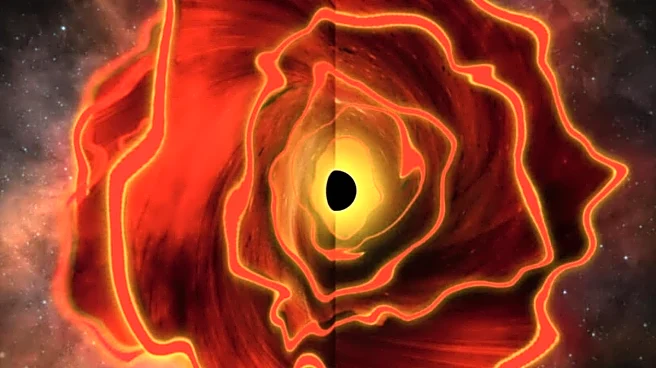
To explain these strange objects, theorists proposed an unusual idea. Imagine a rapidly growing black hole buried inside an extremely dense cocoon of gas. The black hole heats the surrounding gas so intensely that the entire envelope glows like a giant red-hot atmosphere. From a distance, the object can resemble a star even though the energy source is actually a feeding black hole.
Researchers have begun referring to such objects as black hole stars or BH stars.
MIT astronomers involved in the latest work say this would be a genuine hybrid: not a normal star powered by nuclear fusion, and not a standard exposed quasar. The surrounding gas would hide much of the black hole’s direct radiation while re-emitting the energy as infrared and optical light. MIT News described the new observations as evidence for a “brand-new type of astrophysical object,” although the interpretation still requires further confirmation.
What This Means For The Early Universe
Astronomers have discovered supermassive black holes weighing hundreds of millions or even billions of Suns at times when the universe was less than a billion years old. Growing such enormous objects so quickly is difficult under standard models.
A stellar black hole formed from a dying star starts relatively small. To reach billions of solar masses in a few hundred million years, it would need to grow at extraordinary rates.
The black hole star scenario offers a possible shortcut. Because the black hole is embedded in dense gas, it may be able to undergo super-Eddington accretion—growing faster than the rate usually thought sustainable for black holes. The recent observations were obtained as part of the Mirage or Miracle survey, which is specifically designed to test whether Webb is seeing genuinely new phenomena or whether the data can be explained by more familiar physics.
What Evidence Supports The Idea?
In June 2026, NASA announced that Webb had obtained the deepest spectrum yet of a little red dot called GLIMPSE-17775. The spectrum revealed more than 40 spectral lines, many of which are consistent with a black hole surrounded by a hot, dense gas envelope rather than an ordinary galaxy or star.
The newly discussed object, MoM-BH-1, shows similarly unusual red-light characteristics, which led researchers to model it as a black hole hidden inside dense gas. The Guardian reported that the object emits about 100 billion times more energy than known stars, placing it much closer to black-hole-powered systems in terms of luminosity.
Astronomers Not Convinced Yet
Despite the dramatic headlines, scientists are being careful.
Alternative explanations remain on the table. Some researchers argue that many little red dots may simply be compact galaxies whose bright central black holes outshine their outer stars. A recent Webb study identified a more evolved galaxy nicknamed Saguaro that may represent a later stage of the same population, suggesting that at least some LRDs could eventually grow into recognizable galaxies rather than remain exotic hybrid objects.
Other astronomers have also found hints that the gas around these objects may not completely enclose the black hole, meaning the geometry could be more complicated than the simplest black hole star picture.
The key question is whether black hole stars are rare oddities or a common phase in the birth of supermassive black holes.
Future Webb observations, along with X-ray data from NASA’s Chandra Observatory and eventually next-generation telescopes, will test whether these objects are truly dominated by hidden black holes, how long they live, and whether they can grow rapidly enough to produce the monster black holes seen in the early universe.
For now, the safest conclusion is that Webb has revealed that the first billion years of cosmic history were far stranger than scientists expected.
The little red dots have not yet given up their secret. But with each new spectrum, they are beginning to look less like a minor observational curiosity and more like a clue to how the universe built its first giants.

/images/ppid_59c68470-image-178643253724031622.webp)



/images/ppid_59c68470-image-178642757929221444.webp)