
/images/ppid_59c68470-image-178880002466629334.webp)


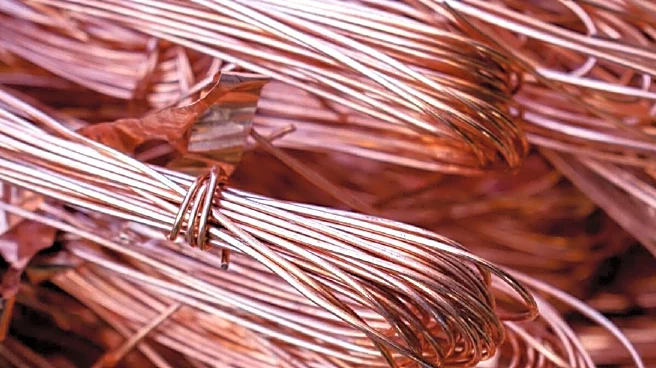
Copper prices have hit a fresh record high in global markets, crossing $14,530 per tonne, as tariff-related buying in the US combines with tightening supplies and strong long-term demand from artificial intelligence (AI), electrification and power infrastructure.
Benchmark three-month copper on the London Metal Exchange (LME) rose to an all-time high of $14,533 per tonne, surpassing the previous record of $14,527.50 set in January.
Analysts said the latest rally reflects a combination of short-term trade-policy concerns and bigger structural changes in the copper market.
One of the immediate triggers is growing concern over potential US tariffs on copper imports. The ongoing Section 232 investigation into copper imports has prompted manufacturers
and traders to bring forward purchases in anticipation of higher import costs.
Banking and market expert Ajay Bagga said the current rally was closely linked to expectations of US tariffs.
“This isn’t copper going up because the world needs more copper right now — it’s copper going up because everyone’s racing to buy it before Washington’s tariffs make it more expensive later,” Bagga said, according to news agency ANI.
Market expectations of a 15% tariff from January 2027, potentially rising to 30% by 2028, have encouraged US manufacturers to stock up on the metal.
This has also altered global trade flows, with large volumes of refined copper being redirected towards the US. Bagga said the US imported more than 225,000 metric tonnes of refined copper in July alone, contributing to tighter availability elsewhere.
Global copper supply is getting tighter
The tariff-driven buying is happening against a backdrop of already constrained copper supply. Kishore Narne, director and head of commodity at Motilal Oswal Financial Services, said the market was caught between persistent supply disruptions and strong structural demand.
“Copper is caught in a tug-of-war between persistent global supply disruptions and driven by mine supply shortfalls in South America and refinery concentrate bottlenecks,” Narne said.
Operational problems at major mines, declining ore grades and bottlenecks in copper concentrates are limiting the growth of mine and refined supply.
According to ANI, Ajay Kedia, director of Kedia Advisory, said the rally reflected tightening mine supply, declining ore grades, falling LME inventories, constrained concentrate availability and slow development of new projects.
New copper mines also take years to develop, making it difficult for supply to respond quickly when demand rises.
AI and data centres add to copper demand
Beyond tariffs and supply disruptions, analysts point to a longer-term demand story. The rapid expansion of AI data centres is increasing demand for electricity and power infrastructure. This, in turn, requires large quantities of copper for cables, transformers, transmission networks and electrical equipment.
Demand is also being supported by electric vehicles, renewable energy projects, power-grid expansion, industrial electrification, data centres and AI infrastructure, and defence investment.
Kedia said AI-led grid demand and accelerating electrification were reinforcing expectations of further fundamentally driven upside in copper.
Antu Eapen Thomas, senior research analyst at Geojit Investments, said tighter availability was supporting the rally as tariff expectations disrupted traditional global trade flows and reduced inventories across major markets.
Why isn’t copper rising as much in India?
Despite the record global price, the rise in domestic copper prices has been relatively contained. In India, MCX Copper is trading around Rs 1,387-1,388 per kg, according to Kedia, and has yet to decisively cross the Rs 1,400 level.
A key reason is the appreciation of the Indian rupee, which has partly offset the impact of higher international copper prices for Indian buyers.
Narne sees downside support for domestic copper around Rs 1,360-1,370 per kg, while a sustained move above Rs 1,400-1,410 per kg could require fresh industrial-demand catalysts or signals of monetary easing.
/images/ppid_59c68470-image-178884252695163853.webp)


/images/ppid_59c68470-image-178883256346566476.webp)
/images/ppid_59c68470-image-178880502582281018.webp)

/images/ppid_59c68470-image-178876005774744622.webp)
/images/ppid_59c68470-image-178875259343142113.webp)
/images/ppid_59c68470-image-178874758826397556.webp)