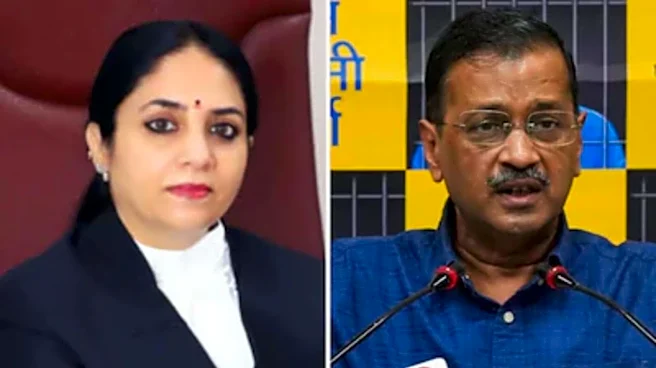


Delhi High Court judge justice Swarana Kanta Sharma on Monday affirmed that “recusal has to stem from law and can’t be based on narrative”, as she rejected the pleas moved by Aam Aadmi Party (AAP) chief Arvind Kejriwal and others.
The former chief minister virtually appeared before the judge through video-conferencing and urged her to take on record his rejoinder to the written submissions filed by the Central Bureau of Investigation (CBI). Justice Sharma said although the pronouncement was scheduled for 2:30 pm, she was “going out of her way” in accepting Kejriwal’s rejoinder as a written submission in the matter.
‘Agni pariksha…but writing without fear’: What Justice Sharma said
Delhi High Court judge justice Swarana Kanta Sharma’s top quotes:
- “As an officer of this court, I am conscious of the fact that a lie even if repeated thousand times in court or on social media does not become truth. It remains false. Truth doesn’t lose its force merely because a lie is repeated several times.”
- “Should I step away from this case? The question before me was whether I should remove myself from hearing this case. My honesty and dignity were questioned. The easiest way for me was to step away without any hearing. But I decided to hear the application because it was not just about me, but about the entire judiciary.”
- “If this court has been asked to undergo agni pariksha by an accused who is discharged not acquitted… the judge must question why the judge is being asked to undergo this agni pareeksha…A judicial function cannot be surrendered by a judge to the mere perception of a litigant.”
- “When I started writing this decision, the courtroom was silent. I felt the heavy responsibility of being a judge who has taken an oath to the Constitution of India. I realised that today my silence was being tested. Now, it was not just about one judge, but about the fairness of the whole system.”
- “I decided that, just like in my 34-year judicial career, I will give my decision without fear and without being influenced by these allegations.”
- “Writing this decision was difficult because there were contradictory statements during the hearing. On one hand, they said they had no doubt about the judge’s honesty, but still wanted the case transferred to another judge. They said, ‘We are not saying you are biased, but we are just afraid you might be’.”
- “The petitioner has put the entire judiciary on trial. So, instead of running away, I chose to resolve this issue. The real strength of the judiciary is to face allegations head-on and give a decision. I wrote this order without any pressure. Accepting the decision if it is in your favour, but complaining if it is not? When a court’s decision is in your favour, you quietly accept the judicial process. But when the same decision goes against you or in favour of the other side, you suddenly start questioning the process.”
- “Do cheezo hoti hai. Ek wo hai jo actual conflict of interest hai. Aur ek ye ki aap kisi cheez ko aese project kare ki ye to conflict of interest hai. Maine usse apne judgement me deal kiya hai.”
- “If the wife of a politician can become a politician, if the children of a politician can become politicians. How can it be said that the children of a judge can’t enter the profession of law? This would mean taking away the fundamental rights of a family of judges,” said the judge, adding that none of her children have been associated with the excise policy case. “In the absence of any proof that the office of the court has been misused by the children of a judge, not a whisper of such allegation can be made…A litigant cannot dictate how children or family members of a judge are to live their lives.”
- “In the opinion of this court, even if the relatives of this court are on the government panel, the litigant has to show the impact of that on the present case or the decision-making power of this court. No such nexus has been shown. The issue, however, needs to be adressed. Merely because a judge takes oath of officer, their family does not take an oath not to enter the profession.”
- “Allowing recusal will allow public to believe that judges are aligned to a particular ideology…If this court were to pen a recusal it would open the doors for powerful litigants to attack judges their families…A judicial function cannot be surrendered by a judge to the mere perception of a litigant… Recusal will carry deeper ramifications. Even a political leader howsoever powerful or influential cannot be permitted to weaken or damage institution by making insinuations against a judge without any material.”
- “Before I conclude, I must record that a courtroom cannot be a theatre of perception…Reputation of judge not an asset but an institutional asset.”
- “In case this recusal is allowed the judicial process would not remain independent but vulnerable to insinuations…This court will stand up for itself and the institution when such standing is required.”
- “Recusal has to stem from law and not from narrative.”
- “Because this allegation has only been made by Mr Kejriwal, so the response is only being given to him.”
The plea and rejoinder
On April 13, Kejriwal stated that Justice Sharma had attended Adhivakta
Parishad event linked to BJP, RSS, four times whereas the CBI, represented by Solicitor General Tushar Mehta, defended the judge’s participation, submitting even sitting Supreme Court and other High Court judges had attended the event organised by the “bar association”.
Why Arvind Kejriwal Wanted Justice Swarana Kanta Sharma Removed From Delhi Liquor Policy Case Explained
Even as Kejriwal asserted that the registry’s refusal to take his rejoinder on record was “miscarriage of justice”, Justice Sharma remarked that since he was not being represented by a lawyer, the court went “out of its way” for him when it allowed him to file his additional affidavit last week, even after the order on the recusal issue was reserved.
The judge said according to the registry’s rule, a party in-person must take permission from the court to file anything and since the present case is not “extraordinary”, the same practice is being followed. She added that in law, there is no concept of filing a “rejoinder” to the opposite party’s written submissions and she would allow Kejriwalto tender his pleadings as written submissions instead, so that he does not feel that he was not heard. “You say you have respect for me. I have respect for every litigant. The rule of court will not be changed for anyone, so I will treat it as written submissions. I am taking it on record. I am giving the indulgence to Mr Kejriwal,” the judge said.
Solicitor General Tushar Mehta appeared in the court for the CBI and opposed Kejriwal’s request to file a rejoinder. Mehta said nowhere in the country are pleadings taken on record after an order is reserved by a court. He also said there is no concept of filing a rejoinder to a written submission and the court should do what it would do for any ordinary litigant.
What Kejriwal said
In his latest filing, Kejriwal has said the CBI has not disputed that Justice Sharma’s children are on central government panels and receive work marked through the “solicitor general-led litigation structure”. Once these facts are admitted, the prosecution cannot be allowed to evade the legal consequences and all insinuations by the CBI against him are wholly irrelevant, the former Delhi chief minister has asserted.
Emphasising that the Aam Aadmi Party (AAP) leader has the highest regard for the Indian judiciary, the rejoinder has asserted that the federal agency has failed to justify the conflict-of-interest and apprehension-of-bias submissions in the case, and its narrative about “institutional integrity”, “anarchist practices”, “social-media campaign”, “browbeating” and “pressurising judges” is wholly irrelevant and scandalous.
“Instead of meeting the substance of the conflict-of-interest plea, the CBI has chosen to resort to speculation, imputation of motives, rhetorical alarmism and scandalous allegations against the applicant, all of which are extraneous to the limited issue that arises for consideration. It is very unfortunate that the CBI is willing to malign the entire judiciary in order to have this matter heard before only one Hon’ble judge,” Kejriwal has alleged.
He has raised several objections against the judge hearing the CBI’s plea against his discharge in the liquor-policy case, including that she had earlier denied him relief on his petition challenging his arrest and refused to grant relief on the bail pleas of other accused, including Manish Sisodia and K Kavitha.
Kejriwal has also claimed that Justice Sharma had made “strong and conclusive” findings. The former Delhi chief minister has further alleged a “direct conflict of interest”, claiming that the judge’s children are empanelled central government lawyers who receive work through the solicitor general, who is appearing in the court for the CBI.
Besides Kejriwal, the applications for the judge’s recusal have also been filed by AAP leaders Sisodia and Durgesh Pathak. Other respondents, including Vijay Nair and Arun Ramchandra Pillai, have also sought her recusal.
On February 27, the trial court discharged Kejriwal, Sisodia and others in the Delhi liquor-policy case, saying the CBI’s case was wholly unable to survive judicial scrutiny and stood discredited in its entirety.
With PTI inputs

/images/ppid_a911dc6a-image-177678283214138050.webp)