
/images/ppid_a911dc6a-image-177751343059230534.webp)


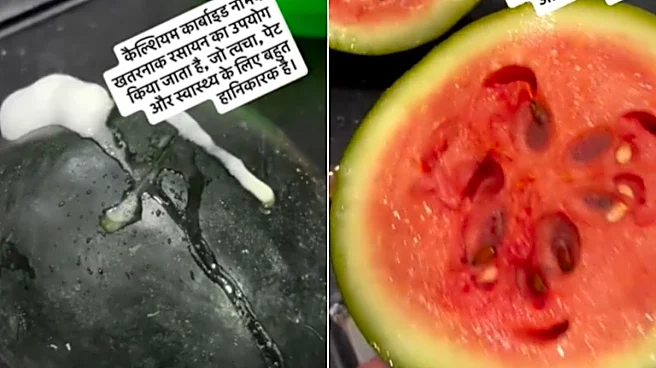
The tragic deaths of the Dokadia family in Mumbai’s Pydhonie area — four people gone after eating watermelon at 1 am — has rattled India in a way few food safety incidents have. And into that fear stepped Marathi actor Shashank Ketkar and a Congress leader, who posted a video showing bubbles fizzing out of a watermelon they had just bought from a Mumbai market.
The video went viral instantly, with thousands asking the same anxious question: is the watermelon I bought this summer safe to eat?
The answer is more nuanced than social media would have you believe — and understanding the science could save you from both a bad meal and unnecessary panic.
Foam is oozing out of the watermelon! It is clear that these are being ripened using chemicals for
the sake of profiteering.
This play with the public's health is happening right under the nose of the BJP government and the administration.
We don't even know if we are eating… pic.twitter.com/6b0pGCskIK
— Karbari Ansari (@karbari_ansari) April 29, 2026
What Are The Bubbles, Really?
The short answer: bubbles in a watermelon are almost always a sign of natural fermentation — not chemical injection. Here is what happens. When certain microorganisms enter a watermelon, they convert the fruit’s natural sugar into alcohol — the same process that happens in beer and wine making. The offshoot of this process is CO2 gas, which is what puts the bubbles in your beer. In a sealed watermelon, that gas has nowhere to go — so it builds up, producing bubbles, foam, and in extreme cases, an actual explosion when the fruit is cut.
High summer temperatures significantly contribute to this process. When bacteria combine with the natural sugars and yeast inside the melon, fermentation begins — and heat accelerates it dramatically. In India’s peak summer, with watermelons travelling long distances from farms to markets to homes without consistent refrigeration, this is far from rare.
Is Chemical Injection A Real Threat?
Claims of chemicals being injected into watermelons to make them appear redder or sweeter have circulated on social media for years. But food scientists and agricultural experts say there is no large-scale scientific evidence supporting this as a widespread practice. Most bubbly or foaming watermelons are simply rotting from the inside — naturally, and faster than you expect in summer heat.
How To Pick A Good Watermelon At The Market
• Look for a dark yellow field spot on the bottom — this is where the watermelon rested on the ground. Dark yellow means ripe. White or pale means underripe.
• Pick the heavier one between two similar-sized watermelons — more weight means more water and juice inside.
• Tap it lightly — a deep, hollow “dum dum” sound signals a ripe, juicy watermelon. A thin, sharp sound means it may be dry or underripe.
What To Check After Cutting
• Smell it first. Fresh watermelon smells sweet and clean. A sour, fermented, or foul odour is your clearest warning — trust your nose and throw it away.
• Check the texture. If the flesh looks sticky, unusually soft, foam-like, or watery, fermentation has already begun inside. Food safety experts are clear: a foaming watermelon is undergoing decay and should not be consumed.
• Bubbles or fizzing after cutting? Do not eat it. Once a watermelon has been pierced or sliced, it becomes the perfect opportunity for mold, yeast, and bacteria to accelerate on the food.
The Mumbai Connection — What We Still Don’t Know
Here is the important distinction: investigators have not confirmed that the watermelon eaten by the Dokadia family was naturally fermented or chemically adulterated. Forensic evidence — green organs, morphine in Abdullah Dokadia’s body — points away from simple food spoilage toward something far more deliberate. The watermelon in the Mumbai case may have been a vehicle, not the cause. The FSL report is still awaited.
Until then, the sensible approach is this: buy carefully, store in the refrigerator, smell before you eat, and if something looks or smells wrong — it almost certainly is



/images/ppid_a911dc6a-image-177770322575463690.webp)

/images/ppid_a911dc6a-image-177767103919987375.webp)
/images/ppid_a911dc6a-image-177762262820275787.webp)
/images/ppid_a911dc6a-image-177763913152169472.webp)

/images/ppid_a911dc6a-image-177766402894856614.webp)