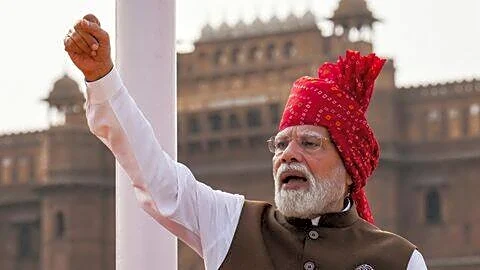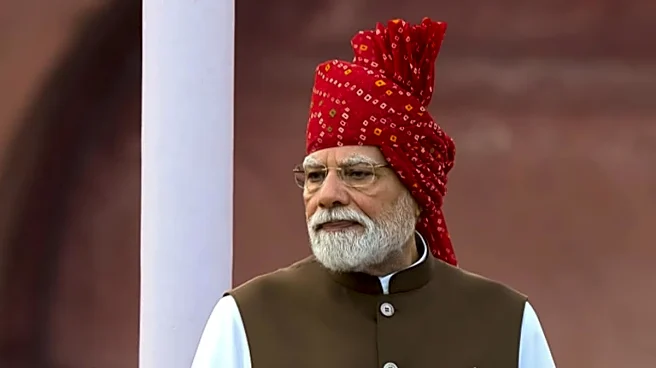

Prime Minister Narendra Modi, addressing the nation on India’s 80th Independence Day, unveiled what he called “Sapta Dhara” — seven streams of strength he wants the country to embrace. From manufacturing and soft power to global brands and banking, he set out a wish list for India to lead the world by 2047.
Speaking from the ramparts of the Red Fort, Modi tied the seven streams to the country’s youth power, saying their strength would be “brought into the process” of nation-building.
He devoted the most detailed portion of his remarks to the first stream — manufacturing — telling entrepreneurs and MSMEs that India must become a trusted hub of the global supply chain, “from design to manufacturing,” building not just large products but the components
and full value chain behind them.
What Did PM Modi Say About Manufacturing?
He called it “an opportunity of our time” for those working in the sector, urging them not to let it pass. His ask had three parts: Indian factories must meet global standards on cost, quality and scale; products must be user-friendly and competitively priced; and packaging must be “appealing and attractive to people around the world.”
He said zero-defect, precision manufacturing should become India’s identity, and that every manufacturer and MSME should build their reputation in global markets on reliability and quality.
What Are The Seven Streams Of Strength?
Modi listed manufacturing as the first of seven, with the remaining six spanning agriculture, technology, infrastructure, defence, the green and blue economy, and soft power.
| # | Stream | Focus |
|---|---|---|
|
1 |
Manufacturing Power | Making India a trusted global supply-chain hub, from components to complete products |
| 2 | Agriculture & Food Products | Expanding food processing; taking millets, spices, fruits and other Indian agri-products global |
| 3 | Technology & Innovation | Building India as a global hub for AI, quantum tech, space, robotics, data centres and next-gen communications |
| 4 | Gati Shakti (Connectivity & Infrastructure) | Seamless connectivity via high-speed rail, modern highways, airports, multimodal logistics and ports |
| 5 | Defence Power | Self-reliance in defence, next-generation defence technologies, and becoming a global defence supplier |
| 6 | Green & Blue Economy | Green hydrogen, renewable energy, storage, green mobility and manufacturing, plus fisheries, coastal tourism and ocean tech |
| 7 | India’s Soft Power | Leveraging yoga, Ayurveda, holistic healthcare, culture and India’s spiritual heritage to build global influence |
Why Is Manufacturing Getting Singled Out First?
Modi’s remarks suggest manufacturing is being positioned as the anchor stream — the one he spent the most time detailing, with concrete asks around cost, quality, scale, product design and packaging.
What Did PM Modi Say About India’s Soft Power?
He pointed to yoga as an example already working — calling it a source of “energy for the world” and a reason global trust in India is growing, alongside the country’s centres of faith, Ayurveda and holistic healthcare.
He then widened the lens to India’s creative economy: handicrafts, films, VFX, animation, gaming and digital content, which he said India must build into a “global capability.” He cited the WAVES Summit (World Audio Visual and Entertainment Summit) as a platform already carrying that message to the world.
Modi also flagged tourism as underused potential — India has over 100 national parks and vast forest resources, he said, but has “fallen short” in drawing foreign visitors.
He asked why India shouldn’t host major global sporting events, and pointed to the country’s fast-growing “concert economy” as a fresh opportunity, noting that international artists increasingly want to perform in India.
He was clear the seven streams aren’t meant to be pursued one sector at a time: progress, he said, has to be holistic and scaled to match the nation’s ambitions.
What Goals Did PM Modi Set For Indian Companies?
Modi pushed past sector strategy into specific, numbers-driven ambition for Indian business:
| Sector | Modi’s Ask |
|---|---|
|
Global rankings |
50 of the world’s Fortune 500 companies should be Indian within a decade |
| Banking | An Indian bank should rank among the world’s top five |
| Pharmaceuticals | An Indian pharma company should be among the world’s five largest |
| Professional services | Indian law firms, rating agencies, consulting and accounting firms should take on global leadership roles |
| Technology & brands | Indian tech companies should be world leaders; Indian brands should become a national identity that draws the world in |
What Did He Ask Of Governments And Reforms?
Modi directed part of his message at state governments and local self-government bodies as much as at the Centre, saying all three — plus industry — need to move together.
On reforms, he said India “cannot be governed by the policies and regulations of the past,” and that rules must be written for 2047’s ambitions, not the past’s constraints.
He was pointed about motive: reforms, he said, are being carried out “not out of compulsion, but out of conviction.”



![[WATCH] Indian team hoists tricolour and sings Jana Gana Mana in Galle on Independence Day](https://glance-mob.glance-cdn.com/public/cardpress/binge-magazine-card-generation/spaces/IN/en/crictracker-spaces/images/ppid_49c02804-image-178677507433586402.webp)

![[WATCH] Horrible mix-up leads to Yashasvi Jaiswal run out in Galle Test](https://glance-mob.glance-cdn.com/public/cardpress/binge-magazine-card-generation/spaces/IN/en/crictracker-spaces/images/ppid_49c02804-image-178677502113218019.webp)
/images/ppid_59c68470-image-178677506364476947.webp)