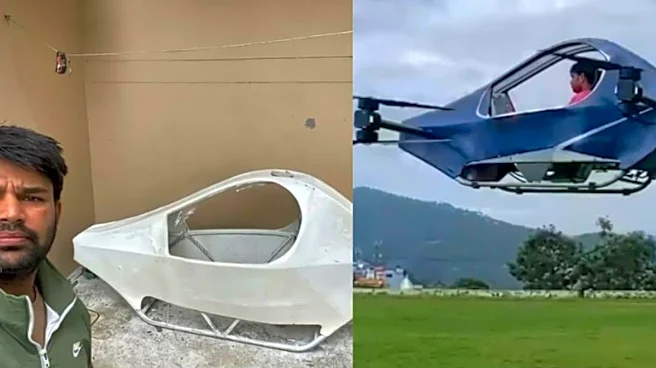



For Ravi Tamta, the idea of building a flying vehicle began with a simple problem he had seen while growing up in the hills of Uttarakhand. Difficult roads and long journeys to reach essential services, including hospitals, made him think about whether there could be a faster way to travel through mountainous terrain.
Thirteen years later, Tamta, a BA graduate from Almora district, has developed a prototype of an electric flying car. His single-seater vehicle, HAPIDA SKYNeX, completed a test flight in August, marking an important stage in his effort to develop personal air mobility technology.
Tamta does not have a formal qualification in science or engineering. Much of what he knows about the technology has come from online resources, self-study
and years of practical experimentation. His work reflects how people can explore complex technical ideas outside traditional educational routes.
However, the test flight does not mean the vehicle is ready for passengers or commercial use. More testing will be required to establish its reliability, stability and safety.
How HAPIDA SKYNeX Works
Tamta developed the prototype through his venture, Hapida Sky Private Limited. The vehicle has been designed for vertical take-off and landing, allowing it to operate without a conventional runway.
The single-seater aircraft uses several electric motors and propellers, with a design similar in principle to multirotor drones. It has a lightweight frame, a cockpit and a transparent canopy. The vehicle is powered by batteries and does not use aviation fuel or ethanol.
Tamta first became interested in developing a flying vehicle in 2015. He grew up in Kaflikhan, near Jageshwar Dham, where travelling through the mountainous region can be difficult. Long road journeys to reach hospitals and other essential services helped shape his interest in finding an alternative form of transport.
The August flight was an important test of that idea. But a working prototype is only an early stage in aircraft development. Further trials would be needed to examine flight stability, battery performance, motor operation, controls and safety systems.
Learning Engineering Without Formal Training
Tamta attended junior high school in his village and later completed a Bachelor of Arts degree at the Nainital campus. He did not study engineering or aviation formally.
Instead, he used online material to learn about the concepts involved and then tested what he learnt through practical experiments. His father, Harish Ram, is a mechanic, and his family also supported his work during the development process.
Over the years, Tamta gradually built up the technical knowledge required to turn his idea into a flying prototype.
But electric aircraft involve complex engineering challenges. Battery capacity, structural strength, motor performance, flight stability and emergency systems all need detailed testing. Online learning can help develop an idea, but human flight requires rigorous technical validation and safety checks.
Tamta’s Other Inventions
HAPIDA SKYNeX is one of several projects associated with Tamta. His earlier inventions reportedly include shoes that can charge mobile phones, a smart walking stick for people with visual impairments and a machine for splitting bamboo.
He has also developed a stick-based mobile charger and firefighting equipment, including a fire extinguisher for the Forest Department.
Tamta hopes his flying vehicle could eventually make short-distance travel across difficult terrain faster. He has also envisaged possible applications in remote areas and medical emergencies, where reaching healthcare facilities can take considerable time.
Such uses, however, would depend on the aircraft meeting all required technical, operational and safety standards.
What Happens Next?
Before HAPIDA SKYNeX could be used operationally, the prototype would need further testing and the necessary regulatory approvals. Depending on its eventual use and classification, this would include meeting applicable requirements of the Directorate General of Civil Aviation (DGCA).
Tamta’s journey shows how curiosity, persistence and self directed learning can take an idea beyond the classroom. At the same time, developing a prototype and proving that it is safe for regular use are two very different stages.
For now, HAPIDA SKYNeX has reached the test flight stage. Its future will depend on further development, technical testing, safety validation and regulatory clearance.