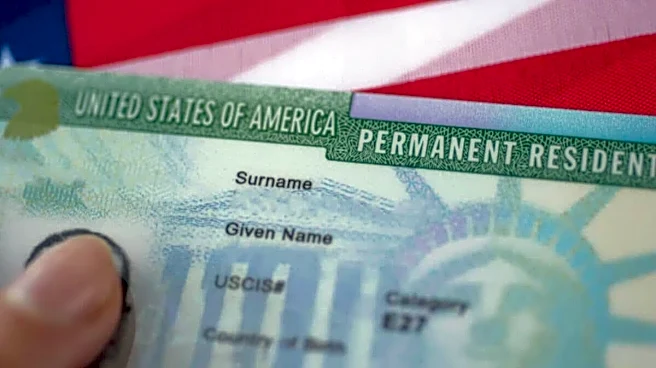




The US has brought a major change to the way it assesses whether certain Green Card applicants could become dependent on government assistance. A new US immigration rule has taken effect from September 18, 2026, changing how the government assesses the financial and personal circumstances of certain people applying for permanent residency.
At the heart of the change is the “public charge” test – a long-standing provision of US immigration law that allows authorities to determine whether someone seeking admission or adjustment of status is likely to become primarily dependent on government support.
The Department of Homeland Security has rescinded the Biden-era 2022 public-charge regulations, giving US Citizenship and Immigration Services (USCIS)
broader discretion to examine an applicant’s circumstances. The final rule was published in July and took effect on September 18.
A large number of Indian professionals in the US seek permanent residency through employment-based immigration, including after years on H-1B status.
However, using a government benefit does not automatically mean a Green Card application will be rejected. USCIS says officers will consider the overall circumstances of an applicant and make a case-by-case determination.
Here is what Indian applicants, particularly those moving from H-1B or other temporary statuses to permanent residency, need to know about the new public-charge rules.
1. New Rules Apply From September 18
The new framework applies to covered Form I-485, Application to Register Permanent Residence or Adjust Status, that are postmarked or electronically submitted on or after September 18, 2026.
Applications that were properly filed before September 18 and remain pending are treated under the earlier framework. The Federal Register specifically says receipt of means-tested public benefits before September 18 will be considered consistently with the 2022 rule.
USCIS has also said it will use a revised version of Form I-485. Older versions submitted on or after September 18 will not be accepted.
2. USCIS Will Look At Five Factors
The new framework does not introduce a single income threshold that automatically determines whether someone qualifies.
Instead, USCIS officers are required to consider five statutory factors: age, health, family status, assets, resources and financial status, education and skills.
These factors are considered together rather than in isolation. USCIS can also examine other relevant circumstances and evidence when making its determination.
For an Indian professional, for example, that means the assessment is not simply about how much he or she earns. Employment, savings, family circumstances, qualifications and other relevant facts may all form part of the overall picture.
3. Wider Range Of Govt Benefits Can Be Considered
Under the Biden-era 2022 framework, USCIS generally focused on certain public cash assistance for income maintenance and government-funded long-term institutionalisation. Under the new framework, USCIS can consider a broader range of means-tested public benefits received on or after September 18 as part of the overall public-charge assessment.
That can include categories such as cash assistance, housing assistance, food assistance and certain government-funded healthcare or financial assistance programmes, depending on the specific programme and circumstances.
The important distinction is that the existence of such a benefit in an applicant’s history is not, by itself, an automatic ground for denial.
4. What Happened Before September 18
Applicants should not assume that every government benefit they have ever received will suddenly be treated under the new framework. The Federal Register says benefits received before September 18, 2026 will be considered consistently with the 2022 regulations.
In practical terms, the broader treatment of previously excluded means-tested benefits begins with the new effective date. That makes the dates of benefit receipt and the date of filing particularly important for anyone who is already in the Green Card process.
5. Indian H-1B Workers Should Pay Attention
The change is particularly relevant to Indian technology professionals and other skilled workers who are transitioning from temporary US immigration status to permanent residency.
Employment-based categories that can be subject to the public-charge ground include EB-1 priority workers, EB-2 professionals with advanced degrees or people of exceptional ability, EB-3 skilled workers and professionals, certain other workers, investors and certain religious workers, among others.
However, being an Indian citizen or being on an H-1B visa does not itself determine whether someone will be found to be a public charge. The applicant’s particular Green Card category and individual circumstances matter.
6. Family-Based Green Card Applicants
The new framework is not limited to employment-based immigration. Many family-sponsored immigrants seeking adjustment of status can also fall under the public-charge provision, including certain spouses, parents and children of US citizens and other family-preference categories.
That means Indian families applying for permanent residency through a US citizen or permanent-resident family member also need to understand whether their particular category is covered.
7. Several Categories Remain Exempt
The public-charge ground does not apply to everyone seeking permanent residency. US law exempts a number of humanitarian and special categories. These include, among others, refugees, asylees, certain Special Immigrant Juveniles, certain victims of trafficking or qualifying criminal activity, VAWA self-petitioners and certain applicants with Temporary Protected Status. Certain special immigrant categories are also covered by statutory exemptions.
Therefore, the question “Will this new rule affect me?” cannot be answered simply by looking at whether someone has received government assistance. Their immigration category must be considered first.
8. No Simple “Salary Cutoff”
One of the most important things applicants should not misunderstand is that the new system does not establish a simple salary number below which a person automatically fails the Green Card test. USCIS will consider assets, resources and financial status alongside the other statutory factors.
An applicant’s education and skills can also be relevant because they may affect their ability to obtain employment and support themselves. The assessment is intended to look at the totality of the circumstances, rather than turn one number on a payslip into an automatic yes-or-no decision.
9. Affidavit Of Support
Where applicable, USCIS can consider the Form I-864, Affidavit of Support. The form is intended to provide a financial commitment from a sponsor in cases where one is required. It does not, however, mean that every other aspect of the applicant’s circumstances becomes irrelevant.
The new guidance allows USCIS to consider the affidavit along with the broader evidence when making its public-charge determination.
10. Public-Charge Bond
There is also a mechanism for a public-charge bond. If USCIS determines that an applicant is inadmissible solely because the person is likely to become a public charge, the agency may invite the applicant to post a bond.
Applicants cannot simply choose to file one on their own. USCIS says a person can submit Form I-945, Public Charge Bond, only after receiving an invitation from the agency through a Notice of Intent to Deny. The amount can take into account the government assistance the applicant may potentially receive over the following five years.
What This Means For Indian Green Card Applicants
The practical takeaway is that the September 18 change makes the overall financial and personal circumstances of covered applicants more significant.
For an Indian professional who has a stable job, relevant qualifications and financial resources, the assessment will involve those circumstances along with any relevant history of public benefits. For someone whose situation is more financially complex, the broader review could involve considerably more factors than under the previous framework.
There is also a legal challenge to the new rule. Several US states, cities and counties have sued to block it, arguing that the policy could discourage immigrant families from using benefits for which they are legally eligible. The Trump administration, meanwhile, has defended the rule as a measure intended to promote self-sufficiency and reduce dependence on public assistance.
For now, however, the September 18 framework is in effect.
For anyone preparing an I-485 application, the key questions are therefore which immigration category they fall under, when their application is filed, what benefits — if any — they or their household have received, and what the full picture of their financial and personal circumstances looks like.
The new rules make those details more important, but they do not turn receipt of a single government benefit into an automatic Green Card rejection. The determination remains a case-by-case assessment under the public-charge framework.
/images/ppid_59c68470-image-178975255977624360.webp)

/images/ppid_59c68470-image-178975002699010093.webp)