
/images/ppid_a911dc6a-image-177105952513238219.webp)
/images/ppid_a911dc6a-image-177105952399574919.webp)
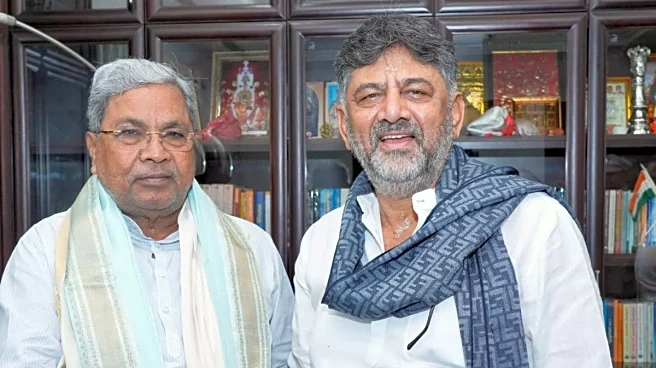
The Siddaramaiah-led Congress government has sparked a heated debate regarding fiscal responsibility after significantly expanding the number of individuals holding ministerial status in Karnataka. In a recent move that has drawn sharp criticism from the opposition and fiscal watchdogs, the administration granted the status of Minister of State (MoS) to 54 additional individuals. CNN-News18 has exclusively accessed the documents giving MoS rank to Congress workers. This latest round of appointments brings the total number of people enjoying either Cabinet or MoS rank in the state to a staggering 149, raising serious concerns about the burgeoning burden on the public exchequer.
The vast majority of these new designees are Congress party leaders
and workers currently serving as heads of various state-run boards and corporations. While the constitutional limit restricts the actual Cabinet to 34 ministers, the government has bypassed these constraints by according “ministerial status” to a wide array of functionaries. A detailed breakdown reveals that beyond the 32 constitutional ministers, Cabinet rank has been bestowed upon 43 MLAs and 9 non-MLAs, including various advisors and special representatives. Furthermore, 11 MLAs and 54 non-MLAs have been elevated to the rank of Minister of State.
The financial implications of these appointments are substantial, as those with ministerial status are entitled to an extensive suite of perks and allowances. Each appointee receives a monthly salary of Rs 50,000, supplemented by a hospitality allowance of Rs 3,000 and a monthly house rent allowance of Rs 80,000. Maintenance and staff allowances add another Rs 20,000 per month. Additionally, the government provides for 1,000 litres of fuel per month — valued at approximately Rs 1,00,000 at current market rates — alongside daily travel allowances ranging from Rs 2,000 to Rs 2,500.
The perks extend into the administrative realm, with each rank-holder entitled to a personal secretary, multiple personal assistants, drivers, and attenders.
Furthermore, the state covers full medical expense reimbursements and ensures these individuals receive protocol honors equivalent to state ministers at official government functions. Critics argue that at a time when the state is navigating significant financial commitments for its guarantee schemes, the generous distribution of such high-ranking statuses to nearly 150 individuals represents an unnecessary and avoidable drain on taxpayer money.