

/images/ppid_a911dc6a-image-177788803932243182.webp)
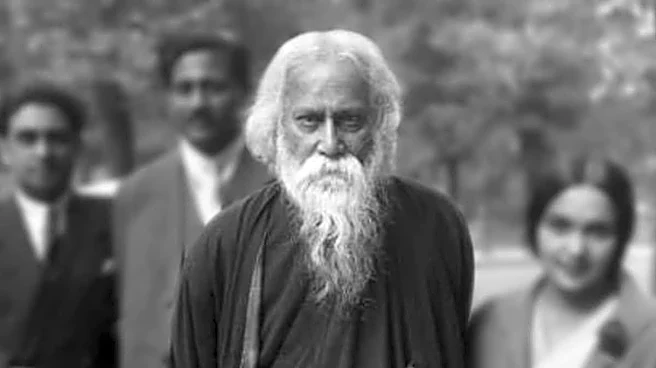
Rabindranath Tagore Jayanti 2026: Rabindranath Tagore, one of India’s most celebrated literary and cultural icons, is honoured across the country and beyond. Interestingly, his birth anniversary is observed twice each year, reflecting the coexistence of the globally recognized Gregorian calendar and the traditional Bengali calendar. This dual observance highlights both a nationwide tribute to the Nobel laureate and a deep regional cultural connection in eastern India and Bangladesh.
Rabindranath Tagore Jayanti 2026: Why Are There Two Dates?
The internationally recognized birth date of Rabindranath Tagore is May 7, 1861, which is observed throughout most of India and by the global community.
However, in West Bengal, Tripura, and Bangladesh, the celebration follows the Bengali calendar. Tagore was born
on the 25th day of Boishakh, popularly called Pochishe Boishakh.
Since the Bengali calendar is lunisolar, this date shifts every year in the Gregorian calendar, usually falling on May 8 or May 9.
Rabindranath Tagore Jayanti 2026 Dates In 2026
In 2026, Rabindranath Tagore’s 165th birth anniversary will be observed on:
- May 7 (Gregorian calendar) – across India
- May 9 (25th Boishakh) – in West Bengal and Bangladesh
Tagore Jayanti 2026: Cultural And Regional Significance
While the May 7 observance is widely followed nationwide, the Bengali calendar date carries deeper cultural significance in eastern regions.
Schools, cultural institutions, and communities host programmes featuring Rabindra Sangeet, poetry recitations, dance dramas, and theatrical performances inspired by Tagore’s works.
These events celebrate his enduring contributions to literature, music, education, and philosophy, keeping his legacy alive for new generations.
Rabindranath Tagore: The Nobel Laureate
Born on May 7, 1861, in Kolkata’s Jorasanko Thakurbari, Tagore was the son of Sarada Devi and Debendranath Tagore. A literary prodigy, he began writing at a young age and eventually became one of India’s greatest cultural figures.
In 1913, he became the first non-European to win the Nobel Prize in Literature for his celebrated work Gitanjali. Known as the “Bard of Bengal,” Tagore also penned India’s national anthem, Jana Gana Mana, and Bangladesh’s Amar Sonar Bangla. Beyond literature, he contributed to education, art, and philosophy, leaving an indelible mark on Indian culture.
Rabindranath Tagore Jayanti 2026: Legacy And Celebrations
Tagore’s birth anniversary is marked by vibrant celebrations, especially in West Bengal. Cultural programmes, artistic performances, and public events showcase his contributions, ensuring that his influence continues to inspire.
From music and poetry to dance and theatre, Tagore’s life and works are celebrated in ways that reflect both his timeless creativity and the region’s rich cultural heritage.
Rabindranath Tagore Jayanti 2026: Lesser-Known Facts
- He was the first non-European Nobel laureate in Literature (1913).
- Tagore authored the national anthems of India and Bangladesh.
- His work is believed to have influenced Sri Lanka’s national anthem.
- He gave Mahatma Gandhi the title “Mahatma.”
- Tagore had intellectual exchanges with Albert Einstein.
- He founded Visva-Bharati University to promote holistic education beyond rigid systems.
- Tagore began painting at the age of 60, gaining recognition for his artwork.
Rabindranath Tagore Jayanti is more than just a celebration of a birth, it is a tribute to a man whose ideas, creativity, and philosophy continue to resonate worldwide.
Whether observed on May 7 or Pochishe Boishakh, the day is a reminder of Tagore’s enduring legacy as a literary genius, visionary educator, and cultural luminary.


/images/ppid_59c68470-image-177798253276968475.webp)








/images/ppid_a911dc6a-image-177805163266784922.webp)

/images/ppid_a911dc6a-image-177799707499141300.webp)