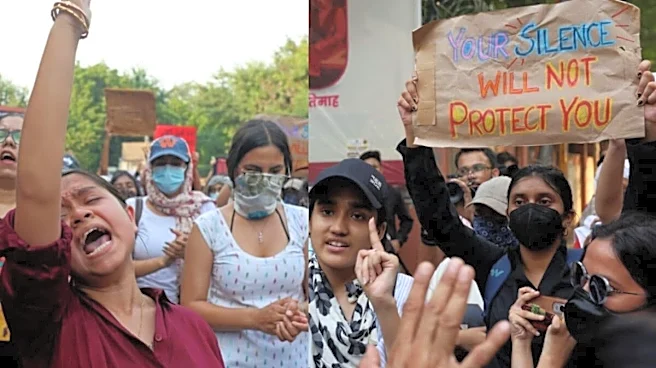



The issue of women’s safety in India is once again in the spotlight after a 17-year-old girl was allegedly gang-raped in a park in the national capital on her birthday, triggering widespread outrage. Women took to the streets, demanding justice, greater safety and the freedom to live without fear.
But crimes against women extend far beyond sexual violence. NCRB data shows that India recorded 4,41,534 cases of crimes against women in 2024, with cruelty by husbands or relatives accounting for the largest share, followed by kidnapping and abduction and other offences.
What NCRB Data Says About Crime against Women?
The latest NCRB data shows that crimes against women in India go beyond sexual violence. In 2024 India recorded, 4,41,534 cases of crimes against women,
with cruelty by husbands or relatives accounting for the largest share. Kidnapping and abduction of women and girls also formed a significant proportion of the cases.
What NCRB Data Says About Crimes Against Women in 2024
India recorded 4,41,534 cases of crimes against women in 2024. Cruelty by husbands or relatives was the largest category, followed by kidnapping and abduction and assault with intent to outrage modesty.
| Crime Category | Cases in 2024 | Share of Total |
|---|---|---|
| Cruelty by husband or relatives | 1,20,227 | 27.2% |
| Kidnapping & abduction of women | 67,829 | 15.4% |
| Assault with intent to outrage modesty | 48,303 | 10.9% |
| Rape | 29,536 | 6.7% |
| Sexual harassment | 15,346 | 3.5% |
| Stalking | 9,865 | 2.2% |
| Assault/criminal force with intent to disrobe | 8,409 | 1.9% |
| Dowry deaths | 5,737 | 1.3% |
| Voyeurism | 1,722 | 0.4% |
Source: National Crime Records Bureau (NCRB), Crime in India 2024.
Crime Against Women: What Has Changed Over The Years?
NCRB data shows that India recorded 4,41,534 cases of crimes against women in 2024, down from 4,48,211 cases in 2023. In 2022, the figure stood at 4,45,256 cases. The crime rate also declined from 66.2 cases per lakh women in 2023 to 64.6 in 2024.
However, the decline in registered cases does not by itself establish that the underlying incidence of crime has fallen, as NCRB figures reflect cases reported and registered by police. The data also shows that crimes against women remain a significant issue, with cruelty by husbands or relatives continuing to account for the largest share of registered cases in 2024.
Crime Against Women: NCRB Data Comparison
NCRB data shows that registered crimes against women rose slightly in 2023 before declining in 2024. The crime rate also fell from 66.2 cases per lakh women in 2023 to 64.6 in 2024.
| Year | Total Crimes Against Women | Crime Rate (Per Lakh Women) |
Year-on-Year Change |
|---|---|---|---|
| 2022 | 4,45,256 | 66.4 | — |
| 2023 | 4,48,211 | 66.2 | +0.7% |
| 2024 | 4,41,534 | 64.6 | -1.5% |
Source: National Crime Records Bureau (NCRB), Crime in India reports.
The crime rate is calculated per lakh of female population.
What Does Indian Law Say About Crimes Against Women?
India has a range of laws dealing with different forms of violence and discrimination against women. Since July 1, 2024, the Bharatiya Nyaya Sanhita (BNS), 2023, has replaced the Indian Penal Code as the principal criminal law. It contains provisions covering rape, sexual harassment, assault, stalking, voyeurism, dowry death and cruelty by a husband or his relatives.
Under Section 63 of the BNS, rape includes specified sexual acts carried out against a woman’s will or without her consent, among other circumstances. Section 64 provides a punishment of at least 10 years’ imprisonment, which can extend to life imprisonment, along with a fine, for rape in cases covered by the provision.
The BNS also specifically criminalises sexual harassment (Section 75), disrobing a woman (Section 76), voyeurism (Section 77) and stalking (Section 78). Cruelty by a husband or his relatives is covered under Sections 85 and 86, while dowry death is addressed under Section 80.
Other important protections include the Protection of Women from Domestic Violence Act, 2005, the Dowry Prohibition Act, 1961, and the Sexual Harassment of Women at Workplace (Prevention, Prohibition and Redressal) Act, 2013. For children, including girls below 18, sexual offences are separately covered by the POCSO Act, 2012.
What Is The Government Doing To Improve Women’s Safety?
The Centre has said that women’s safety remains a priority and has highlighted several measures aimed at prevention, emergency response and support for survivors. In a March 2026 Lok Sabha reply, the government said 15,049 Women Help Desks had been set up in police stations across the country, of which 14,363 were headed by women police officers. The government also said the 112 emergency response system is operational across all 36 States and Union Territories.
Under Mission Shakti, the government is also running One Stop Centres, which provide medical assistance, legal aid, police facilitation, counselling and temporary shelter to women facing violence or distress. As of December 31, 2025, 914 One Stop Centres were operational and had assisted more than 13.37 lakh women, according to the government.
The government has also pointed to changes under the Bharatiya Nyaya Sanhita (BNS). In an August 2026 statement, the Ministry of Home Affairs said offences against women and children have been placed together in a dedicated chapter, while provisions include stricter punishment for certain offences, audio-video recording of rape survivors’ statements and free first-aid or medical treatment for victims at hospitals.








/images/ppid_59c68470-image-179076255170477733.webp)