
/images/ppid_59c68470-image-177079510328112739.webp)
/images/ppid_59c68470-image-177079513716366204.webp)
/images/ppid_59c68470-image-177079503543735857.webp)
Recent remarks by Congress leader Rahul Gandhi, made during a visit to a German automotive manufacturing facility, have once again placed India’s manufacturing sector at the centre of political controversy. By suggesting that Indian manufacturing is “declining”, particularly while standing within one of Europe’s most advanced industrial ecosystems, the comments warrant closer examination, not as a matter of partisan disagreement, but as a matter of factual accuracy. Statements about a country’s economic capacity, when made on foreign soil, carry consequences beyond domestic politics. They influence investor sentiment, shape international perceptions, and affect how India’s growth trajectory is understood globally. It is therefore essential to assess
whether the claim of manufacturing decline aligns with available evidence.
The data suggest it does not.
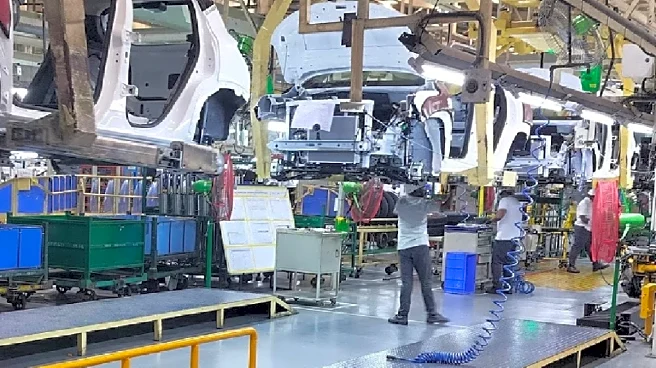
One of the clearest indicators comes from the automotive sector, which has long been regarded as a bellwether for manufacturing health. According to the Society of Indian Automobile Manufacturers (SIAM), India exported over 5 million vehicles in FY2023–24, marking a sharp increase from previous years and a year-on-year growth rate of roughly 20 per cent. Passenger vehicles, two-wheelers, and commercial vehicles have all contributed to this expansion, positioning India among the world’s largest automobile exporters (SIAM, Export Data, 2024).
Complementing this is the strong performance of the auto-components industry. Data from the Ministry of Commerce and Industry show that India’s auto-component exports crossed $21 billion in FY2023, with major destinations including the United States, the European Union, and Germany. These exports increasingly consist of precision-engineered components meeting stringent global quality, safety, and environmental standards—an indication of rising technological sophistication rather than industrial decline (Ministry of Commerce & Industry, Export Statistics).
The India Brand Equity Foundation (IBEF) further notes that India is emerging as a key hub for global automotive supply chains, supported by cost competitiveness, a growing skilled workforce, and expanding domestic demand. According to IBEF, the Indian automobile industry is projected to become the third-largest globally by 2030, with manufacturing output expected to grow steadily across both domestic and export markets. If Indian manufacturing were genuinely in decline, such sustained export growth and deepening integration into advanced global value chains would be difficult to explain.
Understanding India’s manufacturing trajectory, however, requires historical context. For decades after economic liberalisation, Indian policymakers explicitly framed services, not manufacturing, as India’s comparative advantage. Policy thrusts favoured information technology, finance, and business services, while large-scale industrialisation received comparatively less strategic focus. This services-led growth model delivered rapid GDP expansion but delayed the creation of dense manufacturing ecosystems.
As a result, India entered the era of globalised production with a relatively shallow industrial base compared to East Asian economies. Reversing that structural imbalance is not instantaneous. Manufacturing competitiveness depends on cumulative investments in logistics, power, skills, supplier networks, industrial land, and export infrastructure—processes that unfold over decades rather than electoral cycles.
India’s democratic political economy further shapes this path. Unlike China, where manufacturing capacity was rapidly built through top-down decisions with limited scope for public resistance, India’s industrial expansion operates within a pluralistic, federal democratic framework. Land acquisition, environmental clearances, labour regulation, and political negotiation occur across multiple levels of government. Judicial review, public protest, and electoral accountability are integral features of this system. These constraints slow industrial rollout, but they also ensure social and legal legitimacy. Comparing India’s manufacturing outcomes directly with China’s without accounting for these political and institutional differences oversimplifies reality and distorts analysis.
At the heart of the “manufacturing decline” narrative lies a conceptual error: conflating relative underperformance with absolute contraction. India’s manufacturing sector unquestionably faces challenges—high logistics costs, skill mismatches, regulatory complexity, and uneven infrastructure. But none of these indicators point to decline.
On the contrary, official data show steady expansion. Manufacturing exports are rising as a share of total exports, industrial output is diversifying beyond traditional segments, and Indian firms are moving up global value chains. According to the Ministry of Commerce, manufacturing-led exports have consistently grown in recent years, supported by sectors such as automobiles, electronics, engineering goods, and pharmaceuticals.
Political critique is an essential feature of democratic debate, and opposition leaders are well within their rights to question government policy. However, critique gains credibility only when grounded in evidence. This responsibility is heightened when claims are made in international settings, where they influence foreign investors, trade partners, and strategic interlocutors.
To characterise India’s manufacturing sector as declining—while overlooking export data from SIAM, trade statistics from the Ministry of Commerce, and sectoral analysis from IBEF—risks substituting rhetoric for analysis. It also undervalues the efforts of millions of Indian workers, engineers, and entrepreneurs building industrial capacity under complex democratic conditions.
India’s manufacturing story is not one of dramatic collapse or instant transformation. It is a story of late but steady industrialisation, shaped by historical policy choices, democratic constraints and incremental reform. Progress may be uneven and slower than authoritarian models, but the direction is unmistakably upward.
Mousumi Roy writes on politics, material culture, and economic history. Views expressed are personal and solely those of the author. They do not necessarily reflect News18’s views.