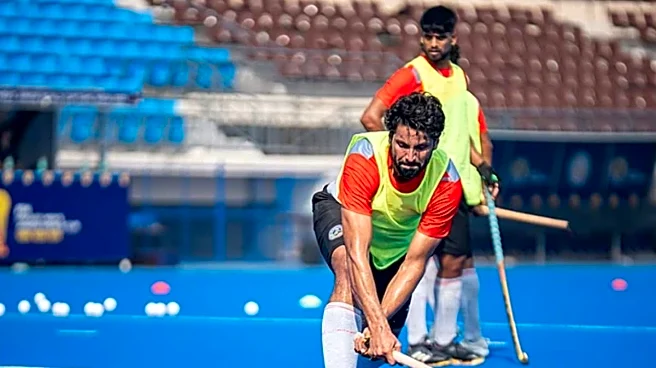

After a disappointing campaign in the 2024–25 Hockey India League, the SG Pipers men’s team moved aggressively at the auction to strengthen their team for the ongoing season. Their biggest signing was
Tokyo Olympics bronze medallist Rupinder Pal Singh, who joins the team after leading the Rarh Bengal Tigers to the title last year.
Ahead of the new season, Rupinder spoke to News18 Sports about his plans with his new team, his assessment of Jarmanpreet Singh’s captaincy and how he hopes to use his vast experience to help the Pipers turn their fortunes around.
Excerpts:
You were part of the Bengal Tigers last season, who went on to become the champions. This year, you are in a new setup. How similar or how different are the two teams?
First and foremost, our main job is to play and that remains unchanged. On the field, not much really changes; strategies evolve, players change and the environment is different, but the core responsibility stays the same. The faces around you may be new, including the coaching staff and that takes time to adjust to.
What stands out the most for me is how professional the SG Pipers’ management has been. The way everything is organised reflects a very professional approach and that has been the biggest change. On the field, however, our role is clear: to play our game, while the strategies and game plans are shaped by the coaches and the players together.
You previously captained the Bengal Tigers and here, Jarmanpreet Singh leads the men’s team. As a senior player with extensive experience, how do you assess his captaincy and his role as skipper?
Jarmanpreet is still growing and bringing him into the leadership group has been a positive step. The more he develops in that role, the better it will be for his own game. In India, there is often a tendency to believe that only the skipper carries responsibility on the field, but I disagree with that.
Every player has a role to play and must take responsibility, make decisions and show leadership in different moments of the game. For Jarman, being entrusted with captaincy is a good thing. The Hockey India League is a great platform where you can learn a lot by playing alongside foreign players and working under overseas coaches. It permits your character to come through, not just as a senior player, but as a leader.
It challenges you to think about how you lead the team on the field and how you support your teammates off it. I feel this experience will really help Jarman grow into his role as a skipper and a leader.
You mentioned that the coaching setup here is different from your previous team. As a senior player, have you had discussions with your current coach, Tim Oudenaller, about how you want to approach and shape the season going forward?
Of course. We all know that the Hockey India League brings together overseas players, Indian players, juniors and seniors. The overseas players come from different nations and there are natural differences between senior and junior players as well.
In my conversations with the coaching staff, I emphasised the need to remove all these barriers. Everyone should be on the same platform. At the end of the day, no one should feel, “I am a junior,” or “I am an overseas player,” or “I am an Indian player.” Sometimes, players can feel hesitant around overseas teammates, thinking they are superior, but that isn’t the case.
On the field, it is always a collective effort. The stronger the relationships are off the field, the better the understanding will be on it. Open communication helps solve problems quickly. Hockey is a team game and if even one or two players feel insecure or unable to perform, it affects the whole group.
That discomfort can come from many things, communication, language or unfamiliarity. It is the responsibility of the team to make every player feel comfortable, included and confident, so that everyone can contribute to the best of their ability.
You have played in multiple overseas tournaments. How do you look to apply those experiences and learnings in the Hockey India League, as you have over the past year? What are some of the key takeaways you are hoping to bring into the team this season as well?
For me, the most important thing is to enjoy hockey. Nothing else matters more than that. The happier you are on the field, the more you enjoy playing, the better your performance will be. Sometimes, we get so caught up in results and expectations that we forget why we began playing in the first place.
There is pressure everywhere, you feel you have to do this or that, but it is important to pause, take a deep breath and enjoy the game you have played for so many years. Right now, my focus is very simple: whenever I step onto the field, I want to enjoy myself.
When I first began playing hockey, it was never about choosing to go out and play; it was just part of life. Now, this is the time to appreciate and enjoy hockey as much as possible. Keep smiling, keep laughing and play with freedom. Results will come and go, sometimes you win, sometimes you lose, but when you enjoy the game, performances follow. That is how you make the most of it.
The SG Pipers struggled last season. When you joined the team this year, what was the first and most important message you shared with the players?
With the players, I felt that the younger ones were seeing me only as a senior. They were a bit hesitant and shy in conversations. So the first thing I told them was that if they had any problems, whether with me or anything else, they should feel free to talk to me.
For me, it does not matter whether someone is a senior or a junior. There are moments when you need to push the juniors and be demanding, but there are also times when you need to give them space and reassurance. My first focus was to build that comfort, to let them know that I am someone they can talk to.
I try to treat them like a brother. On the field, effort is non-negotiable; you have to give everything. But effort does not always guarantee success and when things don’t go well, it’s important to talk about why. Above all, I wanted to break that awkward barrier.
I did not want them to see me as some distant senior or feel uncomfortable around me; I just wanted us to be ourselves and grow together as a team.
You worked with the Indian junior team during the World Cup, where they went on to win the bronze medal. How was that experience for you? As a senior player and a coach, how do you assess their overall performance?
I was with the junior team for about a week to ten days, working on penalty corners and drag-flicking. Even in that short time, it was clear that they have a very strong talent pool. There are at least six or seven players who are capable drag-flickers and it isn’t about identifying just one specialist.
The idea is that the harder you work on specialised skills, the more you grow in that area. The results at the World Cup reflected that work. In the later games, we scored multiple goals from penalty corners, which is a very positive sign. It shows that the system is working and that the players are developing confidence in those moments.
What is important now is continuity. These kinds of camps need to continue because they reinforce the basics. Over time, players tend to move away from fundamentals and revisiting them is crucial. That is why such focused camps are necessary. If you look at the group, there are six or seven defenders who can drag-flick. With continued work like this and with people like Sreejesh doing an excellent job with the team, the junior system will only get stronger.
If this process continues, the senior team will benefit from it in the long run.
You mentioned Sreejesh, which leads to my next question. You have played alongside him for many years in the Indian senior team and also worked with him in the junior setup during that coaching stint. Now, at SG Pipers, he is part of the setup in a mentor role.
How do you think the long-standing chemistry and bond between the two of you can influence the team and help SG Pipers deliver a stronger performance this season?
Of course, Sreejesh’s experience is immense and if everyone in the team can learn from him, it will be valuable. In particular, his presence is a huge boost for our goalkeepers. He has seen every situation possible, he knows what to do, when to do it and how to handle pressure at the highest level.
For that department, this setup is a big advantage. We have an Argentine goalkeeper (Tomas Santiago) in the squad and alongside that, Sreejesh’s mentorship creates a strong learning environment for the younger players. His guidance is important for them.
On the field, whenever a player is under pressure, struggling with form, or facing a tough situation, Sreejesh has already been through it. He understands how to manage yourself in those moments and how to bring out your best performance. That is where his role as a mentor becomes so significant.
Sreejesh knows how to support young players, understand what they are feeling and keep them strong. Having someone like him with the team is a huge asset.