
There are television finales that merely switch off the lights, and then there are finales that feel like the extinguishing of a small cosmic force, a constellation fading from the cultural sky. Stranger
Things Season 5 belongs to the latter. It arrives not as another installment of genre entertainment but as the last tremor of a story that has grown up alongside its audience, shedding innocence, gathering shadows, and finally admitting the truth that all coming-of-age tales must one day face: the world does not remain unchanged simply because we loved it when we were young.
When the show debuted in 2016, it felt like someone had cracked open a forgotten VHS tape and found buried inside a geography of memories, creaking bicycles, blood-red sunsets behind pine trees, friendships tethered by walkie-talkies, and a quiet dread lingering behind every suburban curtain. But nostalgia was always the disguise. Beneath the synths and Spielbergian glow hid something more delicate: a story about children who learned too early that the world is not safe, and about adults who learned too late that childhood cannot be retrieved.
Season 5 enters as both requiem and revelation. Delayed by strikes and global uncertainties, shaped by the aging of its young cast and the pressures of sustaining a phenomenon, this final chapter feels like a series taking inventory of its own mythology, asking what must be carried forward and what must finally be let go. It is a season preoccupied with endings: the end of Hawkins as we’ve known it, the end of Vecna’s long shadow, the end of childhood as a place to which one might ever return. And yet, paradoxically, it is also about endurance, how memories persist even as worlds collapse.
In the fabric of contemporary pop culture, very few finales are asked to be epilogues to an era. Stranger Things Season 5 shoulders that task with the weary grace of a story that has outlasted its innocence but not its heart.
Synopsis
Season 5 unfolds in autumn 1987, but Hawkins no longer resembles the town we once recognised. It has become a place suspended between dimensions, a liminal borderland where reality has been scraped thin and grief lies in the air like ash. What the official reports call an “earthquake” has instead split the town like a wound, leaving the scent of the Upside Down embedded in its soil. Barriers rise. Sirens wail. Soldiers walk with a stiffness that refuses to admit fear. The citizens live in the uncanny space between denial and dread.
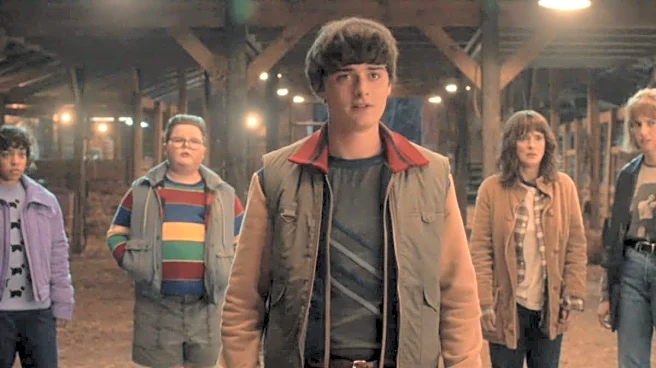
Into this fractured landscape returns the original constellation: Eleven, Hopper, Joyce, Will, Mike, Dustin, Lucas, Nancy, Steve, Robin, Jonathan, each older, bent by experience, yet pulled inevitably toward one another like planets drawn back into orbit. Eleven, hidden away under Hopper’s watch, confronts a power that no longer responds to her with the childlike reliability she once took for granted. Will’s visions, once vague flickers, have sharpened into painful clarity; the Upside Down is no longer whispering to him, it is pressing in like a memory he cannot unlive. His psychic tether to Vecna increasingly recalls Harry Potter’s uneasy link to Voldemort, an unwanted window into the villain’s mind that functions as both curse and reluctant advantage.
Mike, Dustin, and Lucas operate WSQK, a clandestine radio frequency that crackles with coded warnings, becoming the only thread of communication in a town sealed off from itself. Dustin’s grief is quieter now, lodged deep in the sternum like an unspoken apology. Lucas’s maturity has been sculpted by loss, but not hardened by it. And Mike, earnest, conflicted Mike, finds himself caught between who he was and who the world now requires him to be.
Nancy mobilises her journalistic fire into a resistance movement that grows in the fissures of Hawkins’ decaying normalcy. Robin disarms horrors with humour that barely conceals her anxious hope. Steve and Jonathan, once separated by rivalry, are now united by a shared fatigue that has the rhythm of reluctant brotherhood.
Max, suspended in a state between life and departure, becomes the heart around which grief, guilt, and stubborn hope orbit. Her stillness is a silence that fills rooms.
Meanwhile, the government’s new architect of order, Dr. Kay, extends the legacy of Brenner with a colder, more ruthless logic. Deep beneath Hawkins, a clandestine research facility pulses with electricity and menace: cages holding creatures that look bred rather than captured, machinery humming with eldritch power, and experiments suggesting that the Upside Down is no longer merely infiltrating our world, it is adapting.
Season 5’s midpoint erupts in a breathtaking assault beneath Hawkins High, where shadows grow teeth and memories become weapons. It is the season’s pivot, the moment the characters understand that this is no longer about sealing a gate, but about confronting the truth that the line between their world and the other has already blurred beyond recognition.
What Works for This Season
What distinguishes Season 5 from every chapter before it is its willingness to breathe. Early seasons thrived on immediacy, children sprinting from danger, adults sprinting toward answers. But now, the camera lingers. Scenes stretch into moments of reflection. The show seems acutely aware that it is not merely tying up plot threads; it is closing the emotional ledger of a generation.
One of the season’s triumphs is its visual reimagining of the Upside Down. No longer a static mirror of Hawkins, it now pulses with a dangerous, organic intelligence. There are sequences where the air seems to throb, where tendrils writhe along ceilings like living veins, and where the ground appears to remember every footstep that has ever crossed it. It is beautiful in its grotesqueness, a haunting reminder that the dimension has evolved alongside the characters who once feared it like children fear shadows.
Performance-wise, Season 5 reaches a sophistication the earlier seasons could not sustain simply because its actors were too young to hold such emotional weight. Noah Schnapp gives Will a tremoring vulnerability that feels lived-in, earned, and devastating. His storyline, long overdue, becomes the emotional foundation of the season. Millie Bobby Brown plays Eleven with the gravity of someone who has carried more than any child should ever bear.
Max (Sadie Sink) lies comatose, a silent reminder of Season 4’s brutality. Her stillness becomes a narrative anchor, her hospital room a pilgrimage site for nearly every character. Her past sets the emotional stakes for the battles to come. Gaten Matarazzo transforms Dustin’s grief into a kind of hesitant bravery, while Maya Hawke and Joe Keery inject their scenes with the grounded humour of two people who have realised that jokes are sometimes the only shield one has left.
Most crucially, the season understands that nostalgia cannot be a narrative engine forever. The callbacks, the needle drops, the echoes of Season 1, they are present, but they function as emotional textures rather than narrative shortcuts. The writers seem to know that nostalgia, if used incorrectly, becomes embalming fluid; here, it becomes resonance.
What Didn’t Work For This Season
Yet even a strong final season carries the weight of its own mythology. Season 5 occasionally folds under that weight. The cast’s natural aging remains a visual contradiction the script can only partially accommodate. There are moments when the characters’ emotional beats feel calibrated for teenagers, even though the actors who embody them have clearly stepped into young adulthood. The dissonance is not fatal, but it is present, a soft note of unreality in a series built on supernatural physics.
The show also continues its complicated relationship with exposition. For all its atmospheric brilliance, Season 5 sometimes pauses too abruptly to deliver dense chunks of Upside Down lore. These mythology briefings, while interesting in isolation, occasionally siphon energy from scenes that would otherwise thrive on subtext rather than explanation.
Some side plots drift without destination. Certain minor characters introduced as emotional or thematic anchors fade before reaching meaningful resolution, giving the season a faint echo of Season 2’s unevenness. And although Season 5 strives for emotional maturity, it occasionally lapses into self-referential nostalgia that feels less like thematic reflection and more like a wink toward long-time fans.
But even with its imperfections, the season’s emotional honesty remains intact, flaws and all.
How It Adds To Pop Culture
If Season 1 was a cultural spark, Season 5 is the afterglow, the soft but unmistakable pulse of a phenomenon winding down, yet refusing to disappear. Over its nine-year run, Stranger Things matured into a kind of generational mirror, reflecting the anxieties, fantasies, and longings of viewers who encountered it as children and are now adults navigating a world that feels far stranger than any demogorgon.
Season 5 deepens that cultural resonance. Its exploration of trauma and identity dovetails with contemporary conversations about mental health, loneliness, and queer visibility. Will’s arc, treated with a tenderness the show once hesitated to embrace, becomes a touchstone for representation in genre media. Eleven’s journey, stripped of spectacle and reframed through vulnerability, echoes the burnout and exhaustion that define an era.
On a broader scale, Season 5 exemplifies the evolution of event television itself. Its staggered release model becomes a cultural choreography: families gathering over get-togethers, friends watching in synchronised time zones, fans counting down to the New Year finale like a pop-cultural midnight mass. In an age of fractured attention, Stranger Things engineers communal viewing by stitching itself into holiday rhythms.
Merchandise booms. Fan art floods timelines. Synth remixes top streaming playlists. And the Upside Down, as concept and metaphor, continues expanding, not on-screen, but in the digital ecosystems that have sustained the show from the beginning. Season 5 is more than a finale; it is a ritual of remembrance.
Comparison With Previous Seasons
To understand Season 5, one must see it as both culmination and reckoning, the narrative mirror held up to every chapter that came before it. Each season has been a different dialect of the same emotional language, and Season 5 speaks all of them at once.
Season 1 is its heartbeat. The intimacy, the dread creeping through familiar spaces, the sense that the supernatural lurks not in the distance but in the cracks of your own home, Season 5 resurrects that early energy but imbues it with the heavier knowledge of characters who have outlived their innocence. The basements and school halls once filled with childish terror now carry the echo of unprocessed memories, giving the show a melancholy depth Season 1 could not yet possess.
Season 2’s psychological ambition, once uneven, blossoms in Season 5. Will’s arc becomes a masterclass in emotional continuity, the culmination of everything implied but unspoken in earlier years. The possession storyline from Season 2, once treated as a one-season affliction, becomes a lifelong imprint, tying Season 5’s emotional stakes to the series’ earliest exploration of trauma and reinforcing that his connection to Vecna functions much like Harry Potter’s fraught link to Voldemort, an involuntary bridge that is as revealing as it is terrifying.
Season 3 functions almost as Season 5’s foil. The technicolour joy, the mall fireworks, the irreverent humour, those tones feel distant now, yet their absence is meaningful. If Season 3 was the show’s adolescence, Season 5 is its adulthood. But the playfulness of Season 3 lingers like a memory: in Robin’s frantic wit, in Dustin’s stubborn hope, in Steve’s weary charm. The season does not mimic Season 3, but mourns it.
Season 4’s shadow is the longest. Vecna’s mythology, the widening of the Upside Down, the sense that the show had crossed a threshold beyond which return was impossible, all of these threads converge in Season 5. And yet, where Season 4 dispersed its characters across continents, Season 5 pulls them back together, creating emotional intimacy within apocalyptic scale. Season 4 tore Hawkins apart; Season 5 forces everyone to stand in the ruins and decide what can still be saved.
Seen through this comparative lens, Season 5 does not aim to surpass its predecessors. Instead, it seeks to reconcile them, creating a mosaic in which each season’s strengths and weaknesses become part of the final design. It is a finale that understands its own history, and honours it, even when that history is complicated.
Other Relevant Things
Season 5 exists not only as a narrative text but as a cultural artefact shaped by history, industry, and the lived realities of its cast and creators. The years-long gap between seasons left its mark on every frame. The children who once delivered lines with wide-eyed fear now inhabit their characters with an exhaustion that feels startlingly adult. Their performances carry the weight of personal and fictional timelines merging, a strange duality where actors say goodbye to roles that shaped their adolescence at the same moment their characters say goodbye to a childhood that war refused to let them keep.
The Duffers’ heightened directorial involvement lends the season a cinematic cohesion absent in Seasons 3 and 4. Every shot feels intentional, from the lingering close-ups on characters wrestling with unspoken truths to the sweeping, desolate vistas of Hawkins under military occupation. The Upside Down’s redesign is particularly striking: no longer a static mirror dimension, it now behaves like a wounded organism adapting, retaliating, remembering.
Production constraints, pandemic restrictions, strike delays, location limitations, also shaped the season in fascinating ways. Some of the show’s most emotionally potent scenes emerge from these limitations: tighter sets generating intimacy, quieter moments producing narrative clarity. Conversely, the few sequences that explode into large-scale spectacle feel even more impactful because they punctuate a season built on mood rather than chaos.
Thematically, Season 5 leans into motifs that define both the series and the decade in which it was made. Trauma is not a plot point but an inheritance. Institutional mistrust, once background noise, becomes central. The fragility of memory, the yearning for lost childhoods, the fear of becoming unrecognisable to oneself, these emotional undercurrents resonate with a generation that came of age through global crises.
Outside the narrative, the series begins its transformation into legacy. Spin-offs, stage plays, animated projects, extended lore novels, all suggest a franchise refusing to dissipate. Yet Season 5 feels distinctly like an ending rather than a pivot. The characters are released from their story, even if the world continues to expand.
The show’s fandom, one of the most influential of the streaming era, also reaches a turning point. The memes, the cosplays, the fan theories, the Instagram edits, they surge with renewed energy in response to the finale, but beneath them, there is a note of farewell. Season 5 becomes the closing ceremony of a digital collective that grew up alongside the show.
In totality, Season 5 is shaped as much by off-screen realities as by on-screen narratives. It is a fiction stitched together with strands of truth, the truth of aging, of changing industries, of shifting cultural landscapes, and of the strange melancholy that accompanies the end of a story that once felt like home.
What to Expect from the Remaining Five Episodes This Month
If the first set of episodes is concerned with reorientation, emotionally, geographically, psychologically, the remaining five appear positioned to address consequence and reconstruction.
Based on the narrative architecture already in place, the upcoming episodes are likely to shift away from setup and into unavoidable confrontation. Vecna’s influence, currently more atmospheric than literal, will likely manifest in sharper, more targeted intrusions. The show has been unusually restrained with him, which suggests that the second half will allow him to reshape the narrative more visibly.
Eleven’s instability is not a detour; it is likely the thematic backbone of the final arc. The question no longer seems to be whether she can regain her full strength, but whether the story will allow her to define power differently than she did as a child weaponised by people who misunderstood her.
Will’s role is poised to expand significantly. The writing has been careful with his emotional transitions, and the second half seems geared toward giving him narrative agency rather than symbolic presence. His connection to the Upside Down, long treated as a problem to solve, may be reframed as a perspective rather than a weakness, much like Harry Potter’s reluctant psychic link to Voldemort becomes both liability and crucial insight.
Interpersonal conflicts that have simmered quietly are likely to surface, not for melodrama but for thematic closure. The show’s final episodes may not aim for victory so much as acceptance: of loss, of history, of adulthood, of the limits of what this world can hold.
The remaining episodes are less about escalation and more about reckoning. If the first half dismantles assumptions, the second half will decide how much of the past the characters can carry into whatever future the series chooses to leave them with.

/images/ppid_a911dc6a-image-177069553210774222.webp)

/images/ppid_a911dc6a-image-177069556411723817.webp)
/images/ppid_a911dc6a-image-17706955237093381.webp)
/images/ppid_59c68470-image-177069510338166467.webp)

/images/ppid_59c68470-image-177069514115616031.webp)
/images/ppid_59c68470-image-177069503136825695.webp)
/images/ppid_59c68470-image-177069506992029894.webp)
/images/ppid_a911dc6a-image-177069483340961226.webp)