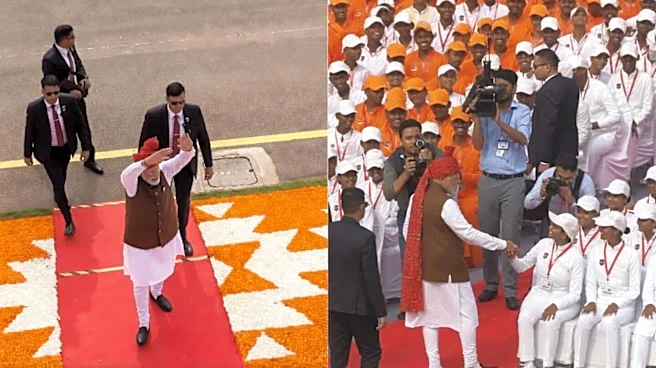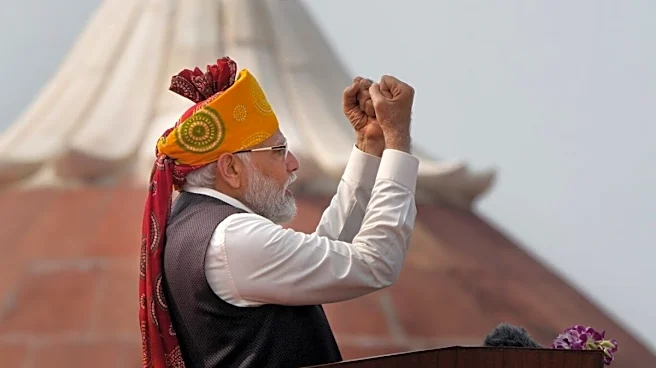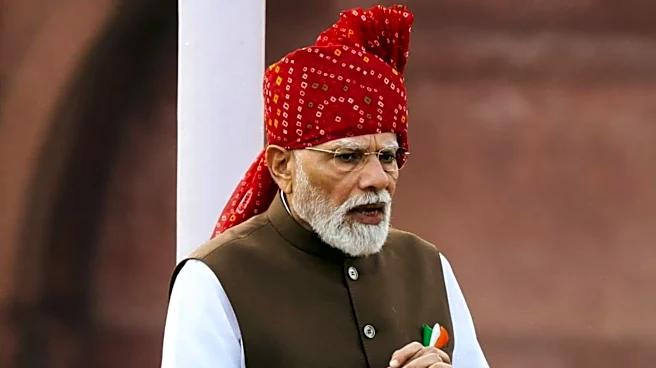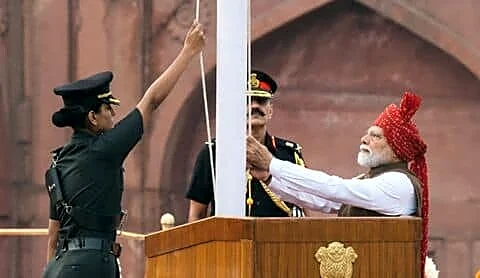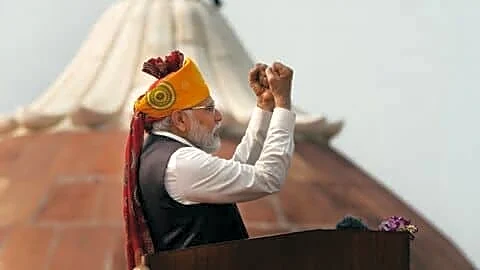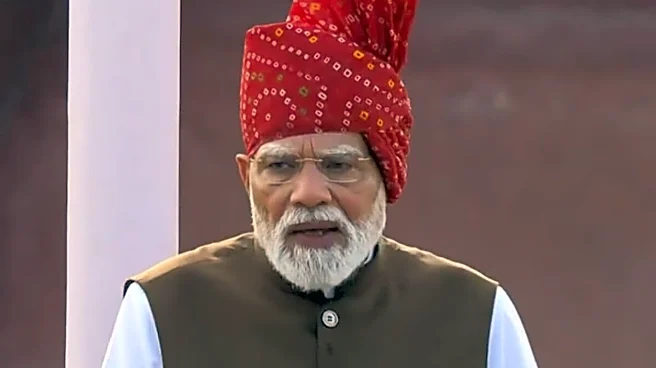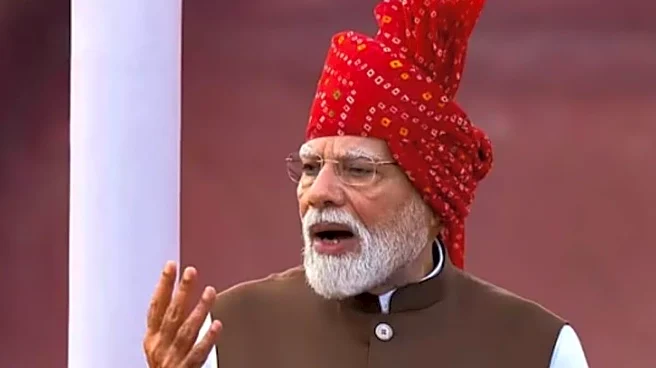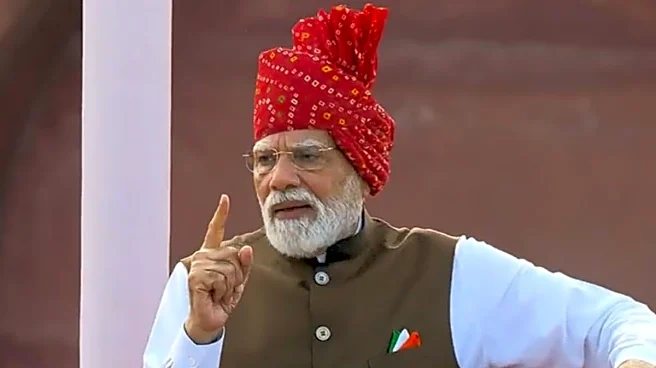

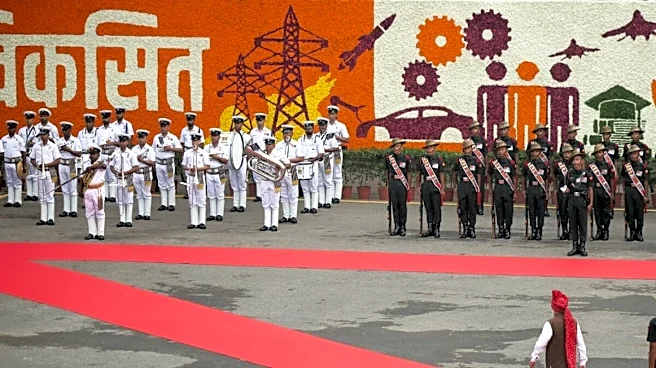
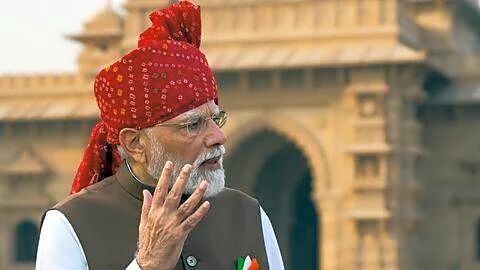
Prime Minister Narendra Modi, addressing the nation from the ramparts of the Red Fort on India’s 80th Independence Day, laid out an expansive vision for a developed India by 2047, while highlighting the government’s record, the role of youth, the need for faster reforms and India’s push towards self-reliance.
From the significance of ‘Vande Mataram’ echoing at the Red Fort to his call for seven “streams of strength”, or Sapta Dhara, PM Modi’s address covered development, manufacturing, agriculture, technology, infrastructure, defence, the green and blue economy, soft power, sports, women’s representation and the fight against Naxalism.
Viksit Bharat 2047: ‘Small Dreams Will No Longer Suffice’
At the centre of the Prime Minister’s address was the goal of transforming India into a developed nation by 2047,
when the country completes 100 years of Independence.
PM Modi said India could no longer move forward with “small dreams” and stressed that big dreams, strong resolve and greater aspirations would raise the country’s capabilities and efforts. He said the goal of a developed India must be achieved through the collective efforts of 140 crore Indians.
ALSO READ | Reforms, Women Reservation, Youth: What PM Modi’s Independence Day Speech Signals For The Year Ahead
He also said India had moved from being counted among the “Fragile Five” to becoming the world’s fastest-growing major economy in the last 12 years, while asserting that the country was now moving ahead with unprecedented speed and confidence.
Seven Streams Of Strength For A Developed India
PM Modi unveiled what he described as seven streams of strength that India must harness over the coming years. These include manufacturing power; agriculture and food products; technology and innovation; Gati Shakti; defence power; the green and blue economy; and India’s soft power.
On manufacturing, he called for India to build the entire value chain, from components to complete products, and become a trusted global supply-chain hub. He stressed global standards, competitive factories, quality, scale and “zero-defect” manufacturing.
For agriculture, PM Modi called for greater food processing and urged India to move “from the farm to the export market”, highlighting millets, spices, fruits, flowers and traditional foods as products that could become global brands.
Technology and innovation formed the third stream, with the Prime Minister referring to AI, quantum technology, space, robotics and data centres. He said India should not merely become a global market but should emerge as a hub of innovation.
The Gati Shakti push, the fourth stream, focused on high-speed rail, modern highways, airports, multimodal logistics and port-led development.
The fifth stream centred on defence self-reliance and next-generation technologies, including drones, hypersonic defence technology and cybersecurity.
The sixth stream covers the green and blue economies, with emphasis on green hydrogen, renewable energy, energy storage, green mobility, green manufacturing, fisheries, coastal tourism and ocean technology.
ALSO READ | ‘Naxals, Maoist Violence No Longer Have Strength To Survive’: PM Modi Warns Of ‘Dimagi Naxal’
The seventh is India’s soft power, including yoga, Ayurveda, culture, films, VFX, animation, gaming, digital content and tourism.
Faster Reforms, Self-Reliance And Energy Security
The Prime Minister called for an acceleration of reforms and argued that India cannot be governed by policies and regulations designed for the past. He said systems must be aligned with the country’s goals for 2047.
PM Modi also stressed self-reliance and the need to strengthen India’s capabilities while protecting national interests.
Energy security, he said, is the demand of the time. He cited the government’s record, including increases in defence production, electronic manufacturing, railway coach production, internet users and digital transactions.
He said reforms were being undertaken “not out of compulsion, but out of conviction” to achieve the country’s larger goals.
Youth Power At The Heart Of Viksit Bharat
PM Modi placed particular emphasis on the youth, calling them both the biggest contributors to and beneficiaries of the journey towards a developed India.
He highlighted the growth of Startup India, saying there are now more than 2.5 lakh registered startups, and announced that an Innovation Fund of Rs 1 lakh crore has been created to support young people’s ideas and capabilities.
The Prime Minister also announced a mission to train 1 crore young people in AI skills over the coming year, with the aim of building capabilities that can help Indian youth lead in the AI era.
ALSO READ | ‘I Have Faith In The Youth Of My Country’: PM Modi Says Gen Z Will Help Turn India’s Dreams Into Reality
He also announced free online coaching for various competitive examinations, saying the move would help reduce the financial burden of coaching on poor and middle-class families.
Sports, Talent Hunt And Drug-Free India
The Prime Minister highlighted India’s growing sporting ambitions and said the country is moving forward as a strong contender to host the 2036 Olympics, while also noting the Commonwealth Games scheduled for 2030.
He announced a nationwide talent hunt for children aged five to 15 years across villages, cities and schools to identify sporting talent for the future.
PM Modi also called for a drug-free India and said a 100-week campaign involving My Bharat volunteers, NGOs, socio-cultural organisations and spiritual leaders has been planned.
Naxalism And ‘Dimagi Naxal’ Remark
On Naxalism, PM Modi said Naxalism had once “drenched the earth in blood” but claimed that Naxals and Maoist violence no longer had the strength to survive.
He said the government had succeeded in eliminating armed Naxals from the forests but warned about what he described as ideological Naxalism or “dimagi Naxalism”.
According to the Prime Minister, this mindset was still looking for opportunities to create paths of violence and anarchy.
Women’s Representation And 33% Reservation
The Prime Minister made a fresh appeal to political parties to support 33 per cent representation for women in state assemblies and the Lok Sabha.
Standing at the Red Fort, PM Modi urged political parties to come forward in support of women’s representation and said mothers and sisters should get their due role in India’s policymaking.
Healthcare, Education And Social Schemes
PM Modi also highlighted government initiatives in healthcare and education. He said Ayushman Bharat provides free medical treatment of up to Rs 5 lakh for senior citizens aged 70 years and above and claimed that the scheme had helped families save large amounts on medicines and operations.
He also cited the expansion of universities and medical education, the National Education Policy, Atal Tinkering Labs and initiatives that have opened new avenues for young people.
Vande Mataram And A Call For Collective Effort
The address began against the backdrop of the historic significance attached to ‘Vande Mataram’.
PM Modi said that for the first time since Independence, ‘Vande Mataram’ was echoing at the Red Fort on August 15, as the country marked 150 years of the National Song.
He also acknowledged people affected by floods and landslides in parts of the country and assured affected families that the entire nation stood with them.
Concluding the larger vision of his address, PM Modi stressed that a nation is not just its government but includes every citizen.
He called for the Centre, state governments, local institutions, industry and citizens to work together to accelerate reforms and achieve the goal of a developed India by 2047.
ALSO READ | 10 Top Quotes From PM Modi’s Independence Day Speech Everyone Is Talking About