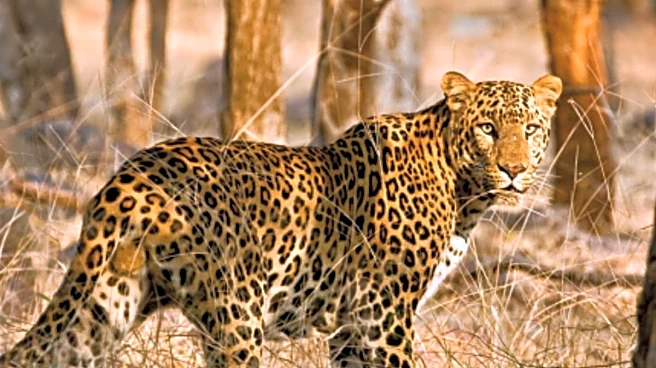



Late at night on February 9, a leopard was spotted crossing the NH-161 highway in the Alladurg area of Medak district, near Siddipet in Telangana. Passers-by, startled by the sight, recorded the moment on their mobile phones and shared the video on social media.
The footage, shot from a moving vehicle, shows the leopard jumping over a roadside fence, stepping briefly onto the highway, and then panicking on noticing vehicles.
Within seconds, it turned back, leapt over the fence again, and disappeared into the forest. The video has since gone viral, triggering fear and intense discussion across the state.
This is not an isolated incident. Across Telangana and neighbouring states, sightings of leopards and tigers near highways, villages, and farmlands
have become increasingly common.
Another case currently causing concern involves a Royal Bengal Tiger that crossed into Telangana from the Tadoba Tiger Reserve in Maharashtra.
The tiger first entered the Yadadri-Bhuvanagiri district, then moved through Jangaon, and is now believed to be roaming in Siddipet district.
Despite efforts spanning nearly 75 days, forest officials have been unable to capture the tiger. Cages have been installed, trap cameras deployed, and teams from both Telangana and Maharashtra—including a special team from Pune—are actively involved in the operation.
The tiger has already killed cows and calves, intensifying fear among villagers. However, its exact location remains unknown. Meanwhile, misinformation and negative campaigns about the tiger are spreading rapidly on social media.
Authorities have urged people to rely only on official updates and immediately report any sightings or footprints to forest officials.
At first glance, these incidents reinforce a familiar narrative—that wild animals are increasingly entering human settlements. But a closer look reveals that this assumption is flawed.The reality is far more uncomfortable. It is not wildlife that is invading human spaces; it is humans who are steadily encroaching upon forests.
As towns expand, homes are built, roads laid, and forest land gradually converted into human habitation. When animals like leopards and tigers appear in these areas, we label it as an intrusion, even though we are the ones who have entered their natural territory.
The situation is further aggravated by a sharp decline in wildlife populations within forests. Natural prey such as deer and rabbits have become scarce. Predators like tigers and leopards cannot survive on small meals.
They hunt large prey, consume substantial quantities in one go, and then rest for a day or two. Their survival depends on the availability of adequate prey in a single hunt. With forests no longer able to sustain this food chain, these animals are forced to venture closer to human habitations.
As a result, domestic animals such as calves, dogs, goats, and pigs—easily found near villages—become alternative prey. This brings predators dangerously close to people, increasing fear, conflict, and the risk of accidents.
While there have been no recent attacks on humans, rural communities, especially farmers who travel to fields early in the morning or late at night, continue to live under constant anxiety.
Experts argue that this growing conflict demands urgent and serious attention from governments. Since food scarcity is the primary driver pushing wild animals toward human areas, solutions must focus on restoring food availability within forests.
Some suggest introducing prey animals into forest regions so predators do not need to stray toward villages. Others recommend relocating wildlife to tiger reserves and sanctuaries, where prey populations can be maintained and monitored.
Unless long-term, ecological solutions are implemented, sightings like the leopard crossing NH-161 will only become more frequent—and the line between forests and human settlements will continue to blur, to the detriment of both humans and wildlife.
/images/ppid_a911dc6a-image-17707172282148604.webp)



/images/ppid_a911dc6a-image-177071703960325094.webp)

/images/ppid_a911dc6a-image-177071655366637065.webp)