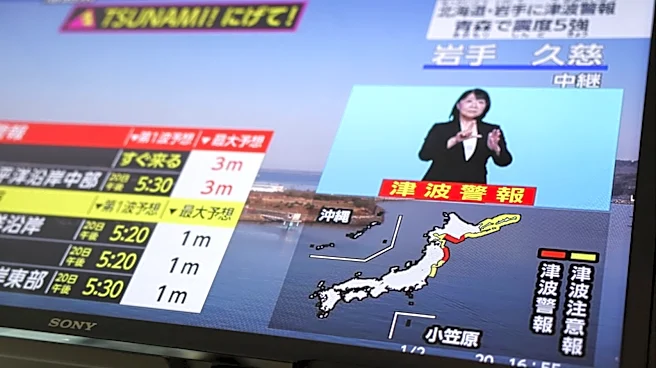




A 7.4-magnitude earthquake struck off the northern coast of Japan on Monday, prompting the Japan Meteorological Agency (JMA) to issue a tsunami warning for waves that could reach up to three metres (10 feet).
The quake hit at 4.53 pm (0753 GMT) in Pacific waters off northern Iwate prefecture, with tremors strong enough to shake large buildings as far as Tokyo, hundreds of kilometres away, Reuters reported.
The Japan Meteorological Agency warned that tsunami waves as high as three metres could reach parts of Iwate, Aomori and Hokkaido prefectures.
“Evacuate immediately from coastal regions and riverside areas to a safer place such as high ground or an evacuation building,” the weather agency said, warning that damage due to tsunami waves was expected.
“Tsunami waves are expected to hit repeatedly. Do not leave safe ground until the warning is lifted,” it said.
The Associated Press reported that the quake occurred off the coast of Sanriku in northern Japan, prompting the meteorological agency to issue a tsunami alert for the region.
Japan’s NHK public television said a tsunami of up to three metres could hit the area shortly.
According to Reuters, the earthquake had an epicentre in the Pacific Ocean and struck at a depth of about 10 kilometres.
The tremor measured an “upper 5” on Japan’s seismic intensity scale, strong enough to make it difficult for people to move around.
In many cases, unreinforced concrete-block walls collapse at this level of shaking.
GOVERNMENT FORMS CRISIS TEAM
Reuters reported that the Prime Minister’s office set up a crisis management team following the earthquake.
The Japan Meteorological Agency said the earliest tsunami waves could reach the northern shoreline immediately.
Reuters noted that Japan is one of the world’s most seismically active countries, sitting on top of four major tectonic plates along the western edge of the Pacific “Ring of Fire.”
The country experiences around 1,500 earthquakes each year and accounts for about 18 per cent of the world’s earthquakes.
While most tremors are mild, the damage they cause varies depending on their location and the depth below the Earth’s surface at which they occur.
RECALLING THE 2011 DISASTER
Reuters reported that in 2011, a magnitude 9.0 earthquake triggered a tsunami that left 18,500 people dead or missing and caused a meltdown at the Fukushima nuclear plant.
Meanwhile, authorities continued monitoring the situation after the latest quake, as warnings remained in place for parts of northern Japan.