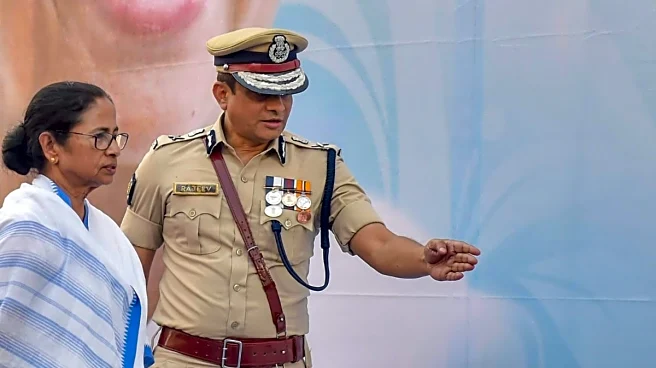

The Union Public Service Commission (UPSC) has returned the West Bengal government’s proposal for preparation of a panel for appointment to the post of Director General of Police (Head of Police Force),
advising the state to seek appropriate directions from the Supreme Court of India. The Commission cited inordinate delay as the reasons for its decision.
In its communication to the Chief Secretary of West Bengal, the UPSC referred specifically to the Supreme Court’s directions in Prakash Singh vs Union of India. In its order dated 3 July 2018, the Supreme Court mandated that all states must forward their proposals to the UPSC at least three months prior to the retirement of the incumbent DGP, in order to ensure a transparent, timely, and merit-based selection process.
According to the UPSC, the vacancy for the post of DGP (HoPF) in West Bengal arose on 28 December 2023. However, the state government forwarded its proposal only in July 2025 — more than one and a half years after the vacancy occurred and well beyond the timeline prescribed by the apex court.
Despite the delay, the UPSC convened an Empanelment Committee Meeting (ECM) on 30 October 2025 to examine the proposal and the clarifications submitted by the state government. During the deliberations, divergent views emerged among committee members regarding the date of occurrence of the vacancy, particularly in light of the delayed submission. Owing to these differences, the Commission decided to seek a legal opinion from the Attorney General of India.
The Attorney General, in his opinion, categorically stated that the delay by the West Bengal government in forwarding names for empanelment was excessive. He observed that there is no provision under the applicable rules or precedents that empowers the UPSC to condone such an inordinate delay and proceed with the empanelment process as if no irregularity had occurred. He cautioned that accepting the delayed proposal could create serious anomalies, as delayed reporting of vacancies may deprive legitimate aspirants of their right to be considered for empanelment. The Attorney General further noted that if the state government faced any difficulty in adhering to the Supreme Court’s timeline, the appropriate course would have been to seek clarification or leave from the Supreme Court itself.
Based on this legal opinion, the UPSC concluded that it could not proceed with the empanelment process and returned the proposal to the West Bengal government, advising it to seek appropriate directions from the Supreme Court of India. The decision was conveyed through an official letter issued by Nand Kishor Kumar, Director (AIS), UPSC, dated 31 December 2025, with a copy marked to the Ministry of Home Affairs.
The issue has also taken a judicial turn following a petition filed by senior IPS officer Rajesh Kumar before the Central Administrative Tribunal (CAT). Rajesh Kumar, who is among the senior-most officers eligible for consideration, has alleged that he was denied a fair opportunity to be considered for the post of DGP due to the delayed and irregular process adopted by the state government. The CAT has taken cognisance of the matter and directed the UPSC to expedite its decision on the DGP (HoPF) empanelment for West Bengal amid the prolonged delay.
With Acting DGP Rajeev Kumar scheduled to retire on 31 January, the question of who will lead the West Bengal Police next is now under intense legal and administrative scrutiny. Following the UPSC’s letter, attention is focused on the steps the state government will take, including whether it will approach the Supreme Court for directions, seek an interim arrangement, or pursue any other course permissible under law.
![Chris Lynn names all-time batters across formats, includes three Australians [Exclusive]](https://glance-mob.glance-cdn.com/public/cardpress/binge-magazine-card-generation/spaces/IN/en/crictracker-spaces/images/ppid_49c02804-image-177074003031190541.webp)

![Chris Lynn picks his all-time T20 XI, leaves out Rohit Sharma & Virat Kohli [Exclusive]](https://glance-mob.glance-cdn.com/public/cardpress/binge-magazine-card-generation/spaces/IN/en/crictracker-spaces/images/ppid_49c02804-image-177074010501291991.webp)
/images/ppid_a911dc6a-image-177074002727017161.webp)







/images/ppid_a911dc6a-image-177073963136583776.webp)