
The Commission for Air Quality Management (CAQM) has invoked Stage IV of the Graded Response Action Plan (GRAP), including a ban on all construction and demolition activities in Delhi-NCR, after the Air Quality Index
(AQI)neared the ‘severe plus’ mark at 450. According to the order released by CAQM, the AQI of Delhi, which was recorded as 431 at 4 pm on Saturday, exhibited an increasing trend and has been recorded as 446 at 6 pm on the date owing to slow wind speed, stable atmosphere, unfavourable weather parameters and meteorological conditions and lack of dispersal of pollutants. “Keeping in view the prevailing trend of air qualityand in an effort to prevent further deterioration of air quality in the region, the CAQM Sub-Committee on GRAP decides to invoke all actions as envisaged under Stage-IV of the extant GRAP – ‘Severe+’ Air Quality (DELHI AQI > 450), with immediate effect, in the entire NCR. This is in addition to the actions under Stages I, II & III of extant GRAP already in force in NCR,” the order stated.
What is GRAP?
GRAP stands for Graded Response Action Plan — a set of staged anti-pollution measures triggered when air quality gets very bad in Delhi-NCR. It is designed to protect public health and reduce emissions quickly during extreme pollution episodes.
#WATCH | Delhi | A local, Harsh Vardhan, says, "Pollution has only increased. I am coming from Dwarka and am having difficulty breathing. The government should do something. It is good that GRAP 4 has been invoked in the national capital. I suggest the 'odd-even' scheme should… https://t.co/wqmxGOIWCF pic.twitter.com/6YNX9EQ1Y8
— ANI (@ANI) December 14, 2025
What are the stages?
During winters, the Delhi-NCR region enforces restrictionsunder GRAP, which categorises air quality into four stages:
GRAP-1 (Poor category, AQI 201-300): Basic pollution control steps like dust suppression and traffic regulation when air quality is poor.
GRAP-2 (Very poor category, AQI 301-400): Tighter measures including limits on generators and parking when air quality is very poor.
GRAP-3 (Severe category, AQI 401-450): Major restrictions such as banning construction and diesel generators when air quality is severe.
GRAP-4 (Severe plus category, AQI above 450): Emergency actions such as truck entry bans, work-from-home, and school restrictions when air quality is severe+.
What are Stage IV restrictions?
Stage IV of GRAP brings the strictest restrictions in Delhi-NCR. Stage-4 is triggered to immediately reduce pollutant sources and protect public health.
VEHICLES AND TRAFFIC: Under this stage, the entry of trucks into Delhi is stopped, except those carrying essential commodities or providing essential services.
However, CNG, LNG, electric and BS-VI diesel trucks are allowed.
The plying of Delhi-registered diesel heavy goods vehicles (BS-IV and below) is banned, again with exceptions only for essential services.
CONSTRUCTION AND DEMOLITION: All construction and demolition activities are banned, including even linear public projects such as highways, roads, flyovers, power transmission lines, pipelines and telecom works, which are otherwise allowed in lower stages.
SCHOOLS: Schools are allowed to run classes in a hybrid mode (online and physical) not only for primary students but also for higher classes (VI to IX and XI) in Delhi and the most affected NCR districts, with students given the option to attend online where feasible. Under Stage IV, state governments are asked to consider additional emergency steps, such as closing colleges and educational institutions, shutting non-essential commercial activities and even introducing odd-even rules for vehicles if the pollution situation worsens further.
What does it mean for schools and offices?
The Delhi government has directed all government and private schools to hold classes till Class XI in hybrid mode, and 50% staff at government and private offices have been asked to work from home as stricter pollution norms came into effect on Saturday.
Schools: Delhi’s Directorate of Education directed all government and private schools in the national capital to conduct classes in Hybrid mode – both physical and online mode – for children up to Class IX and XI (except Class X) with immediate effect until further orders.
“The option to exercise the online mode of education, wherever available, shall vest with the students and their guardians. Further, all Heads of Schools are directed to disseminate this information to the parents and guardians of the students immediately,” it said.
Offices: “Directions under section 5 of the Environment (Protection) Act, 1986, to all Government Offices under GNCTD and all Private Offices operating within the National Capital Territory of Delhi, to work on 50% strength and the rest to work from home under Graded Response Action Plan,” the government said in the order issued as per CAQM direction.
The government had issued similar directives to government and private offices to cap on-site attendance on November 24 as GRAP-III measures were in effect at the time, although the directive was later revoked when the air pollution curbs were withdrawn.
#WATCH | Delhi: Visuals from near AIIMS as a thick layer of toxic smog blankets the city. CAQM (Commission for Air Quality Management) has invoked all actions under GRAP Stage-IV in Delhi-NCR.
AQI (Air Quality Index) around the area is 484, categorised as 'Severe', as… pic.twitter.com/u1A7iKPb7m
— ANI (@ANI) December 14, 2025
What is allowed?
ESSENTIAL SERVICES: Hospitals, pharmacies, emergency services, power/water supply, and food distribution continue operatingnormally.
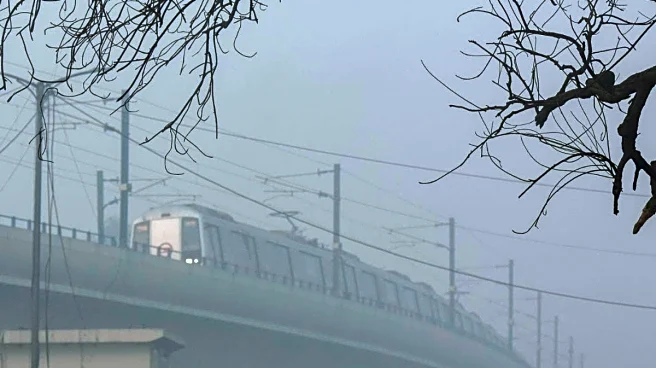
Infrastructure projects linked to public utilities such as metro rail, highways, airports, defence, healthcare and sanitation are allowed to continue under strict dust-control norms.
Metro, buses, and other public transport remain functional.
Movement of essential goods and people is allowed.
PERMITTED VEHICLES: Clean-fuel vehicles (electric, CNG, LNG, BS-VI diesel) are allowed. Reduce non-essential travel to lower pollution and health risks.
HEALTH PRECAUTIONS
People with respiratory issues, children, and elderly should stay indoors as much as possible.
Use air purifiers, wear N95/KN95 masks if you must go out, and keep windows closed on very bad AQI days.
/images/ppid_a911dc6a-image-177097207809447271.webp)

/images/ppid_a911dc6a-image-177097222099232166.webp)
/images/ppid_a911dc6a-image-17709720403932929.webp)
/images/ppid_a911dc6a-image-177097225847491038.webp)
/images/ppid_a911dc6a-image-177097212174092329.webp)
/images/ppid_a911dc6a-image-177097216247359260.webp)