


New Delhi, Aug 11 (PTI) Tourists visiting Delhi will be able to explore the capital through four curated tourism circuits connecting temples, gurdwaras, churches, Jain and Buddhist places of worship, archaeological sites and other landmarks, as the government seeks to turn the city from a transit point into a destination in itself.
The four circuits – ‘The Soul of Delhi’, ‘The Heritage of Delhi’, ‘Delhi’s Sacred Harmony’ and ‘Echoes of Delhi’ – were launched on Tuesday by Chief Minister Rekha Gupta at the Spiritual and Heritage Tourism Conclave-2026 held at Akshardham Temple. Spiritual leader Sadhguru Jaggi Vasudev was also present at the event.
The circuits cover 21 sites, with each route mapped in a specific sequence and connecting attractions
across different parts of the city, according to an official.
The first circuit, ‘The Soul of Delhi’, starts at Gurudwara Bangla Sahib in Connaught Place and moves to Sacred Heart Cathedral, also in Connaught Place, followed by Agrasen Ki Baoli on Hailey Road, Lotus Temple in Kalkaji and Akshardham Temple in East Delhi, he said.
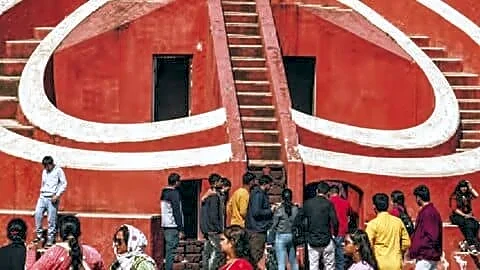
The second circuit, ‘The Heritage of Delhi’ begins at Birla Temple on Mandir Marg, followed by Jhandewalan Mata Mandir, Jantar Mantar in Connaught Place, Yogmaya Mandir in Mehrauli and Jagannath Temple in Hauz Khas.
‘Delhi’s Sacred Harmony’, the third circuit, starts at Praacheen Hanuman Mandir in Connaught Place and takes visitors to Digambar Jain Lal Mandir in Chandni Chowk, Ambedkar Memorial in Civil Lines, Purana Qila on Mathura Road and Hazrat Nizamuddin, he shared.
The fourth circuit, ‘Echoes of Delhi’, is the longest of the four and has six stops. It begins at Gurudwara Rakab Ganj Sahib, followed by the Buddhist Temple on Mandir Marg, Church of Redemption on North Avenue, Mehrauli Archaeological Park, Chhatarpur Mandir and Linga Bhairavi Sannidhanam at Chhatarpur Farms, he said.
The circuits have been designed to present Delhi’s spiritual, cultural and historical attractions as connected travel experiences rather than isolated tourist spots.
The initiative is part of the government’s effort to develop Delhi from a ‘Transit City’ into a ‘Destination City’, encouraging visitors who come to the capital to stay longer and explore different parts of it.
The conclave was organised on the theme ‘Delhi: The Capital of Spirituality, Heritage and Experiences’, the official said.
Delhi’s tourism identity extends beyond its well-known historical monuments and includes a wide range of religious and cultural sites representing different faiths and traditions.
Chief Minister Rekha Gupta said Delhi should be experienced as a living reflection of India’s diverse culture and traditions and not only through a few prominent monuments.
She said the city had preserved its history through different periods and had also emerged as a place where people from across the country live and celebrate their respective cultures, traditions and festivals.
Gupta said the objective of the circuits was not merely to connect tourist spots but to create a broader experience covering spirituality, history, architecture, culture, cuisine and diverse faiths.
She said tourists should be encouraged to spend more time in Delhi and explore different parts of the capital instead of visiting only a few prominent locations.
According to the chief minister, longer tourist stays could also create opportunities for hotels, restaurants, tour operators, local guides, artists, artisans and small entrepreneurs.
Gupta also highlighted the potential for spiritual tourism, saying growing global interest in Indian spirituality, yoga, peace and inner well-being could provide opportunities for Delhi’s religious and spiritual destinations.
The government, spiritual institutions, hospitality industry, tour operators, heritage organisations, local businesses, experts, content creators and travel influencers all had a role to play in promoting Delhi as a tourism destination, she added.
Delhi Tourism Minister Kapil Mishra said beyond the mausoleums, shrines, and minarets, Delhi’s true history is imbued with the adornments of Sanatan; our government is committed to bringing that very authentic history to the forefront of the world.
At the Akshardham Temple, those myriad aspects connected to Delhi’s cultural and architectural heritage have been depicted–those that were deliberately not mentioned until now, he added.
The four circuits, with their combination of religious sites, living traditions and historical landmarks, are intended to give tourists a wider experience of the capital while encouraging them to discover parts of Delhi beyond its most frequently visited monuments. PTI SHB SHB MDO MDO





/images/ppid_59c68470-image-178655508779822899.webp)