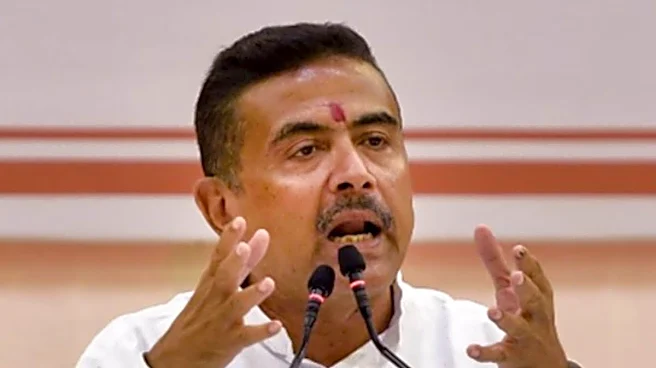

On August 17, Suvendu Adhikari completed 100 days in office since he took the oath as West Bengal’s first BJP chief minister on May 9. It was the party’s brightest electoral moment since Narendra Modi’s victory in the 2014 general elections. Not many even in the BJP thought it could win the defiant state.
But the Suvendu government did not have the luxury to gloat or ponder. He was tasked by the PM to start fixing the Communist-hollowed, TMC-battered state right away.
His government hit the road running, and with a plan. Its first 100 days have been a frenetic mix of policy decisions and groundwork. From a much larger list, one can screen just 20 measures that point to the CM’s urgency to deliver and to pull his state out of a deep economic and law-and-order
ditch. Let us draw up a quick list.
On national security and border, the CM’s first cabinet approved transfer of roughly 1,000 acres to the BSF in nine border districts, covering about 173 km of unfenced stretches. This includes the highly vulnerable Chicken’s Neck corridor. Some land also went to SSB and ITBP in North Bengal.
Mamata Banerjee had stubbornly held out against this for years.
The West Bengal government began using holding centres for illegals. It publicly claimed it was pushing back undocumented migrants back into Bangladesh.
After years of delay, the state finally began the census exercise. Again, its eyes will be on illegal residents.
The Bharatiya Nyaya Sanhita was also implemented at last. Mamata had refused to let go of the colonial-era Indian Penal Code.
One of the boldest steps was ordering district magistrates to re-verify SC/ST/OBC caste certificates issued since 2011 (about 1.69 crore). The administration started weeding out fakes.
In an OBC quota reset, the Suvendu government restored the 7 per cent OBC framework for 66 pre-2010 listed communities. The Calcutta High Court had struck down TMC-era notifications. The state removed 77 Muslim communities from the OBC list, which the Mamata regime had sneaked in.
The government has also started cleaning up the scam-ridden, beleaguered education space. It promised that merit will prevail in recruitment through SSC, PSC, and the Police Recruitment Board. Nearly 1 lakh appointments are likely by March 2027.
Ayushman Bharat rolled out after Mamata blocked it for eight long years in West Bengal. The Suvendu government identified about 1.43 crore families for cards.
Another big welfare step has been the rollout of Annapurna Yojana. It replaced TMC’s Lakshmir Bhandar with Rs 3,000 a month for eligible women. The government claimed transfers to over 1.2–1.3 crore women, but it has angered sections who got excluded or are awaiting verification.
A slew of central schemes like PM Kisan, PM Surya Ghar, Jal Jeevan Mission, Ujjwala, PM Vishwakarma, and PM Fasal Bima were unlocked. Purulia got a Rs 1,296 crore drinking-water project.
On the limping industrial front, Adhikari laid the foundation of Amit Metaliks’ Rs 4,000-crore integrated steel plant at Raghunathpur, Purulia, expected to generate 5,000–10,000 jobs. Other early projects include Shyam Steel, Lux Cosy and an Amul plant. The government announced land for 25 industries, a new land purchase and pooling policy, and a single-window system.
Jute carries great economic, political, and sentimental value in West Bengal. The revival of the jute mills rekindles the state’s ability to dream again. Tea and textiles are getting attention too.
In Purulia, a civil airport under UDAN, and land for the Sevak-Rangpo broad-gauge project is on the cards, so are an ESI hospital and substations.
MGNREGA, Agniveer schemes are kicking in.
On the ideological front, Vande Mataram was made mandatory in government and government-aided schools, including madrasas. The state also moved to drop religion-based honorariums for imams, muezzins and purohits. Cattle-slaughter norms have been tightened.
Syama Prasad Mookerjee’s role has been incorporated in school and university syllabi from the next academic year. His 125-foot statue and a museum will soon come up along with a Eco Park and restoration of his Jirat ancestral home.
Rs 50 crore has been budgeted for a Kurmi-Kurmali board to preserve the language, culture and heritage. In the Darjeeling hills, Suvendu invoked local heroes like Durga Malla and Helen Lepcha and announced jobs and compensation for families of those who died in the Gorkhaland agitation.
Permissions for Durga Puja, Kali Puja, Ram Navami, Hanuman Jayanti, and Gita Paath at the Maidan would no longer have to go through the high court.
The state Assembly passed the West Bengal Public Safety and Control of Anti-Social Activities Bill, 2026 and an amendment to the Maintenance of Public Order Act. From now, vandalism of public property, attacks on the police or factory lockouts can trigger arrest and recovery of thrice the damage.
To end the TMC syndicate raj, four new helplines have been set up: cut-money (155334), syndicates (1553335), illegal road tolls (1553337), and illicit liquor (1553339). There are four other Nabanna control-room numbers.
Women’s desks at police stations and pink patrol vehicles have been flagged off. A 200-member Arjun civil-defence brigade has been announced to tackle cybercrime, fire, and disaster response.
A civic campaign has razed unauthorised buildings. Hawkers are being evicted in Howrah, Sealdah, Dum Dum, and Jadavpur station, inviting protests from the Left. Eid namaz was shifted from Red Road to Brigade Parade Ground.
Free bus travel for women has started; eggs included twice a week in mid-day meals; KMC gave clearance to the Baranagar–Barrackpore Pink Line metro.
West Bengal under Suvendu Adhikari is taking up policy reforms and ground action almost daily. Something that the state has seldom seen in the last 49 years.