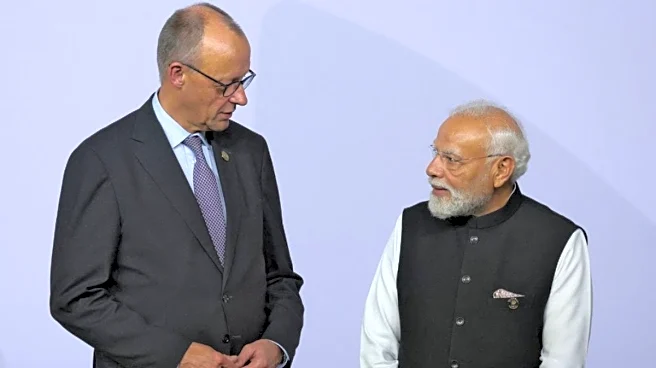

Prime Minister Narendra Modi will host German Chancellor Friedrich Merz in Gujarat on January 12, marking a visit that is being seen in New Delhi’s strategic circles as far more than just another high-level
diplomatic engagement.
Merz, who will be in India on January 12 and 13 on his first official visit, has chosen India as the destination for his first Asia tour as chancellor – breaking with a long-standing tradition where German leaders typically head to China or Japan.
The symbolism is hard to miss and underlines the growing strategic weight India now carries in Germany’s foreign policy calculus. The first day of the highly anticipated visit will begin with strong optics.
Here’s all you need to know:
9.30 am: Modi and Merz will visit the Sabarmati Ashram
10 am: They will take part in the International Kite Festival at the Sabarmati riverfront
11.15 am onwards: The two leaders will then move to Mahatma Mandir in Gandhinagar for formal bilateral engagements.
WHY GUJARAT, WHAT WILL THE TALKS FOCUS ON?
The choice of Gujarat and the carefully curated public programme, is clearly aimed at showcasing both cultural connect and political warmth.
The bilateral talks between Modi and Merz will focus on reviewing the India-Germany Strategic Partnership, which has just completed 25 years. Over the past two and a half decades, the relationship has been anchored largely in trade, investment and technology cooperation, with Germany remaining one of India’s most important economic partners in Europe.
WHAT IS THE VISIT ALL ABOUT?
This visit, however, is expected to push the India-Germany relationship into a more explicitly strategic direction.
The two sides will discuss expanding cooperation in trade and investment, technology, education, skilling and mobility, while also deepening engagement in defence and security, science and innovation, green and sustainable development, and people-to-people ties.
Modi and Merz are also expected to exchange views on major regional and global developments, at a time when the international order is under severe strain – from the war in Ukraine to shifting equations in the Indo-Pacific and changing signals from the United States. They will also engage with business and industry leaders from both countries, and several agreements are likely to be signed during the visit giving concrete shape to the ambitions being discussed.
What gives this visit an added strategic edge is the profound shift underway in Germany’s own security and defence posture. In a landmark move, Germany’s parliament, the Bundestag, has voted to introduce voluntary military service as Berlin seeks to rebuild and strengthen its armed forces after Russia’s full-scale invasion of Ukraine.
From January 2026, all 18-year-olds in Germany will receive a questionnaire asking if they are willing to join the armed forces – mandatory for men and voluntary for women – signalling a major change in a country that had long moved away from mass military mobilisation. Merz has gone further, publicly pledging to build Europe’s strongest conventional army – an ambitious goal for a military that has suffered from years of underinvestment and neglect.
His coalition government’s new reform package aims to raise the strength of the German armed forces to around 2,60,000 soldiers by 2035, up from about 1,80,000 today, along with an additional 2,00,000 reservists. This massive expansion will require not just money, but also reliable strategic partners, technology collaborations and diversified defence relationships.
It is in this context that India’s importance to Germany is growing. For New Delhi, France has so far been the closest and most prominent strategic partner in Europe with the Rafale fighter jet deal standing out as a symbol of deep defence cooperation.
The German chancellor’s visit is now being seen as an attempt by Berlin to move in a similar strategic direction with New Delhi – beyond commerce and into core security and defence cooperation. For India, this aligns neatly with its own long-term objective of diversifying defence partnerships, building indigenous capabilities, and working with like-minded powers amid an increasingly uncertain global environment.
If this visit delivers on its promise, it could mark the beginning of a new phase in India-Germany ties – one where the relationship is no longer defined only by trade numbers and technology transfers, but by a shared strategic vision in a rapidly changing world.
/images/ppid_a911dc6a-image-177095803945834897.webp)

/images/ppid_a911dc6a-image-17709580293397222.webp)
/images/ppid_59c68470-image-177095764644795315.webp)

/images/ppid_59c68470-image-177095772128260787.webp)


/images/ppid_59c68470-image-17709576039333966.webp)
/images/ppid_59c68470-image-177095767987982667.webp)
/images/ppid_59c68470-image-177095752630142947.webp)
/images/ppid_59c68470-image-17709575691924647.webp)