


/images/ppid_59c68470-image-178957752886597816.webp)
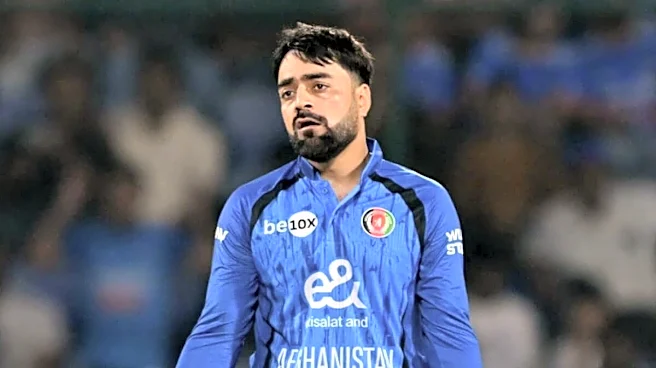
Afghanistan are no longer a team short on talent. They are no longer the newbies of international cricket either, who can be excused for making mistakes because of a lack of experience.
They have played enough cricket around the world, especially in the shortest format, and have produced world-class players who, on their day, have the ability to challenge the best teams.
But they are still a work in progress. And the biggest gap in their development is perhaps not skill. It is the ability to handle pressure.
Their first T20I against India at the Arun Jaitley Stadium on Sunday was a perfect example.
It was a historic occasion for Afghanistan – their first-ever ‘home T20I’ against India and hundreds of their fans turned with hopes of seeing them finally
beat India under the new leadership of Ibrahim Zadran.
But they witnessed a familiar story.
Afghanistan crumbled when the pressure increased.
They gifted wickets rather than making India work for them. Afghanistan failed to make the most of crucial moments with the bat first and, when it was their turn to defend 156, Ibrahim’s men, despite having enough experience, looked short of ideas once India put them under pressure, thanks to Abhishek Sharma and his 121-run stand for the second wicket with Ishan Kishan.
Handling pressure is an art. Players and teams take years to master it. On big occasions, when the margin for error is very small and one mistake can change the course of a game, that skill matters more than ever.
Before the series, their new T20I captain Ibrahim Zadran had spoken about Afghanistan’s ambition to play better cricket in New Delhi and finally end their 16-year-long wait for a win over India in men’s international cricket.
But when the first opportunity came, they once again found themselves on the wrong side of the big moments.
To win big battles, you have to start well. Afghanistan didn’t in the first T20I of the three-match series.
Rahmanullah Gurbaz was dismissed for a duck by Jasprit Bumrah on the second ball of the match. That was followed by a collapse which left Afghanistan five down for 43 in seven overs.
The problem wasn’t that the top order failed. In fact, it was the manner in which it failed.
India didn’t have to work particularly hard for those wickets because Afghanistan gifted them. And that is perhaps the biggest concern for Ibrahim and his team.
A top order comprising Gurbaz, Ibrahim, Sediqullah Atal, Gulbadin Naib and Darwish Rasooli cannot afford to repeatedly hand India control of a game.
The good thing for Afghanistan was that Azmatullah Omarzai and Mohammad Nabi stood up when their team needed them the most. The experienced duo put together a crucial partnership of 83 runs for the sixth wicket and ensured Afghanistan had something to defend, with Omarzai scoring an unbeaten 64 from 44 balls and Nabi making 33 off 27.
Without them, the situation could have been considerably worse.
The score of 156/8 at the Arun Jaitley Stadium wasn’t a big one, but it did give the Afghanistan bowlers something to work with. At the same time, it felt like a total that could have been significantly better had the top order taken responsibility.
And that is where Afghanistan’s problem lies.
It is no longer about whether they have enough ability. They do.
Rashid Khan is a world-class match-winner. Gurbaz has shown what he can do at the top. Ibrahim has emerged as an important batter for Afghanistan across formats. Omarzai is already a player who can influence games with both bat and ball.
Nabi brings experience that very few players in the world can match.
So what is missing? It is execution. And the ability to adapt when the game doesn’t go according to plan.
Against India, you cannot afford to take your foot off the pedal. Abhishek Sharma’s innings was another reminder of that. The Indian opener attacked from the start and made 82 off 32 balls in no time, taking the game away from Afghanistan before they could properly settle into their defence.
And it is not as if Afghanistan haven’t seen this before.
Abhishek punished them in the first T20I and showed what can happen when an aggressive Indian batter gets going. But the lesson isn’t only about Abhishek. India have other players as well who are capable of doing the same.
The bowling performance in Delhi highlighted another issue.
Afghanistan needed wickets in the powerplay. They needed to put India under pressure before the chase became comfortable. Instead, India raced to 82/1 before Rashid Khan was introduced in the seventh over.
There was logic behind keeping Rashid back. He is Afghanistan’s biggest match-winner and perhaps their most important bowler. But big games often require difficult decisions.
By the time Rashid came on, India had already done enough damage. Rashid subsequently restricted the scoring and showed why he remains Afghanistan’s biggest weapon. But by then, the game had already slipped away.
That is another lesson Afghanistan need to learn.
Sometimes your best player has to be brought into the game before the situation becomes desperate.
There was also no convincing Plan B once India’s batters got away. Afghanistan appeared to be reacting to the situation rather than controlling it. This is where handling pressure becomes different from simply playing good cricket.
India did not do anything extraordinary in the first T20I. They simply did the basics right.
They took the opportunities that came their way. They didn’t gift wickets. They kept the scoreboard moving and, once they had established control, did not allow Afghanistan back into the contest.
That is exactly what Afghanistan need to learn.
And interestingly, India themselves took years to learn it.
For 11 years (from 2013 to 2024), India had everything required to win major tournaments, yet when the biggest moments arrived, they often fell short.
The ICC trophy drought of 11 years became a recurring conversation.
India were not losing because they lacked good players. But because the pressure of the occasion got the better of them.
But eventually, India learned how to deal with those moments. It didn’t happen overnight. It came through repeated exposure to high-pressure games, painful defeats, experience and, perhaps most importantly, learning not to panic when the opposition gained the upper hand.
Afghanistan may have to go through the same process.
Their rise has already been extraordinary. They have gone from being a team fighting for recognition to one of the most dangerous sides in T20 cricket. They have beaten strong teams like Australia, New Zealand and Pakistan and have players who are regulars in the biggest franchise leagues around the world.
But becoming a consistently successful international team requires another level of maturity.
They have to learn to win ugly. They have to learn to survive when things don’t go their way. They have to learn not to gift wickets. They have to learn to have a Plan B when Plan A fails.
And most importantly, they have to learn how to keep their heads when the pressure is at its highest. Because against India, mistakes are punished quickly. If Gurbaz falls early, someone has to compensate.
If the top order collapses, the middle order has to absorb the pressure. If the first bowling plan isn’t working, the captain has to change it. And if Rashid is being saved for later, the other bowlers have to make sure there is still a game left for him to influence.
In the first T20I, Omarzai and Nabi showed that Afghanistan do have players who can absorb pressure. But they cannot be expected to rescue the team every time.
That is the next challenge for Ibrahim’s Afghanistan.
They are not far away. The talent is there. The match-winners are there. The experience is also growing with every match. The only missing thing is their ability to put everything together during pressure situations and that is the hardest part of becoming a great team.
India took years to master it. Afghanistan have reached the stage where they need to start learning it.
They have two more T20Is against India to prove that the Delhi defeat was a one-off and not a continuation of an old problem.
They don’t need to reinvent their cricket. They simply need to do the basics better, which is to start well, value wickets, take the game deeper, use match-winners at the right time, have a back-up plan and don’t allow the pressure of playing India to dictate their game.
Because the difference between being a dangerous team and becoming a great one is often not talent. It is what you do when the game starts slipping away.
On Sunday in the first T20I, Afghanistan let it slip. The next two games will tell us whether they have learnt anything from it.



/images/ppid_59c68470-image-178958252814566397.webp)






/images/ppid_59c68470-image-178958007208844229.webp)
/images/ppid_59c68470-image-178958002730696311.webp)