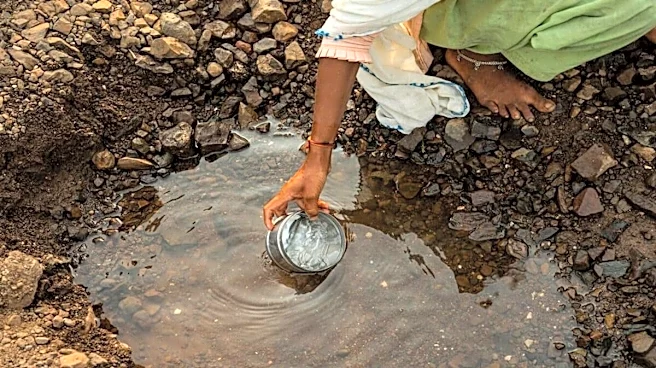



The Maharashtra government on September 26 officially declared a drought in 265 out of the state’s 358 talukas (tehsils), effectively covering nearly 74% of the state.
The decision follows an 18.8% rainfall deficit and prolonged dry spells between June and September 2026, which have caused massive Kharif crop failures across major agricultural belts.
THE CAUSE
The 2026 drought in Maharashtra is primarily caused by a significant monsoon rainfall deficit, prolonged dry spells, and abnormal weather patterns linked to climate variability and a strong El Niño phenomenon. The state recorded an overall rainfall deficit of about 18% during the southwest monsoon season, receiving 798.2 mm compared to the normal 970.9 mm. Large parts of the state experienced prolonged dry breaks
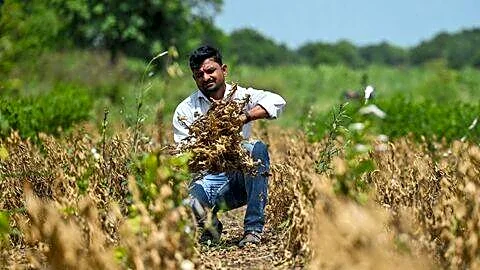
lasting 40 to 60 days between rainfall events, especially hitting rain-dependent agricultural areas. Interior regions like Marathwada and parts of North Maharashtra faced severe precipitation shortages—with some districts recording deficits as high as 50% to 60%—leaving crucial Kharif crops like soybean, cotton, and tur heavily damaged. Meteorological agencies noted that a stronger-than-usual El Niño climate pattern contributed to drier South Asian conditions and irregular, unpredictable monsoon distribution. As a result of these compounding factors, the Maharashtra Government officially declared a drought in September 2026 across 265 of the state’s 358 talukas (tehsils), covering roughly 74% of the region.
AFFECTED REGIONS & DISTRICTS
The drought has severely impacted four major regions: Vidarbha, Marathwada, North Maharashtra, and the Pune division. The crisis is heavily driven by sharp regional variations in monsoon distribution.
The worst-hit districts include:
- Yavatmal: 16 talukas affected
- Jalgaon: 15 talukas affected
- Ahilyanagar, Nagpur, Amravati, and Nanded: 14 talukas affected each
WORST CRISIS IN 25 YEARS
The 2026 drought is widely being described as the worst drought crisis in 25 years, with older generations drawing severe parallels to the historic crisis of 54 years ago. Officials and local observers state that this is the most widespread and severe drought since at least the late 1990s/early 2000s. Farmers and elder citizens are comparing the sheer intensity of the 2026 crisis to the historic 1972 Maharashtra drought. The 1972 drought fundamentally scarred the rural economy and altered the state’s history.
DECLARED RELIEF MEASURES
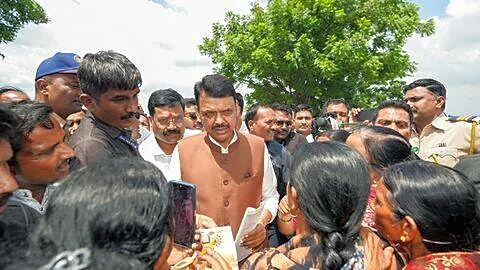
Chief Minister Devendra Fadnavis and Deputy Chief Minister Sunetra Ajit Pawar announced the implementation of 12 immediate relief measures to mitigate distress for farmers and rural households:
Financial & Loan Relief: Restructuring of crop loans, a stay on the recovery of agriculture-related loans, and waivers on land revenue.
Subsidies & Exemptions: Concessions on agricultural electricity bills and school fee waivers for farmers’ children.
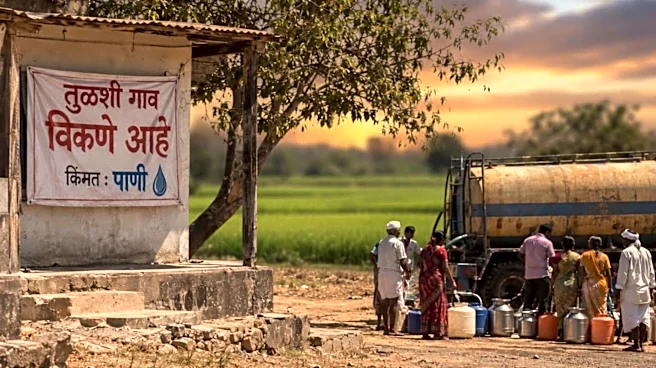
Resource Deployment: Supply of drinking water via water tankers and emergency arrangements for livestock fodder.
Employment Support: Relaxation of norms under rural employment guarantee schemes.
District collectors have been ordered to complete tech-driven crop-loss assessments (using GPS-tagged photos and drones). Direct financial compensation packages for crop damage will be distributed once these assessments are finalized.
POLITICAL ROW
The drought declaration has sparked a fresh political row. The opposition Congress party has publicly challenged the ruling government’s focus on aggressively building water-intensive data centres in regions like Thane, questioning whether ordinary citizens and struggling farmers should hold priority rights over the state’s depleting water resources.
While Maharashtra has suffered multiple dry spells over the last 10 years (such as in 2018), the 2026 crisis stands out as uniquely severe. It has already surpassed recent benchmarks to become the most drought-affected September in at least five years.
The current situation is considered exceptionally dangerous due to several key factors:
- Covering 74% of the state’s territory (265 out of 358 talukas), the geographical spread of this drought is far wider than the localized water crises the state experienced over the last decade.
- Unlike the 1972 crisis—where rains failed early and farmers didn’t sow—in 2026, farmers borrowed heavily to invest in seeds, fertilizers, and labor. The monsoon failed right before the harvest, leading to an unprecedented economic blow and complete loss of invested capital.
- Core agricultural belts like Marathwada and Vidarbha are dealing with massive 17-week rain deficits. Districts like Solapur have recorded up to a 50% shortfall in average seasonal rain, triggering a near-total collapse of critical crops like soybean, cotton, and sugarcane.
Government officials and the Maharashtra State Agricultural Price Commission have warned that the ecological and economic impact of this multi-season crisis will likely persist for at least two years.

/images/ppid_59c68470-image-179059258956112846.webp)

/images/ppid_59c68470-image-179057502351059091.webp)