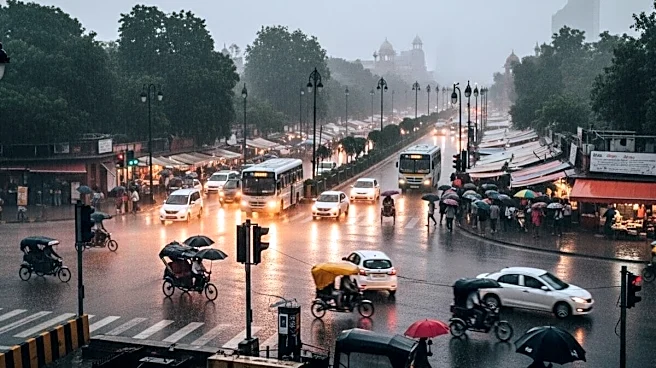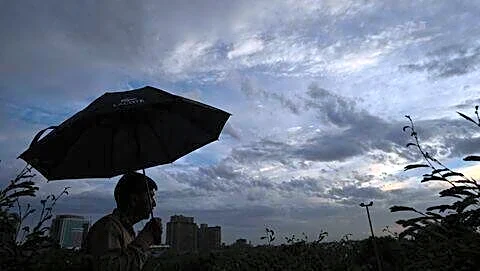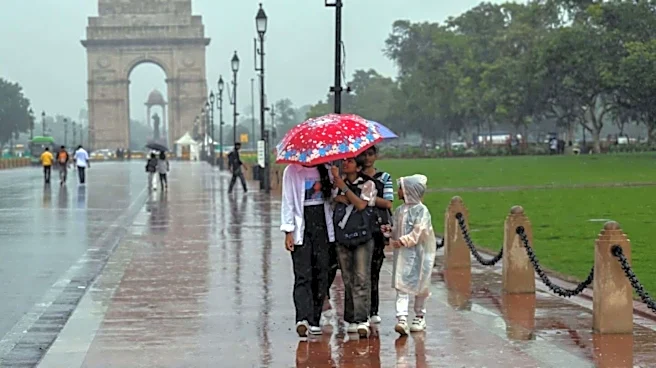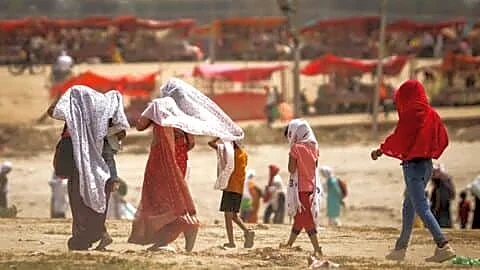






New Delhi, Jun 13 (PTI) A recent spell of rainfall has provided a welcome respite from the extreme heat in the national capital. However, weather experts have warned that Delhiites may experience discomfort due to elevated humidity levels in the coming days.
Delhi on Saturday recorded a maximum temperature of 35.6 degrees Celsius, 4.3 notches below the season’s average, the India Meteorological Department (IMD) said.
The minimum temperature was recorded at 21.4 degrees Celsius, 6.6 notches below the season’s average. The relative humidity was recorded at 48 per cent at 5.30 pm.
Weather experts said Delhi is likely to witness another spell of thunderstorms, lightning and rain on Saturday evening and night, similar to the weather activity experienced
on Friday night. The conditions are being influenced by a western disturbance that is currently positioned over the hills and is gradually moving away.
As the system weakens and shifts further away, its impact on Delhi is expected to reduce from Sunday onwards.
Consequently, maximum temperatures are expected to begin a gradual rise over the coming days, weather experts said.
The IMD has forecast partly cloudy skies with thunder and lightning for Sunday, and no significant weather warnings have been issued. The minimum temperature is likely to be around 24 degrees Celsius, while the maximum temperature is expected to reach about 37 degrees Celsius.
Despite the absence of any significant heatwave conditions, weather experts said residents are likely to experience discomfort over the next few days due to high humidity levels left behind by the recent spell of rain.
The combination of increasing temperatures and moisture in the air is projected to contribute to this discomfort.
Delhi’s air quality was recorded in the “satisfactory” category at 6 pm on Saturday, with an Air Quality Index (AQI) reading of 111, Central Pollution Control Board (CPCB) data showed.
According to the CPCB, an AQI between zero and 50 is considered ‘good’, 51 and 100 ‘satisfactory’, 101 and 200 ‘moderate’, 201 and 300 ‘poor’, 301 and 400 ‘very poor’, and 401 and 500 ‘severe’. PTI SSM MPL MPL