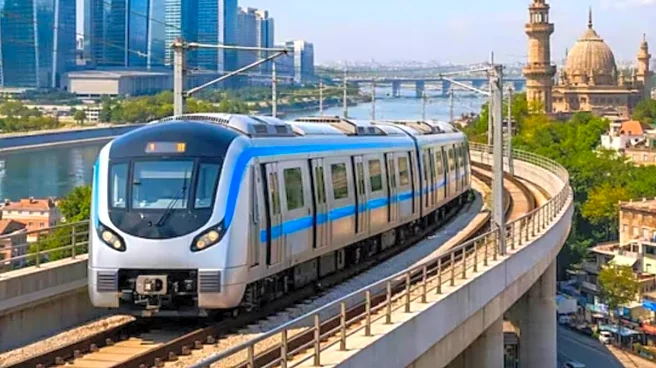




Haryana is poised to enter a transformative phase in infrastructure development, with the state cabinet approving the Delhi-Panipat-Karnal Namo Bharat (RRTS) Corridor at an estimated cost of Rs 33,051 crore. Far more than a mobility upgrade, the project is expected to reshape the economic and geographic landscape stretching from the national capital to Karnal, while accelerating the next phase of NCR expansion.
The proposed high-speed regional transit system will span approximately 136.3 kilometres, linking Delhi with key Haryana cities including Kundli, Sonipat, Ganaur, Panipat, Gharaunda and Karnal. In Delhi, major stations such as Sarai Kale Khan, Kashmiri Gate, Burari and Alipur will anchor the corridor. Haryana will see the development of
11 modern stations, aimed at facilitating faster, more efficient travel for millions of daily commuters. The state government’s share of the project stands at Rs 7,472 crore, to be released in phases.
Officials say the corridor will significantly reduce travel time, bringing Karnal within a 90-minute commute of Delhi. The improved connectivity is expected to ease pressure on existing road networks, particularly the congested GT Road, while offering a faster and more environmentally sustainable alternative.
Beyond mobility, the project is already generating momentum in the real estate sector. Karnal, often referred to as the ‘Paris of Haryana’, is emerging as a potential satellite hub within NCR. Industry stakeholders believe the corridor will trigger a surge in both residential and commercial investments across the region.
Aman Sharma, Managing Director and Founder of Arise Group, described the project as “a golden opportunity” for investors, noting that enhanced connectivity will likely push up land and property values across Karnal, Sonipat and Panipat. Demand for land parcels, particularly along key corridors such as GT Road, has already begun to rise, amid growing interest from buyers seeking alternatives to Delhi’s congestion and pollution.
Echoing similar optimism, Robin Mangla, President of M3M India, said the corridor would make cities like Karnal, Panipat and Sonipat increasingly attractive for both investors and end-users. He added that the reduced travel time would play a critical role in driving long-term urban and economic growth across Haryana.
In a parallel push to strengthen connectivity, the cabinet has also approved the Rithala–Narela–Kundli metro extension under Phase IV. The 2.7-kilometre elevated stretch, with stations at Kundli and Nathupur, will be developed at a cost of Rs 545.8 crore, with Haryana contributing Rs 448.5 crore and the Centre Rs 97.3 crore. The extension is expected to further boost residential demand in Sonipat’s industrial zones.
Parvinder Singh, CEO of Trident Realty, termed the RRTS corridor a “new beginning” for cities beyond Delhi, highlighting its potential to transform them into emerging economic centres. According to him, the combination of rapid transit and metro expansion will catalyse new housing and commercial developments, while generating employment opportunities across sectors.
The Delhi-Panipat-Karnal corridor forms part of the broader Namo Bharat network and will integrate with other RRTS routes, including the operational Delhi-Ghaziabad-Meerut corridor and the under-construction Delhi-Gurugram-SNB-Alwar line. All corridors are set to converge at Sarai Kale Khan, enabling seamless, multi-directional travel without repeated interchanges.
Government officials emphasise that the project aligns with transit-oriented development (TOD) principles, with economic activity expected to cluster around stations. Reduced vehicular congestion and lower emissions are also anticipated as more commuters shift to high-speed public transport.
As groundwork progresses, the corridor, alongside the Kundli metro extension, is being positioned as a cornerstone of Haryana’s long-term urban strategy. With improved accessibility, rising investor confidence and expanding infrastructure, cities such as Karnal, Panipat and Kundli could soon emerge as key real estate destinations within NCR, offering significant returns on early investments.