


/images/ppid_a911dc6a-image-177531122953844085.webp)
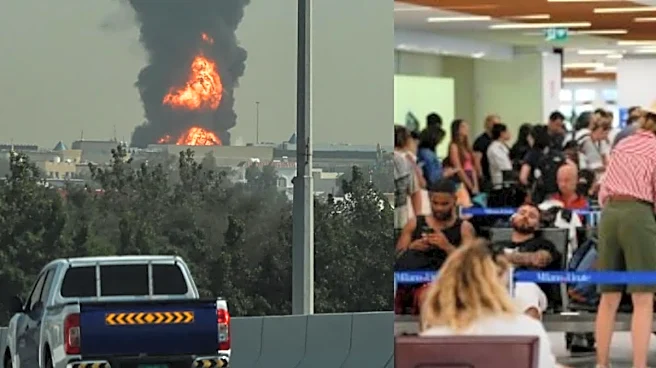
What would typically be considered real-time documentation of events is now under scrutiny in Dubai, after a 25-year-old British flight attendant working as cabin crew for a local airline in the UAE has been arrested and now faces serious cybercrime charges for posting a photo of a drone strike at Dubai Airport.
The incident is part of a wider crackdown, up to 70 British citizens (including tourists, expats, and cabin crew) are reportedly detained in the UAE for taking, filming, or sharing images related to recent Iranian drone and missile strikes. According to Gulf News as of March 18, at least 35 people were detained in one sweep alone, with additional arrests in separate cases, including foreign nationals and tourists.
What Exactly Happened?
According to the Daily Mail, the young man was concerned about safety following explosions near Dubai Airport. After the airline assured staff that the situation was not too dangerous, he took a photo of the heavily damaged area at the airport. He shared the image in a private WhatsApp group with colleagues, asking, “Is it safe to walk through the airport?”
Police later examined his phone, discovered the photo, and arrested him under the UAE’s strict cybercrime laws. He is now facing up to two years in prison and a fine of up to £40,000 (approximately 200,000 UAE dirhams which equates to approximately INR 50 Lakh).
Are Expats Being Targeted in This Crackdown?
The flight attendant’s case is not isolated. A separate 60-year-old British tourist (a London holidaymaker) was also arrested after taking a photo or video of an airstrike/missile strike. He reportedly deleted the image immediately when asked by police but was still detained.
With more than 88% of the UAE’s 11.5 million residents classified as expatriates — Indians alone accounting for roughly 4.1 million — the message is unmistakable, the authorities are policing the very workforce and consumer base that the country’s tourism and “influencer-friendly” brand so aggressively courts.
According to Detained in Dubai (a UK-based organisation providing legal assistance), around 21 people have been charged together under the UAE’s cybercrime laws for publishing or sharing material that could “disturb public security” or incite panic. The group claims the total number of affected Brits could be as high as 70.
The UAE’s Attorney-General has warned of “immediate criminal accountability”, stating that authorities will not tolerate any attempt to “exploit cyberspace” during a crisis. Among those charged is a 60-year-old British man in Dubai, a case that has already drawn international attention.
“There are countless images, videos and news reports circulating online about the conflict. People understandably assume that if something is already widely shared or published by media outlets, it must be acceptable to comment on or repost it. In the UAE, that assumption can be extremely dangerous,” Radha Stirling, CEO of Detained in Dubai told in a news release statement.
Campaign for Justice
A big campaign has now been launched demanding the release of the detained Britons. Activists and families argue the laws are overly draconian and are being used to suppress information about security incidents. Critics call it “pure censorship,” while human rights groups highlight harsh prison conditions, including limited consular access, sleep deprivation, and denial of medication for some detainees.
The UK Foreign Office is understood to be supporting the families, but many feel the response has been insufficient.
What Type Of Content Is Considered As An Offence?
Authorities have framed the violations under broader cybercrime and national security laws, but the offences fall into three clear categories. According to the state news agency WAM, the individuals charged fall into three distinct categories, each different in method, but treated with equal seriousness under the law.
1. Real Footage, Altered Narrative
2. Fabricated and AI-Driven Content
3. Content Framed as Propaganda
Many of those detained were not the original creators of the content they shared. Instead, they- reposted videos already circulating online, forwarded clips through messaging apps, shared updates without verifying context, the issue here is amplification.
Penalties and Prison Time
The penalties are substantial. Offenders face a minimum one-year prison term, along with fines starting at Dh100,000 (£20,400/$27,300). For foreign nationals, this may be followed by deportation. In cases deemed more serious particularly those linked to national security sentences can extend to two years, with fines reaching Dh200,000 (£40,900/$54,500).