
The Commission for Air Quality Management (CAQM) on Saturday reimposed restrictions under stage four of the Graded Response Action Plan (GRAP) in Delhi-NCR as the AQI began inching towards 450, or the “Severe+”
category.
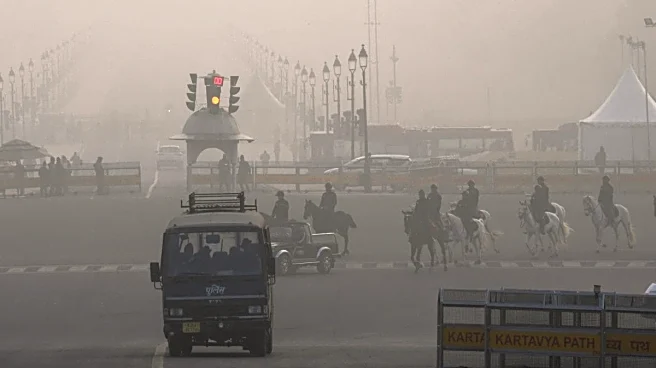
The decision came after the Air Quality Index (AQI) of the national capital plunged to 428 (Severe) at 8 pm today.
In a notification, the CAQM noted that the AQI in Delhi was at 400 at 4 pm and rose to 428 four hours later “owing to western disturbance, highly unfavourable weather/ meteorological conditions and lack of dispersal of pollutants.”
“Keeping in view the prevailing trend of air quality and relevant factors and in an effort to prevent further deterioration of air quality in the region, the CAQM Sub-Committee on GRAP unanimously decides to invoke all actions as envisaged under Stage-IV of extant GRAP – ‘Severe+’ Air Quality (DELHI AQI > 450), with immediate effect, in the entire NCR, as a proactive measure. This is in addition to the actions under Stages I, II & III of extant GRAP already in-force in NCR,” it said.
Under GRAP, the air quality is categorised into four stages: Poor (AQI 201-300), Very Poor (AQI 301-400), Severe (AQI 401-450) and Severe+ (AQI above 450). As per official classification, an AQI between 0 and 50 is considered ‘good’, 51 to 100 ‘satisfactory’, 101 to 200 ‘moderate’, 201 to 300 ‘poor’, 301 to 400 ‘very poor’ and 401 to 500 ‘severe’.
What’s Open, Closed and Banned?
Schools: Under stage-4 restrictions, state governments in Delhi and NCR states discontinue physical classes for students from nursery to Class 5. For students of Classes 6 to 9 and Class 11, governments may shift physical classes into online mode. For them, schools function in hybrid mode, allowing students to attend either online or in person. Classes 10 and 12 are often exempted to minimise disruption to board exam preparations.
Offices: Government and private offices in Delhi are directed to operate with only 50 percent staff on site. The remaining employees are required to work from home. Private offices are been advised to introduce flexible working hours to reduce peak-time congestion.
As discretionary emergency measures, state governments have the authority to consider further steps such as closing colleges and educational institutions, suspending non-emergency commercial activities, or implementing odd-even vehicle rationing schemes. The central government may also decide on work-from-home policies for its employees.
Emergency services: Hospitals, pharmacies, emergency services, power/water supply, and food distribution continue operating normally. Infrastructure projects linked to public utilities such as metro rail, highways, airports, defence, healthcare and sanitation are allowed to continue under strict dust-control norms. Metro, buses, and other public transport remain functional. Movement of essential goods and people is allowed.
Ban On Vehicles: Under stage-4, the entry of trucks into Delhi is stopped, except those carrying essential commodities or providing essential services. However, CNG, LNG, electric and BS-VI diesel trucks are allowed. The plying of Delhi-registered diesel heavy goods vehicles (BS-IV and below) is banned, again with exceptions only for essential services.
A new restriction introduced under GRAP-4 in December 2025 was a ban on vehicles entering Delhi that are not BS-VI compliant (including those running on petrol) and do not have a Delhi registration. This will be in force again.
Construction activities: All construction and demolition activities are banned, including even linear public projects such as highways, roads, flyovers, power transmission lines, pipelines and telecom works, which are otherwise allowed in lower stages.
/images/ppid_a911dc6a-image-17710264327998831.webp)

/images/ppid_a911dc6a-image-177102646607765106.webp)