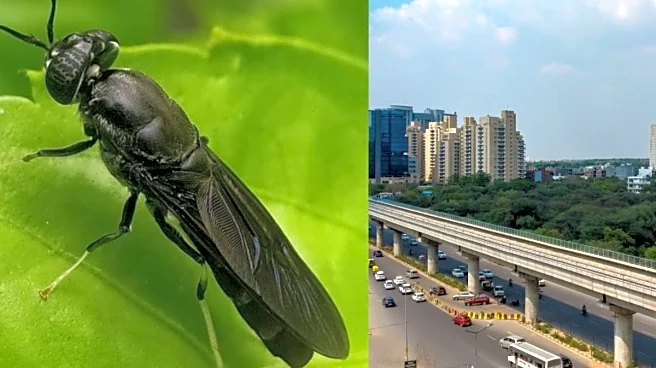

Bengaluru creates more than eight thousand tonnes of waste every day, a large part of it organic leftovers from homes, markets and restaurants. Landfills are full, villagers near dump yards are angry,
and the city’s garbage trucks travel farther every year.
Now the government is looking at a strangely elegant solution from nature itself. Black soldier flies, quiet grey insects found across the tropics, may soon become frontline workers in Bengaluru’s waste management system.
Deputy Chief Minister D K Shivakumar recently said the city is considering large scale black soldier fly composting at locations like Doddaballapur, Bidadi and Kanakapura. If implemented well, this would add a powerful biological tool to a system that has relied too heavily on landfills and long-distance transport.
What Exactly Is a Black Soldier Fly
The black soldier fly, Hermetia illucens, is nothing like the common housefly. The adult insect looks closer to a slim black wasp. It does not bite, it does not eat human food, and it does not hover around kitchens. The adults live only to mate and lay eggs. The real heroes of the process are the larvae.
Black soldier fly larvae are thick, cream coloured grubs that can devour large amounts of organic waste at high speed. They thrive on vegetable scraps, fruit peels, kitchen waste, food industry by products and even manure. This makes them ideal for a city like Bengaluru, where fifty to sixty percent of the waste stream is organic and highly nutritious for insect digestion.
The larvae have another advantage. Unlike houseflies, they do not spread disease easily because the adults have very limited mouthparts and avoid human environments. This makes them safer to rear at scale.
The Life Cycle That Makes Waste Disappear
A black soldier fly egg takes only a few days to hatch into a tiny larva. Over the next ten to twenty days, the larva eats almost nonstop. In this time, it can reduce the volume of organic waste by half or more, depending on the quality of waste and the temperature.
As the larvae eat, they produce two useful outputs. The first is larval biomass, which is rich in protein and fat and can be processed into feed for fish, poultry and pets. The second is frass, the dark earthy material left behind after digestion, which works as a nutrient rich organic fertilizer.
Once the larvae reach a mature stage, they naturally crawl away from the food source to find a dry place to pupate. This built in behaviour allows farms to collect them easily without heavy labour.
How a Black Soldier Fly Unit Works
A typical black soldier fly facility begins with segregated organic waste arriving from markets or collection points. Workers remove plastics, metals and other contaminants. The waste is then placed in shallow trays or beds and mixed to achieve the right moisture.
Larvae are introduced into these trays. Over one to two weeks, they rapidly consume the waste, turning visible scraps into a uniform dark mass. Many facilities build small ramps inside the trays. When the larvae are ready to pupate, they naturally climb the ramps and fall into collection bins.
The collected larvae are washed, dried and turned into animal feed or oil. The remaining frass is screened and sold as fertilizer. The cycle repeats when a portion of the larvae is allowed to pupate into adults that lay new eggs.
Cities like Mangaluru and Kochi have already tested this process with encouraging results. Globally, black soldier fly composting is growing in Africa, Europe, Australia and parts of South America, especially in places where animal feed prices are high and landfill space is scarce.
Why This Matters for Bengaluru
Bengaluru’s biggest waste challenge is organic waste management. When wet waste goes to landfills, it produces methane and leachate. When trucked long distances, it creates traffic and increases fuel use.
Traditional composting is slow and occupies large land areas. Black soldier fly composting is faster, more compact and creates marketable by products that can help offset operational costs.
But this solution will work only if segregation improves. Contaminants like plastic, chemicals and heavy metals can harm the larvae and reduce the quality of the fertilizer and animal feed.
The government will also need clear rules, community involvement and transparent functioning to avoid the distrust that past waste projects have caused.
If Bengaluru gets these pieces right, the black soldier fly could quietly reshape the city’s garbage story. Instead of rotting in landfills, thousands of tonnes of kitchen and market waste could be converted each week into fertilizer, animal feed and clean soil nutrients. It is a simple idea powered by a small insect, but its impact could be large enough to change how the city thinks about waste itself.
/images/ppid_a911dc6a-image-177069628112285222.webp)

/images/ppid_a911dc6a-image-177069623890213897.webp)
/images/ppid_a911dc6a-image-177069633713368765.webp)




/images/ppid_a911dc6a-image-177069553210774222.webp)
/images/ppid_a911dc6a-image-177069556411723817.webp)
/images/ppid_a911dc6a-image-17706955237093381.webp)
/images/ppid_59c68470-image-177069510338166467.webp)

/images/ppid_59c68470-image-177069514115616031.webp)