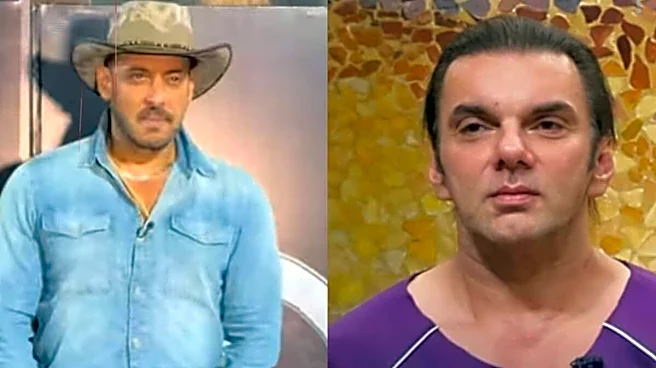




Salman Khan has recently been popping into the news a lot. From commenting on the student protests against the NEET paper leaks to the Delhi High Court supporting his plea and squashing the teaser trailer of the film Kala Hiran, and even appearing on the reality TV show Alliance to support his brother Sohail Khan. The actor has also been instrumental in launching a relief drive for those people who are victims of the flood that is passing through Assam, wiping away crops, houses and cattle.
So when producer Shailendra Singh shared an interaction that he had with Salman Khan in conversation with Cyrus Broacha, two questions arose. Shailendra Singh mentioned an incident when he had gone to meet the actor at his Bandra home as he was getting a hair
treatment done and ate biryani while looking into the mirror.
Shailendra Singh said, “I went to Salman for a meeting at his place in Galaxy Apartments. In those days, we used to have Monday night parties. He was sitting at the dining table, eating, and looking at himself in the mirror. He likes to eat while looking in the mirror. There’s a small table in the kitchen with a mirror in front, so you’re sitting next to him, but you’re actually talking through the mirror.”
The producer continues, “Suddenly, this strange-looking guy walks in, puts on gloves, takes out a needle and starts injecting his scalp. I’m watching all of this in the mirror and thinking, ‘What the f* is going on here?’ He [Salman Khan] just said, ‘There’s a price to pay to be a star, bro.’ He kept eating while the treatment continued.”
This might sound like a strange series of events, but Salman Khan has been very open about cosmetic procedures he has undergone as a star. However, it is the fact that Salman Khan eats his food while looking into the mirror that piqued our attention.
We spoke to Preeti Sharma, Clinical Psychologist, Ganaa Lifesciences to understand more. Here’s an excerpt from our conversation:
Q: What might looking into a mirror while eating indicate psychologically?
When we look at behaviours like eating in front of a mirror, it is easy to assume eccentricity, but psychologically, it often serves a grounding function. Food is deeply tied to our emotional state. For individuals under high public scrutiny or constant sensory overload, eating while observing one’s reflection can act as an anchor, bringing awareness back to the physical self and creating a controlled, quiet space in the present moment.
Q: Could looking at oneself while eating increase self-awareness or mindfulness? How might that affect eating behaviour?
Seeing yourself eat instantly disrupts mindless consumption. A mirror forces what we call ‘objective self-awareness’, it shifts eating from an automatic habit to an intentional act. You become hyper-aware of your pace, your posture, and your relationship with the food on your plate.
Q: What does research suggest about how mirrors influence appetite, food choices, portion control, or eating speed?
From a psychological and behavioural standpoint, eating in front of a mirror primarily operates through two mechanisms: social facilitation and cognitive self-regulation. When dining alone, observing one’s reflection triggers what Nakata and Kawai (2017) identified as the ‘social facilitation of eating.’ Their empirical research demonstrated that seeing oneself eat creates a subconscious perception of shared dining, which enhances meal enjoyment and appetite for solo eaters by mimicking companionship.
At the same time, the mirror serves as a self-regulatory tool. A study by Jami (2016) in the Journal of the Association for Consumer Research found that mirror-induced self-awareness alters taste perception and food evaluation.
When individuals consume indulgent or unhealthy foods in front of a mirror, the heightened self-awareness creates mild cognitive discomfort between their actions and health standards, ultimately reducing the appeal of junk food and nudging individuals toward more deliberate, mindful eating choices.
Q: What warning signs indicate that an eating ritual has moved from a harmless quirk to something requiring professional attention?
In clinical practice, the line between a harmless eating quirk and a psychological red flag comes down to three things: flexibility, distress, and intent. A habit remains benign as long as it is adaptable. However, it shifts into clinical territory when the mirror ceases to be a preference and becomes a strict dependency, where the absence of a mirror triggers acute anxiety, agitation, or an inability to finish a meal.
The most telling warning sign is a shift in intent: instead of using the mirror for presence or calm, it becomes a tool for hyper-vigilant ‘body checking,’ where a person obsessively inspects physical flaws, counts jaw movements, or uses self-scrutiny to cultivate shame and forcefully suppress appetite.
When an eating ritual begins causing social isolation such as refusing family meals or avoiding dining out because the environment lacks a mirror, it has moved past eccentricity into ritualized distress, body image pathology, or an underlying eating disorder that warrants professional clinical evaluation.