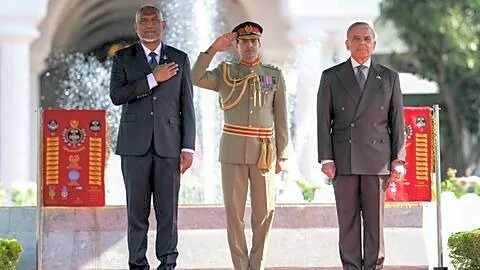


In a move closely monitored by strategic circles in New Delhi, Pakistan and the Maldives have signed twenty Memorandums of Understanding during Maldivian President Mohamed Muizzu’s state visit to Islamabad. The wide-ranging pacts span defence cooperation, maritime security, cybersecurity, and trade, marking a deliberate attempt by both nations to expand bilateral ties across the Indian Ocean Region.
The bilateral exchange, witnessed by Pakistani Prime Minister Shehbaz Sharif and President Muizzu, reflects a notable strategic alignment as Malé continues to diversify its international partnerships.
Focus on Maritime Security and Defence Alignment
Among the primary frameworks agreed upon are pacts directly addressing defence cooperation, police training, and maritime security. Given the Maldives’
critical geographic position along major global sea lines of communication, enhanced maritime collaboration between Malé and Islamabad introduces fresh security dynamics in India’s immediate southern neighbourhood.
The two nations also finalised agreements to counter illicit drug trafficking, strengthen joint law enforcement training, and enhance intelligence sharing across cybersecurity and artificial intelligence domains.
Economic Push and Expansion Into Civil Sectors
Alongside strategic and security frameworks, the talks set an ambitious target to scale bilateral trade to 200 million dollars within two years, moving beyond the current modest trade levels. Key economic agreements were established between the Trading Corporation of Pakistan and the State Trading Organisation of the Maldives to facilitate bulk trade in agricultural commodities and essential foods.
The additional MoUs cover critical public service domains, including health professional recruitment, civil service training, higher education, air connectivity, climate change mitigation, and fisheries development.
Strategic Implications for India’s Maritime Interests
The developments in Islamabad come amid heightened regional competition in the Indian Ocean. Security analysts in New Delhi view the inclusion of defence and maritime security in the bilateral pacts as an area requiring careful observation, particularly regarding its potential impact on regional maritime architecture and India’s long-standing security role in the archipelago.
While New Delhi continues to maintain extensive development and economic ties with Malé, the growing diplomatic footprint of regional players highlights shifting geopolitical equations across key maritime corridors.