
/images/ppid_a911dc6a-image-17706388464872146.webp)
For decades, those part of the creative space in Bollywood, including filmmakers and actors espousing nationalist and dharmic sentiments, have been viewed as occupying the fringes of the industry.
In the past, many were looked at with disdain and disgust by the “secular-liberal” cabal within the industry and outside it. In the decades following Independence and during much of the so-called “Nehruvian Era”, the “fringe” and the “mainstream” in the field of creative arts were primarily determined by whether or not one accepted the “secular-socialist” narrative and pushed it further through their writings, films, or any other medium of art as part of a well-thought-out strategy to communicate the ideological imperative to the wider audience.
From
the 1970s onwards, a new and rather disturbing trend emerged—the dominance of the underworld in Bollywood. Creativity and talent were no longer considered guarantees of success, and blockbusters, hits, and flops were determined by whether or not one was in the good books of those calling the shots. Several filmmakers and actors made their fortunes by currying favour with the underworld and their conduits—the shadowy financiers who pumped enormous funds into Bollywood.
The “secular” narrative continued to dominate storytelling in Bollywood. In fact, many films pushed the agenda further—they showed Hindus in a bad light, while portraying Muslims, even Pakistanis, as just, humane, and in some cases, victims of Hindu tyranny. Films such as Garam Hawa (1974), Amar Akbar Anthony (1977), Roja (1992), Bombay (1995), and Zakhm (1998), among others, are classic examples of agenda-driven cinema that attempted to promote a predominantly “secular”, one-sided narrative.
In 1998, I&B Minister Sushma Swaraj officially granted “industry” status to the Hindi film industry. This landmark decision of the BJP-led NDA government not only fulfilled the decades-long demand of those eager to wrest the creative space from the hands of the underworld, but also allowed producers access to bank financing and formal, institutional support, thereby reducing reliance on underworld funding and dependence on black money.
In 2001, the Reserve Bank of India issued guidelines for financing film production, opening the floodgates for organised financing. The financial streamlining of the industry dealt a severe blow to those who benefited from unorganised sources of funding. It led to what can be called the “corporatisation” of Bollywood, with noticeable changes including high corporate investments, professional operations, and better infrastructure.
With the influence of the underworld minimised, if not eliminated, newer themes began to be explored, although it took over a decade to free the Hindi film industry from the shackles of “secular-liberal” dominance which, in many ways, continues to be considered “mainstream”, although significant shifts have taken place in recent years, primarily post-2014.
Initially, films such as PK (2014), starring Aamir Khan—who is infamously known for feeling “unsafe” in India—and Bajrangi Bhaijaan (2015), starring Salman Khan, one of the three Khans who ruled the roost during the 1990s and early 2000s, did well commercially, although they received flak, and rightly so, for pushing the same old “secular” agenda which audiences were no longer prepared to accept. Something had changed.
Post-2014, Bharat was no longer the India of the previous decade and those preceding it, where passivity and inaction dictated state policy. The people of India were no longer prepared to see their country portrayed as weak, debilitated, or one that had for years reeled under the forced burden of “secular” politics. They had voted a strong, nationalist government to power, and what the citizens were, and are, interested in is a vibrant, resilient, robust, and militarily strong Bharat—one that does not kow-tow to external pressures and is more than capable of shaping its own destiny.
Another layer was added to this dimension when Over-the-Top (OTT) platforms began to offer an alternative space for filmmakers to showcase their work. In many ways, the advent of OTT revolutionised filmmaking. Producers, directors, actors, technicians, and everyone involved with the craft now had the opportunity to create whatever they wanted. If “woke” stories found a platform, so did themes that always had an audience but never the right platform.
In keeping with the larger demands of the audience and the monumental shift ushered in by OTT, filmmakers and actors—largely and perhaps even purposefully unnoticed before 2014—began making significant strides in the industry. The year 2019 witnessed a remarkable turn, with two films that sought to look at matters from a different perspective—The Accidental Prime Minister, based on Sanjaya Baru’s book of the same title, starring Anupam Kher as Prime Minister Manmohan Singh and Akshaye Khanna as Sanjaya Baru; and Aditya Dhar’s Uri: The Surgical Strike, starring Vicky Kaushal in the lead.
While The Accidental Prime Minister performed well at the box office despite the controversies surrounding the film—the Congress accusing the filmmaker of producing propaganda to show the former Prime Minister, and more importantly Sonia Gandhi, in a bad light—Uri: The Surgical Strike, based on the real story of the retaliation to the Jaish-e-Mohammed-led 2016 Uri terror attack, did exceedingly well.
Vicky Kaushal’s dialogue, “How’s the josh!”, became immensely popular and continues to resonate with those who wear nationalism as a badge of honour. Another film, Section 375, released in 2019 and starring Akshaye Khanna in the lead, although based on rape and the amended law that heavily tilts in favour of women, made a direct reference to the suspension of civil liberties and conviction without trial during the Emergency imposed by Indira Gandhi in 1975.
Actor and now parliamentarian Kangana Ranaut’s 2025 film Emergency delved deeper into the political chaos that the nation plunged into during the tumultuous years of the Emergency—an abrasive, unconstitutional measure that brought tremendous disrepute to the Indira-led Congress party and remains a source of unsavoury memories for those who suffered during what can best be described as an “Age of Tyranny”.
With films such as The Kashmir Files (2022), Article 370 (2024), and more recently Baramulla (2025), which have engaged with Kashmir from a never-seen-before perspective, the secularist, pro-separatist virtue signalling surrounding the conflict has finally been stemmed.
The year 2025 marks an epochal shift in the history of popular Hindi cinema. In February 2025, Chhaava—a film based on the heroism of Chhatrapati Sambhaji Maharaj, the son and successor of Chhatrapati Shivaji Maharaj—stormed theatres across the country. This Vicky Kaushal-Akshaye Khanna blockbuster dismantled the popular narrative of the “Great Mughals”.
Debunking the colonial narrative on Sambhaji, Chhaava portrayed Chhatrapati Sambhaji Maharaj as what he truly was—a brave, unrelenting Maratha supremo who chose death over conversion. It also shattered the “secular-liberal” portrayal of Aurangzeb as a compassionate ruler and able administrator who, according to liberals, had been unfairly maligned by nationalist historians.
Contrary to the fantastical stories told about Aurangzeb in books authored by distorians such as Audrey Truschke, Chhaava depicted Aurangzeb—played with menacing precision by Akshaye Khanna—as exactly what he was: a cruel, unrelenting, brutal, and barbaric emperor who not only had his adversary Sambhaji tortured and eventually killed, but was also a wicked and murderous son, apart from being a bigot who despised Hindus.
Dialogues such as “Jahan jahan bhagwa rang nazar aaye use laal kar do”, “Humari taraf aa jaao, Mughalo se haath mila lo, zindagi badal jayegi, bas apna dharm badal lo”, and “Poore khaandaan ki laash par khade hokar humne yeh taj pehna tha” epitomise the cruelty embodied by Aurangzeb.
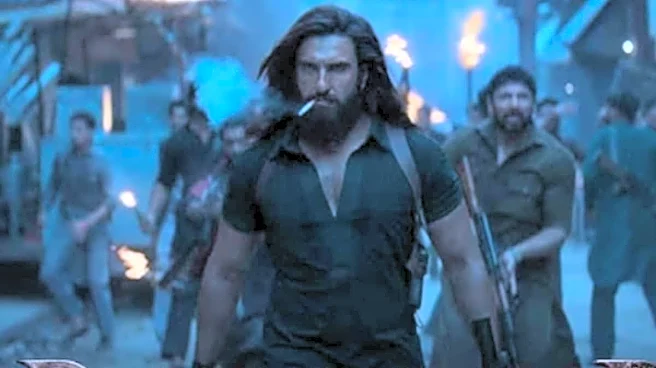
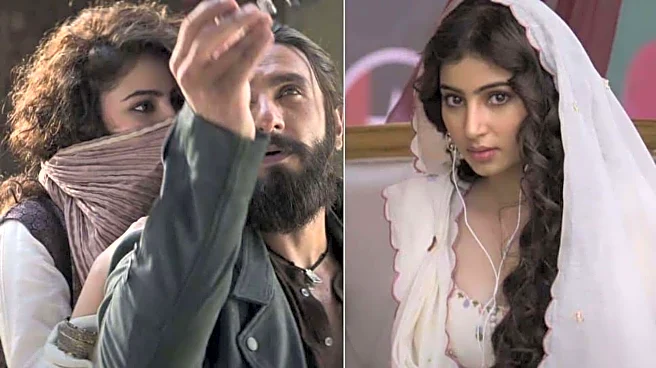
Much has already been written and discussed about the newest, boldest, and perhaps one of the most genre-defying spy narratives to emerge from Bollywood—Dhurandhar. It would suffice to say that what began post-2014—a gradual shift of the Overton Window towards realistic portrayals devoid of secularist defensiveness—has now hit the film business like a cyclone.
Filmmakers have discovered that rhetorical goodwill films funded, produced and acted in by the “Aman ki Asha” coterie will no longer rake in the moolah, and the new Indian viewer—now exposed to the pre- and post-Dhurandhar narrative period—will demand accountability from Pakistan even on celluloid. It is time the Indian viewer demands similar accountability from those in Bollywood who have praised Pakistan effusively and even called it their paternal land.
Dr Chandni Sengupta is Assistant Professor of History at Sri Aurobindo College, University of Delhi. The views expressed are personal and solely those of the author, and do not necessarily reflect News18’s views.






/images/ppid_a911dc6a-image-177063956445978400.webp)

/images/ppid_a911dc6a-image-177063961975577596.webp)
/images/ppid_a911dc6a-image-177063953658055705.webp)
/images/ppid_a911dc6a-image-177063958173193498.webp)